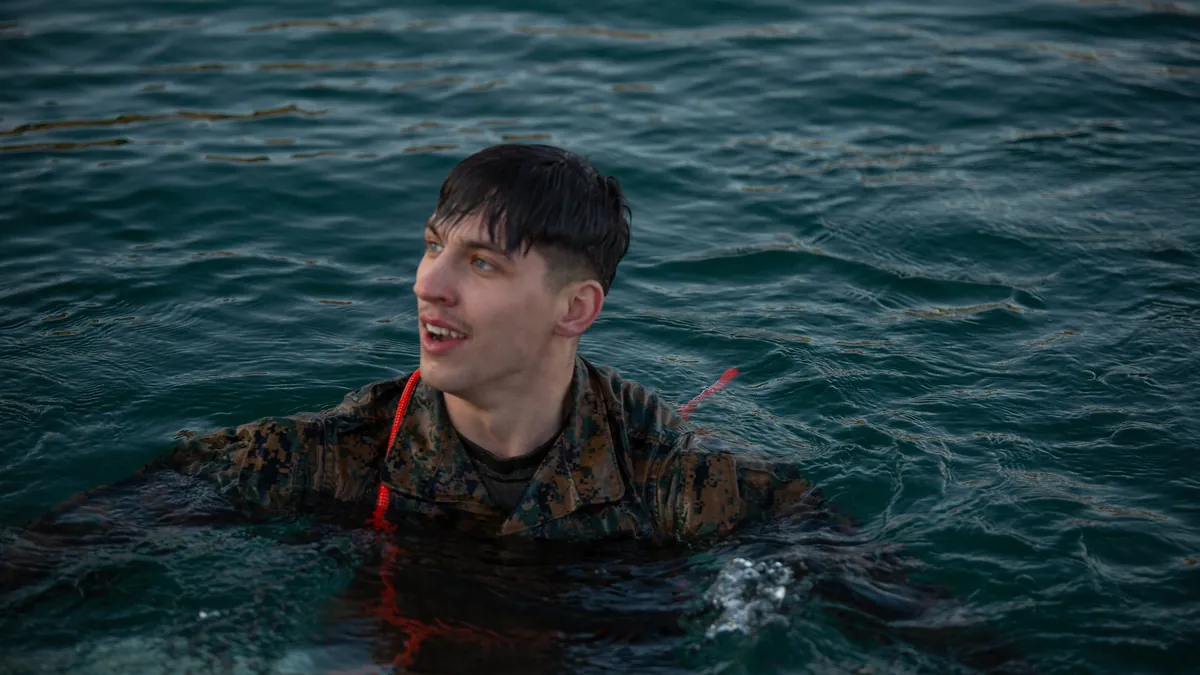
Cold water after training: it eases soreness but may blunt muscle gains
Published on
A 12-week trial found smaller muscle and strength gains in people who took a cold bath after every lifting session. What meta-analyses say, how much it eases soreness, why it does not seem to hurt after cardio and when it makes sense to use it.
In 2015, Llion Roberts's team at the University of Queensland split 21 active men into two groups who did the same strength training for 12 weeks, 2 days a week. The only difference was the 10 minutes after each session: some got into cold water and the others did a light active recovery. At the end, the active recovery group had gained more strength and more muscle. Their fast-twitch fibres grew by 17% and the number of nuclei per fibre rose by 26%; in the cold water group, neither changed significantly.
The ice bath has become a fashionable recovery tool, and it is not useless. But if you train to build muscle or strength, the timing matters a great deal. Here is what studies say, what it is good for and when to save it for another day.
Does cold water after training blunt muscle gains?
Everything points to yes, with some nuances. In a second part of the same work, Roberts took biopsies from 9 men after a leg session and found that, with cold water, satellite cells and the muscle-building signal (the p70S6K protein) were activated less than with active recovery. In other words, the cold partly switches off the response that follows training.
Meta-analyses point the same way. The one by Malta and colleagues (2021), with 8 studies, found that regular cold water use after strength training reduced improvements in 1RM, isometric strength and muscular endurance (effect size -0.60), as well as in explosive efforts. The one by Piñero, Schoenfeld and colleagues (2024), also with 8 studies, focused on muscle: training without cold produced small but clear hypertrophy, while training with cold afterwards gave hypertrophy ranging from small to negligible.
| Study | What it compared | Result |
|---|---|---|
| Roberts (2015) | 12 weeks of strength training with 10 minutes of cold water or active recovery afterwards | More strength and more muscle without cold water |
| Malta (2021), 8 studies | Regular cold water after strength and after endurance training | Smaller strength gains; no effect on aerobic endurance |
| Piñero (2024), 8 studies | Hypertrophy with and without cold water afterwards | Less growth with cold water; studies of fair to poor quality |
| Bleakley (2012), 17 trials | Cold water versus rest for muscle soreness | Slightly less soreness at 24, 48 and 72 hours |
Why it happens: training triggers an inflammatory, blood-flow and signalling response that is part of adaptation. Cold dampens it. That can be useful when you need to recover before another event; for building muscle in the long run, it works against you.
Does it help with muscle soreness?
A little, yes. The Cochrane review by Chris Bleakley (2012) pooled 17 small trials with 366 participants. Compared with rest, cold water reduced soreness at 24, 48 and 72 hours, with effects of -0.55, -0.66 and -0.93. The review itself warns that study quality was low and that almost none monitored possible side effects.
And there is no magic dose. In a later trial with Bleakley among its authors, 50 people tried four protocols, from 1 minute at 10 °C to 10 minutes at 6 °C, or simply sitting at rest. No group differed significantly from the others in soreness, mobility or strength, not even from the one that used no cold water. If you want to know what else works for soreness, see muscle soreness: what it is and how to ease it.
What about after cardio?
Here the picture changes. In the 2021 meta-analysis, cold water did not alter aerobic endurance gains: neither peak power in an exercise test nor time-trial results. And in a 2026 trial by the same Brazilian group, 16 men did 5 weeks of high-intensity intervals, half of them with 15 minutes of cold water at about 11 °C after each session. Maximal oxygen uptake, running performance and muscle markers improved equally in both groups.
If you combine cardio and weights, the practical rule is simple: cold does not get in the way of cardio, but it does get in the way of weights. How to organise both in the same week is explained in cardio and strength together.
When cold water makes sense and when it does not
| Situation | Cold water? | Why |
|---|---|---|
| You train to build muscle or strength | Not straight after lifting | Studies show smaller strength and muscle gains |
| Competition with back-to-back events or matches | It may help | It reduces soreness slightly when the priority is performing tomorrow, not growing |
| After a cardio or interval session | If you enjoy it, no problem | It did not affect aerobic gains in studies |
| Severe soreness on a one-off day | Optional | Small relief; good sleep and gentle movement help too |
If you like the cold and you lift weights
There are no clear studies on how many hours to leave between the cold and training so that it does not interfere. The prudent approach, with what we know, is to keep it for non-lifting days or do it well away from the session, and not make it your post-workout ritual. Other things matter more for real recovery: sleep, fatigue management and a deload week from time to time.
Precautions
- Start gradually: the first contact with very cold water triggers a rapid-breathing reflex. Do not do it alone or in open water without experience.
- Get advice first if you have heart problems or high blood pressure: intense cold is a strong stress on the cardiovascular system.
- Do not use it to mask an injury: if something hurts sharply or does not improve, what you need is a diagnosis.
The Progrevia generator already spreads out rest days and includes a deload week every four, which is the best-supported form of recovery. If you want the basics of why muscle grows, see the mechanisms of hypertrophy.
- Roberts LA, Raastad T, Markworth JF, et al. Post-exercise cold water immersion attenuates acute anabolic signalling and long-term adaptations in muscle to strength training. The Journal of Physiology. 2015;593(18):4285-4301.
- Piñero A, Burke R, Augustin F, et al. Throwing cold water on muscle growth: a systematic review with meta-analysis of the effects of postexercise cold water immersion on resistance training-induced hypertrophy. European Journal of Sport Science. 2024;24(2):177-189.
- Malta ES, Dutra YM, Broatch JR, Bishop DJ, Zagatto AM. The effects of regular cold-water immersion use on training-induced changes in strength and endurance performance: a systematic review with meta-analysis. Sports Medicine. 2021;51(1):161-174.
- Bleakley C, McDonough S, Gardner E, et al. Cold-water immersion (cryotherapy) for preventing and treating muscle soreness after exercise. Cochrane Database of Systematic Reviews. 2012;(2):CD008262.
- Glasgow PD, Ferris R, Bleakley CM. Cold water immersion in the management of delayed-onset muscle soreness: is dose important? A randomised controlled trial. Physical Therapy in Sport. 2014;15(4):228-233.
- Malta ES, Neto JCR, Beck WR, et al. Regular cold-water immersion following HIIT does not affect intramuscular adaptation markers, inflammatory profile or endurance performance. Scandinavian Journal of Medicine & Science in Sports. 2026;36(3):e70241.
Progrevia · · How we write our guides
Frequently asked questions
Is an ice bath after training bad?
If you train to build muscle or strength, it is best avoided straight after lifting: in the trial by Roberts (2015), those who did it gained less muscle and strength over 12 weeks, and two meta-analyses point the same way.
Does cold water get rid of muscle soreness?
It reduces it a little. The 2012 Cochrane review, with 17 small trials, found slightly less soreness at 24, 48 and 72 hours than with rest, although the studies were of low quality.
How long and at what temperature should you stay in cold water?
There is no proven dose. In a trial with 50 people, no protocol, from 1 minute at 10 °C to 10 minutes at 6 °C, differed significantly from the others or from sitting at rest.
Can I use cold water after cardio?
Yes. In studies, cold water after cardio or intervals did not reduce aerobic gains or running performance.
How many hours should you leave between cold water and lifting?
There are no clear studies on that gap. The prudent approach is to keep cold water for non-lifting days or do it well away from your strength session.
Informational content based on the available scientific evidence: it does not replace advice from a healthcare professional. If you have an injury or a medical condition, or are pregnant, check with one before changing your training or diet.
