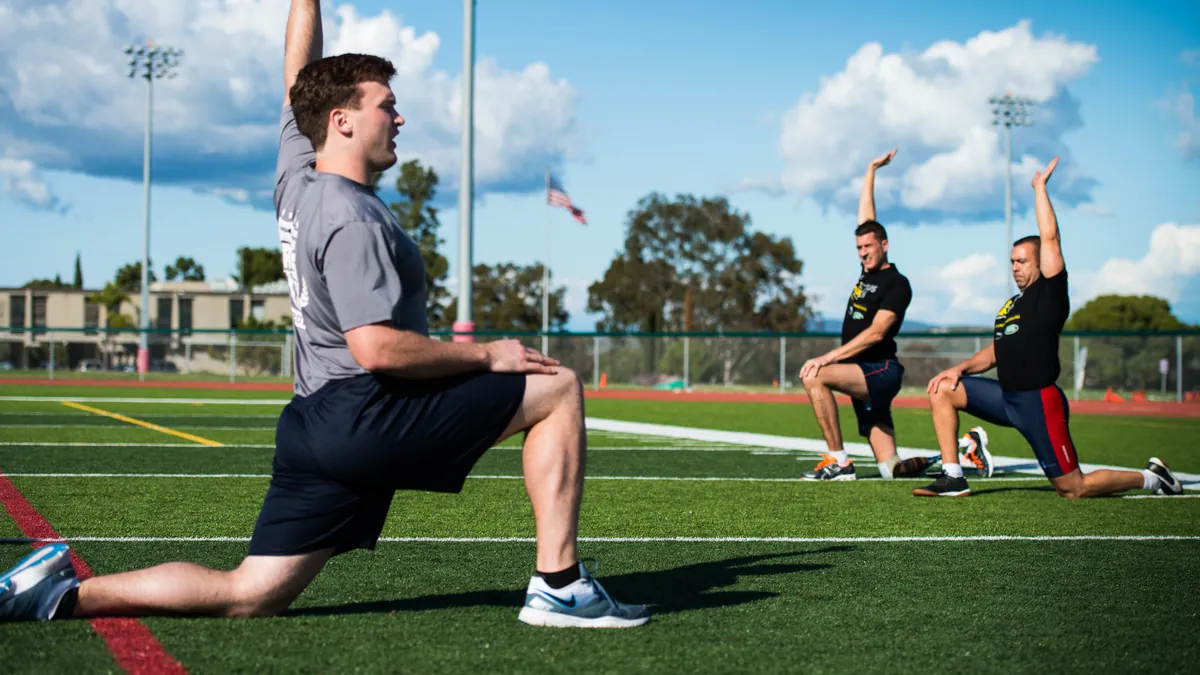
Stretching before or after training: what the science says about stretching
Published on
Stretching does not prevent soreness: in a Cochrane review, it reduced it by one point out of a hundred. When stretching is actually useful, how long to hold each stretch so you do not lose strength and what really prevents injuries.
For decades, PE class started the same way: a while of stretching, holding each position. It was supposed to prepare the muscle, prevent injuries and head off the next day's soreness. Today we know that all three claims are, at the very least, debatable, and that stretching does have a place in training, but a different one from the one we gave it.
In this guide you will see what happens to your strength if you stretch before training, whether stretching prevents injuries or soreness, what it is really good for, how long to hold each stretch and how to fit it into your week.
Types of stretching
- Static: you take the muscle into a stretched position and hold it, usually for 15 to 60 seconds.
- Dynamic: controlled movements that take the joint through its full range, such as leg swings or arm circles, without holding the position.
- PNF (proprioceptive neuromuscular facilitation): combines stretching with contracting the muscle against resistance and stretching again.
Does stretching before training cost you strength?
A little, and it depends mainly on time. Kay and Blazevich (2012) reviewed 106 studies on the immediate effect of static stretching on strength and power. Holding a stretch for less than 30 seconds had no negative effect (−1.1% on average), and between 30 and 45 seconds, no significant one either (−1.9%). The clear loss appeared with stretches of 60 seconds or more per muscle.
Behm and colleagues (2016) reached a similar conclusion in their systematic review: straight after stretching, static stretching lowered performance by 3.7% on average, PNF by 4.4%, and dynamic stretching improved it by 1.3%. With static stretches of 60 seconds or more per muscle, the loss was 4.6%, and with less than 60 seconds, 1.1%. And one practical detail: when stretching was followed by dynamic activity, like the ramp-up sets of any warm-up, no clear effect on performance was seen.
| Type and duration | Average effect straight after |
|---|---|
| Static, under 30 s per muscle | −1.1%, no relevant effect |
| Static, 30-45 s per muscle | −1.9%, not significant |
| Static, 60 s or more per muscle | Clear loss: −4.6% on average |
| PNF | −4.4% |
| Dynamic | +1.3% |
The key idea: before training, dynamic mobility is better. If you need some static stretching because you feel stiff, less than 60 seconds per muscle followed by your warm-up sets will not cost you strength.
Does stretching prevent injuries?
Here the evidence is less favourable than is usually believed. Lauersen, Bertelsen and Andersen (2014) pooled 25 trials with 26,610 participants and 3,464 sports injuries in a meta-analysis. Stretching showed no preventive effect: the relative risk was 0.96, practically the same as not stretching. Strength training, on the other hand, reduced injuries to less than a third (relative risk 0.32), and proprioception work, such as balance exercises, also reduced them.
Behm and colleagues (2016) found no clear effect of static or PNF stretching on injuries overall or on overuse injuries, although they recommend including it within a warm-up followed by dynamic activity to reduce muscle injuries and gain range of motion. In other words: it may have a role in sports with sprints or very wide movements, but as a general prevention tool, strength clearly wins.
| Intervention | Relative risk | Reading |
|---|---|---|
| Stretching | 0.96 | No preventive effect |
| Proprioception | 0.55 | Almost half the injuries |
| Several interventions combined | 0.66 | A third fewer |
| Strength training | 0.32 | Less than a third of the injuries |
Does stretching get rid of soreness?
Not in any noticeable way. The Cochrane review by Herbert, de Noronha and Kamper (2011) pooled 12 studies, one of them with 2,377 participants. Stretching before exercise reduced next-day soreness by half a point on a 100-point scale, and stretching afterwards by one point. In the large study, stretching before and after reduced peak soreness over the week by about 4 points out of 100. The authors concluded that stretching does not produce clinically important reductions in soreness in healthy adults. What does help is explained in muscle soreness: what it is and how to relieve it.
What stretching is really for: gaining flexibility
Where stretching clearly works is range of motion. Behm and colleagues (2016) observed that all forms of stretching improve range immediately, although that effect usually lasts less than 30 minutes. Lasting flexibility requires consistency.
Thomas and colleagues (2018) analysed 23 long-term stretching studies. Static stretching gave better results than ballistic or PNF, and what mattered most was total weekly time: at least 5 minutes per muscle, spread over 5 or more days. What was done in a single session mattered less.
And a useful nuance: strength training also improves flexibility. Afonso and colleagues (2021) compared strength training with stretching for gaining range of motion in a meta-analysis of 11 trials with 452 participants and found no differences between them. If you do your strength exercises through a full range, you are already working on mobility.
When and how to stretch
| Goal | When | What to do |
|---|---|---|
| Preparing for training | Before | Dynamic mobility and ramp-up sets; static only if you feel stiff, under 60 s per muscle |
| Gaining flexibility | After training or on separate days | Static, 5 minutes or more per muscle a week, spread over 5 days or more |
| Preventing injuries | All year round | Strength training and balance exercises; stretching adds little |
| Relieving soreness | — | Stretching barely helps: rest, gentle movement and managing the load |
| Relaxing | Whenever you like | Gentle, unhurried stretches, if they feel good |
A warm-up that actually works
Instead of static stretching at the start, a good warm-up raises temperature, mobilises the joints you are going to use and finishes with light sets of the first exercise. That is the RAMP protocol, which we explain step by step in the RAMP scientific warm-up. The routines from the Progrevia generator already include it, adapted to the muscles of each session.
Common mistakes
- Stretching each muscle for a minute right before lifting heavy. It is the combination with the greatest loss of strength.
- Stretching "so you do not get sore". It does not work; manage your volume and progression.
- Relying on stretching to prevent injuries. Strength and movement control protect far more.
- Stretching into pain. A clear sense of tension is enough; forcing it does not speed up progress.
- Stretching one day and skipping ten. To gain flexibility, the weekly total and consistency are what count.
Conclusion
Stretching is not compulsory before training, it does not get rid of soreness and it does not prevent injuries on its own: strength training reduced them to less than a third, and stretching did nothing. Before training, dynamic mobility is better; if you stretch statically, keep it under 60 seconds per muscle and follow it with your warm-up. If your goal is to gain flexibility, stretch statically for at least 5 minutes per muscle a week spread over several days, or gain range by training strength through a full range of motion. And if you feel stiffer with age, the routine for over-40s helps you combine both.
- Kay AD, Blazevich AJ. Effect of acute static stretch on maximal muscle performance: a systematic review. Medicine & Science in Sports & Exercise. 2012;44(1):154-164.
- Behm DG, Blazevich AJ, Kay AD, McHugh M. Acute effects of muscle stretching on physical performance, range of motion, and injury incidence in healthy active individuals: a systematic review. Applied Physiology, Nutrition, and Metabolism. 2016;41(1):1-11.
- Lauersen JB, Bertelsen DM, Andersen LB. The effectiveness of exercise interventions to prevent sports injuries: a systematic review and meta-analysis of randomised controlled trials. British Journal of Sports Medicine. 2014;48(11):871-877.
- Herbert RD, de Noronha M, Kamper SJ. Stretching to prevent or reduce muscle soreness after exercise. Cochrane Database of Systematic Reviews. 2011;(7):CD004577.
- Thomas E, Bianco A, Paoli A, Palma A. The relation between stretching typology and stretching duration: the effects on range of motion. International Journal of Sports Medicine. 2018;39(4):243-254.
- Afonso J, Ramirez-Campillo R, Moscão J, et al. Strength training versus stretching for improving range of motion: a systematic review and meta-analysis. Healthcare. 2021;9(4):427.
Progrevia · · How we write our guides
Frequently asked questions
Is it better to stretch before or after training?
Before, dynamic mobility is better: according to Behm (2016), dynamic stretching improved performance by 1.3% and static stretching lowered it by 3.7%. Static stretching makes more sense after training or on separate days if your goal is to gain flexibility.
Does stretching before training reduce strength?
Only if you hold each stretch for a long time. In Kay and Blazevich's review (2012) of 106 studies, less than 30 seconds per muscle had no relevant negative effect, and the clear loss appeared from 60 seconds.
Does stretching prevent injuries?
Not on its own. In Lauersen's meta-analysis (2014) of 26,610 participants, stretching did not reduce injuries (relative risk 0.96), while strength training reduced them to less than a third (0.32).
Does stretching relieve muscle soreness?
Practically not. Herbert's Cochrane review (2011) found that stretching before or after reduced soreness by between half a point and one point on a 100-point scale, an effect the authors considered clinically unimportant.
How long should you stretch to gain flexibility?
According to Thomas (2018), at least 5 minutes a week per muscle, spread over 5 days or more, with static stretching. What counts most is the weekly total and consistency, not what you do in one session.
Informational content based on the available scientific evidence: it does not replace advice from a healthcare professional. If you have an injury or a medical condition, or are pregnant, check with one before changing your training or diet.
