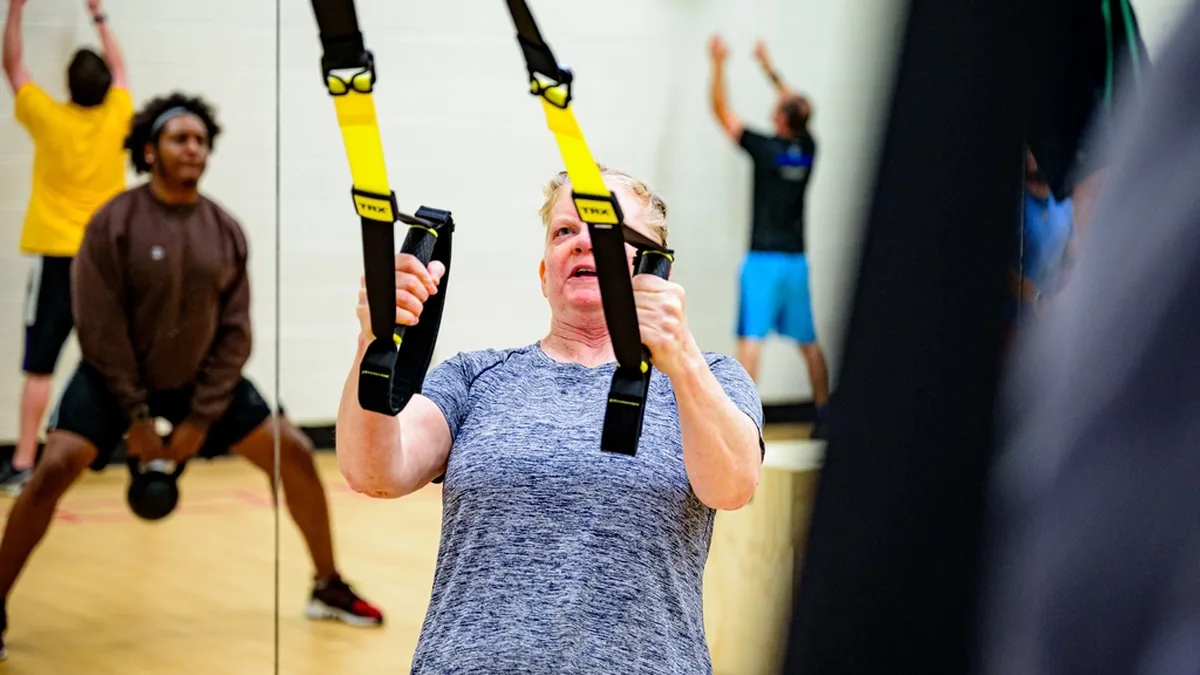
Gym routine for over 40s: how to train with more intelligence than intensity
Published on
After 40, the rules of the game change. Recovery takes longer, injury risk increases, and your training strategy must adapt.
What really changes after 40
Age-related muscle mass loss (sarcopenia) begins around age 30 at a rate of 3-8% per decade. From 50 onwards, the rate accelerates. The good news: strength training is the only intervention with solid evidence for reversing this process at any age.
What changes with age is not the capacity to build muscle - studies show hypertrophy just as real in people of 60-70 as in young adults. What changes is recovery time, volume tolerance and accumulated joint risk.
- Recovery first: 48-72h between sessions working the same muscle groups
- Impeccable technique: absolute priority over weight
- Less high joint impact: trap bar instead of conventional deadlift; squatting to parallel instead of deep
- Integrated mobility: 10-15 min before each session, especially hips, shoulders and thoracic spine
Recommended structure for the over-40s
3 days a week (Full Body): the safest distribution for maximising frequency with enough recovery. Each muscle group is stimulated 3 times a week with moderate per-session volume.
Example session: goblet squat · bench press · dumbbell row · hip thrust · shoulder press · biceps curl · triceps extension. 3 sets of 10-15 reps, RIR 2-3.
Load: 60-75% of 1RM for most exercises. Avoid absolute muscular failure in axially loaded exercises - always stop with 2-3 reps in reserve.
Priority supplementation
Creatine monohydrate (5g a day) has especially solid evidence in the over-50s for preserving muscle mass. Total protein should be a minimum of 1.6g/kg/day - older people have a slightly reduced anabolic response per gram, so aiming for the upper range (2g/kg) is advisable.
The pillars of training after 40
Training after 40 is not radically different from training at 25, but it requires adjustments in three specific areas: fatigue management (which takes longer to dissipate), warm-up (which must be more thorough) and recovery (which needs more active attention).
Extended warm-up: 10-15 minutes of specific activation before any heavy work is not optional. Include hip, ankle and shoulder mobility (the joints that develop the most restrictions with age), gluteus medius activation, and progressive light sets before the main work. A cold muscle in a 40+ body has a significantly higher injury risk than in a 25-year-old.
More importance to RIR (repetitions in reserve): constantly training to muscular failure has a high recovery cost. For the over-40s, working at RIR 2-3 (leaving 2-3 reps in the tank) in most sets produces a comparable hypertrophic stimulus with a much lower recovery demand. Failure can be reserved for the last set of each exercise in certain phases of the programme.
More warm-up volume, less working volume: if a standard plan prescribes 4-5 working sets per exercise, reducing them to 3 with higher execution quality is usually more effective for the over-40s. The difference in stimulus is minimal; the difference in recovery cost is significant.
3-day routine for the over-40s
Day 1 - Full Body A:
Goblet squat: 2 warm-up + 3×8-10 working sets
Dumbbell bench press: 3×10-12
Low cable row: 3×10-12
Light overhead press: 3×12-15
Anti-rotation core (Pallof press): 3×12
Specific hip stretching: 10 min
Day 2 - Full Body B:
Romanian deadlift: 2 warm-up + 3×8-10
Incline dumbbell press: 3×10-12
Lat pulldown: 3×10-12
Barbell hip thrust: 3×12-15
Core (plank, hollow): 3×25 sec
Thoracic mobility: 10 min
Day 3 - Full Body C (lower intensity):
Leg press: 3×12-15
Machine row: 3×12-15
Lateral raises: 3×15
Biceps curl: 2×12
Triceps extensions: 2×12
Yoga or foam rolling: 15 min
Specific supplementation for the over-40s
Beyond protein, three supplements have solid evidence specifically relevant to athletes over 40: creatine monohydrate (3-5 g a day, improving strength and muscle mass, especially pronounced in older people), vitamin D3 (2000-4000 IU a day, essential for muscle and bone function, with very prevalent deficiency), and omega-3 (2-3 g a day EPA+DHA, anti-inflammatory properties that support recovery).
Active recovery: a fundamental tool after 40
As age increases, active recovery - low-intensity movement on rest days - becomes more valuable than absolute rest. Walking 30-45 minutes, gentle swimming, restorative yoga or joint mobility work does not interfere with muscle recovery; on the contrary, it improves circulation, helps clear metabolites and maintains joint lubrication.
The joints of the over-40s benefit especially from regular movement: joint cartilage has no blood supply of its own and gets nutrients from synovial fluid, which is distributed mainly through movement. A week of absolute rest is not beneficial for the joints; it is moderate movement that keeps them healthy.
Evidence-based recovery techniques for adult athletes
Foam rolling and massage: reduces the perception of delayed onset muscle soreness (DOMS) and improves joint range of motion in the short term. 5-10 minutes post-workout on the muscle groups worked. It does not heal injuries or regenerate tissue, but it improves recovery comfort.
Contrast showers (cold-hot): alternating 30 sec cold / 2 min hot in cycles of 5-10 min. The cyclical vasoconstriction/vasodilation improves venous return and can reduce DOMS. A study by Hausswirth et al. (2011) showed superior subjective recovery compared with passive rest.
Quality sleep: growth hormone (GH) is mainly secreted in deep sleep phases (NREM stage 3). From 40 onwards, GH secretion naturally decreases, making sleep quality even more critical. Strategies for optimising it: room temperature 16-19°C, total darkness, a regular circadian rhythm (the same bedtime and wake time), no screens 60 minutes before bed.
The most common injuries after 40 and how to prevent them
Rotator cuff tendinopathy: the most frequent in shoulder training from 40 onwards. Prevention: do not raise the elbows above the shoulder plane in the overhead press, strengthen the external rotators with specific exercises (banded external rotation), do not do lateral raises with a locked elbow.
Mechanical low back pain: frequently caused by incorrect movement patterns in the deadlift or squat. Strengthening the core specifically (anti-extension, anti-rotation, anti-lateral flexion) drastically reduces the risk. The McGill Big 3 (curl-up, bird-dog, side plank) is the most supported protocol for lumbar health in athletes.
Patellar tendinopathy: jumper's knee. Prevention: do not do explosive descents in the squat, strengthen the quads eccentrically (decline squat, single-leg decline squat), maintain good ankle mobility (ankle restriction forces the knee to compensate).
Realistic expectations for the over-40s
With a well-designed programme, a 40+ athlete can expect: strength increases of 20-40% in the first 6-12 months, muscle mass gains of 1-3 kg during the first year, significant improvement in body composition (less fat, more muscle), better bone density, reduced risk of type 2 diabetes and cardiovascular disease, and improved sleep quality. These are results documented in the scientific literature for adults starting strength training after 40. Genetics matters less than you think: systematic training beats most genetic variation in practical results.
Training as preventive medicine after 40
Resistance training from 40 onwards has a health benefit profile no drug can match: it lowers systolic blood pressure by 4-9 mmHg, improves insulin sensitivity and reduces type 2 diabetes risk by up to 50%, increases bone mineral density reducing osteoporotic fracture risk, maintains the muscle mass lost with age (sarcopenia: 3-8% per decade from 30 onwards), and improves deep sleep. Training at 40, 50 or 60 is not vanity: it is the preventive intervention with the strongest scientific backing available for maintaining functional independence in the decades ahead.
Practical cases: what to expect in the first year
A 48-year-old man with no previous experience following a 3-day programme like the one described can expect: strength increases of 30-50% in the big lifts during the first 6 months (mainly neurological adaptation), a gain of 2-4 kg of lean muscle mass in the first year, a 2-4% reduction in body fat even without an intentional caloric deficit (the extra muscle raises basal metabolism), visible improvement in posture and reduced chronic low back pain. A 52-year-old woman can expect similar strength results, with slightly slower progression in hypertrophy (the post-menopausal hormonal difference exists, but it is smaller than usually assumed). The common denominator: those who are consistent get results, regardless of age.
Adapting progression to real recovery
The over-40s who progress best are those who have learned to manage progression flexibly: they do not force load progression when recovery is compromised, but they do apply it systematically when they are fresh and ready. A practical indicator: if you arrive at the session without energy or with residual muscle soreness from the previous session, reduce the load by 10-15% instead of trying to progress. If you arrive fresh and energetic, apply the programmed overload. This adaptive flexibility produces more consistent results than the rigid progression that works well at 25 but becomes counterproductive after 40.
Well-managed training is the best anti-ageing available: it maintains testosterone, GH, insulin sensitivity and bone density. There are no pills or treatments with the same effectiveness at the same price. Investing 3-4 hours a week in the gym produces health returns that extend over decades.
More on supplementation after 40
Some supplements have especially relevant evidence for people over 40: creatine monohydrate (beyond its effect on strength and muscle mass, it has documented cognitive and neuroprotective benefits, particularly relevant with age), vitamin D with K2 (vitamin D deficiency is very prevalent and associated with worse muscle function, higher fracture risk and poorer immune response), omega-3 at doses of 2-3 g a day of EPA+DHA (reducing inflammatory markers and improving muscle recovery, especially relevant when recovery is already slower with age), magnesium glycinate (involved in more than 300 enzymatic reactions; deficiency is common and can manifest as muscle cramps, interrupted sleep and general fatigue). Consult your doctor before starting any supplementation, especially if you take regular medication.
Conclusion: the best age to start is now
The biggest mistake people over 40 make when considering strength training is thinking it is already too late. Strength studies in people of 60, 70 and even 80 show strength increases of 20-30% in 12 weeks of supervised training. Sarcopenia - the muscle mass loss associated with ageing - is not an inevitable destiny: it is a consequence of inactivity that can be reversed with the right training. Every year that passes without strength training is a year of losing muscle mass, bone density and functional capacity. Every year you train is a year of maintenance and, in the early years, of gain. The choice is simple. So is the tool.
Additional resources for over-40s who train
To go deeper into strength training for older adults, the most evidence-backed resources include: "Strength Training for Older Adults" from the NSCA, Peter Attia's writing on longevity and performance, and Brad Schoenfeld's articles on hypertrophy in different populations. The knowledge available today about training in midlife is more solid than ever: use it.
What the official NSCA statement says about training with age
When training past a certain age comes up, most recommendations circulate without a source. There is, however, a reference document: the position statement of the National Strength and Conditioning Association on resistance training for older adults, signed in 2019 by Fragala, Cadore, Dorgo, Izquierdo, Kraemer, Peterson and Ryan.
It is worth understanding what such a document is, because it is not one more study. A position statement is produced by a panel of researchers who review the whole body of literature and commit to concrete recommendations. This one rests on 663 research citations: not anyone's opinion, but the state of the question, organised.
The document's core is that interventions on muscle mass and strength serve to minimise the deleterious effects of immobility, manage chronic disease and improve physical functioning, psychological well-being and quality of life. Put differently: past a certain age, resistance training stops being about appearance and becomes about autonomy.
| Goal | What it brings past 40-50 | What trains it |
|---|---|---|
| Muscle mass | Slows age-related loss | Sufficient volume with load progression |
| Maximal strength | Underpins everyday movements | Main lifts with demanding loads and careful technique |
| Power | It is what lets you react and avoid a fall | Fast movements on the concentric phase |
| Physical function | Autonomy: standing up, carrying, climbing stairs | Complete patterns, not just isolated machines |
The power row is the most neglected and the one that weighs most over the years. Maximal strength declines with age, but the speed at which force is produced declines earlier and faster — and it is precisely the quality that decides whether a stumble ends in a scare or a fracture.
The practical consequence is not to train "gentler" because the years add up. It is to train with real load, minding technique, and adding the power work that many adult programmes leave out exactly when it is most needed.
- Fragala MS, Cadore EL, Dorgo S, Izquierdo M, Kraemer WJ, Peterson MD, Ryan ED. Resistance training for older adults: position statement from the National Strength and Conditioning Association. Journal of Strength and Conditioning Research. 2019;33(8):2019-2052.
Frequently asked questions
Is it safe to deadlift after 40?
Yes, with nuance. Conventional deadlift with high load involves significant lumbar loading. The safer alternative for people with a history of lower back discomfort is the trap bar (hex bar) deadlift or sumo deadlift, which reduce the moment of force on the lumbar spine. Perfect technique — neutral spine, hip hinge — is non-negotiable regardless of variation.
Should I reduce the weight I trained with at 30?
Not necessarily, but do adjust volume and frequency. What typically needs adjustment is total volume (fewer sets per session), how often you reach absolute failure, and the priority you give to active recovery days.
Can people over 40 gain as much muscle as young adults?
The capacity for hypertrophy exists at any age. Studies in 60-75 year-olds show muscle protein synthesis responses comparable to young adults with equivalent protocols. The real difference lies in recovery and accumulated joint risk, not in the biological inability to grow. Starting or resuming strength training after 40 produces real and measurable adaptations.