Grip strength: what it says about your health and how to improve it
Published on
In a study of almost 140,000 people in 17 countries, every 5 kg less grip strength was linked to a 16% higher risk of death, and grip predicted it better than blood pressure. Which numbers count as low, why it is a thermometer and not the cause, and how to improve it.
Between 2003 and 2009, the PURE study measured the grip strength of 139,691 people aged 35 to 70 in 17 countries across all income levels, using a simple hand dynamometer. Darryl Leong's team at McMaster University then followed them for about 4 years. Every 5 kg less grip strength was linked to a 16% higher risk of death from any cause and a 17% higher risk of cardiovascular death. And one finding surprised many: grip strength predicted mortality better than systolic blood pressure.
It is not an isolated finding. Since then, studies with hundreds of thousands of people have repeated the pattern. Here is what the evidence says, which numbers count as low, why grip is a thermometer and not the cause, and how to improve it without spending all day squeezing a ball.
What grip strength says about your health
In 2018, the BMJ published the UK Biobank analysis by Carlos Celis-Morales and colleagues at the University of Glasgow: 502,293 people aged 40 to 69 followed for an average of 7.1 years. For every 5 kg less grip strength, the risk of death from any cause rose by 20% in women and 16% in men, and cardiovascular, respiratory and several cancer risks also increased. Adding grip strength to a risk score based on age, sex, diabetes, body mass index, blood pressure and smoking improved the prediction.
| Study | People | Main finding |
|---|---|---|
| Leong (2015), PURE | 139,691 in 17 countries | Every 5 kg less grip: 16% higher risk of death |
| Celis-Morales (2018), UK Biobank | 502,293 | Every 5 kg less: 20% higher risk in women and 16% in men |
| Wu (2017), 42 studies | 3,002,203 | Every 5 kg less: 16% higher risk; linear relationship up to about 56 kg |
| García-Hermoso (2018), 38 studies | 1,907,580 | High grip: 31% lower risk of death than low grip |
The meta-analysis by Antonio García-Hermoso and colleagues (2018) adds an important nuance: it is not only about the hand. People with greater knee extension strength also had a 14% lower risk of death. Grip is simply the cheapest and quickest way to measure strength.
How much grip strength is too little?
The 2019 European consensus on sarcopenia, coordinated by Alfonso Cruz-Jentoft (Ramón y Cajal University Hospital, Madrid), defines low strength as grip below 27 kg in men and 16 kg in women. It is the first criterion for suspecting sarcopenia, the loss of muscle and strength linked to ageing. In the UK Biobank, the weakness thresholds used were similar: below 26 kg in men and 16 kg in women.
| Reference | Men | Women |
|---|---|---|
| European sarcopenia consensus (2019) | Below 27 kg | Below 16 kg |
| Weakness in the UK Biobank (2018) | Below 26 kg | Below 16 kg |
These thresholds mark what is clearly low, not what is desirable. Normal values vary a lot with age, sex and country: the review by Dodds and colleagues (2016) pooled data from 96,537 measurements and found that populations in developed countries have similar values to each other, higher than those in developing countries.
A thermometer, not the cause
Here is the most common mistake: thinking that squeezing a hand gripper every day extends your life. Grip studies are observational and measure an association. Grip reflects the strength and overall condition of the body, and that is why it predicts so well.
A 2023 trial illustrates it. Labott and Donath followed 79 healthy older adults for a year who did, or did not, a 60-minute agility programme twice a week. Grip did not change in either group, although those with the strongest grip were also the most agile. By contrast, when the training is strength training, grip does improve: a 2025 meta-analysis of 13 studies and 711 older adults with sarcopenia found clear improvements with strength programmes of about 3 sessions a week.
The practical idea: do not train your grip to improve a number. Train whole-body strength, and your grip will rise with it. What protects you is strength, not the gripper.
How to improve grip strength
| Exercise | How it works your grip | Tip |
|---|---|---|
| Deadlift | You hold the heaviest load of the session | Use a double overhand grip as long as possible before switching to mixed |
| Barbell or dumbbell rows | A closed-hand pull on every rep | No straps while you can hold the weight |
| Pull-ups and dead hangs | You hold your own bodyweight | Finish the session with 2-3 hangs of 20-40 seconds |
| Farmer's walk | You carry weight in each hand while walking | Heavy dumbbells or kettlebells, 20-40 metres |
Deadlift technique is covered in the deadlift guide, and if you cannot do pull-ups yet, start with pull-ups from zero. The farmer's walk is the carry pattern we explain in the 5 basic strength movement patterns.
How to measure it
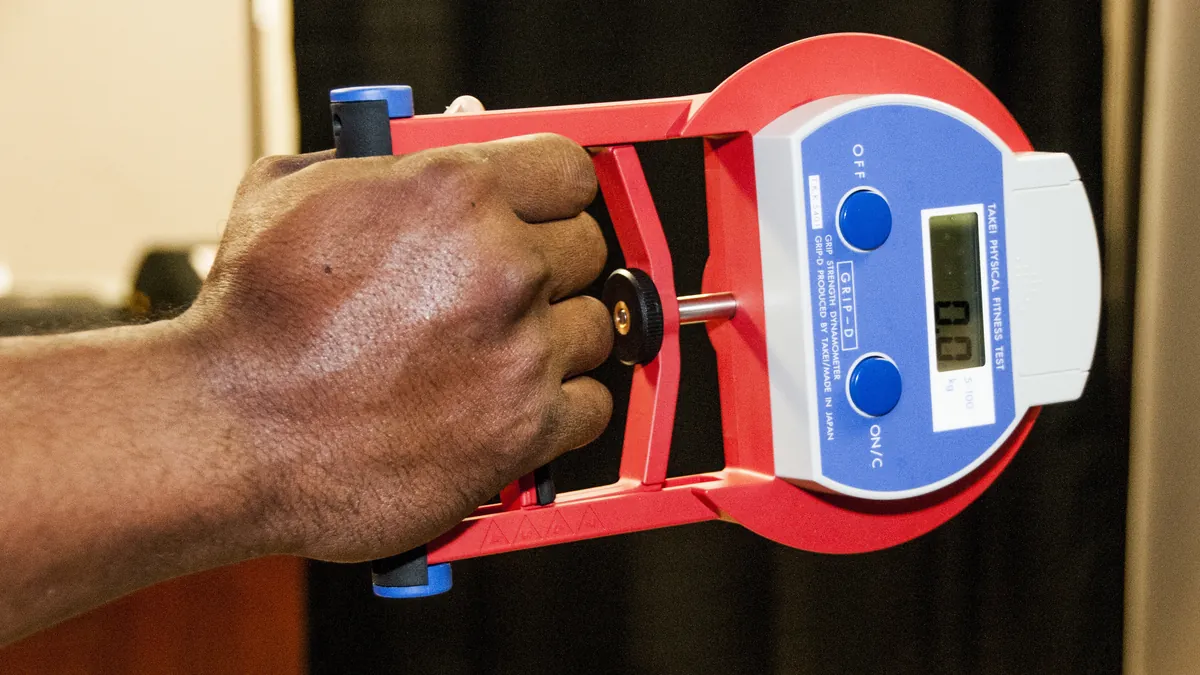
Studies use a hand dynamometer, the same type of device used in PURE. Many physiotherapists and some pharmacies have one, and it takes a couple of minutes: standing or seated, elbow close to your body, squeezing as hard as you can for a few seconds, and taking the best of several attempts. If you do not have access to one, home tests such as how long you can hang from a bar give an idea, but they do not have the same reference thresholds.
Who should pay most attention to it
- People over 50: strength loss with age is progressive, and low grip is the first warning sign in the European consensus. You may find the gym routine for over-40s useful.
- People who have stopped training: strength is lost more slowly than it seems, but it is lost; we cover it in how much muscle you lose when you stop training.
- People with cardiovascular risk factors: strength adds to the rest of your care; if you have high blood pressure, see exercise to lower blood pressure.
The Progrevia generator builds full-body routines with pulls, hip hinges and pushes every week, which is exactly what raises grip strength without a separate session for it.
- Leong DP, Teo KK, Rangarajan S, et al. Prognostic value of grip strength: findings from the Prospective Urban Rural Epidemiology (PURE) study. The Lancet. 2015;386(9990):266-273.
- Celis-Morales CA, Welsh P, Lyall DM, et al. Associations of grip strength with cardiovascular, respiratory, and cancer outcomes and all cause mortality: prospective cohort study of half a million UK Biobank participants. BMJ. 2018;361:k1651.
- García-Hermoso A, Cavero-Redondo I, Ramírez-Vélez R, et al. Muscular strength as a predictor of all-cause mortality in an apparently healthy population: a systematic review and meta-analysis of data from approximately 2 million men and women. Archives of Physical Medicine and Rehabilitation. 2018;99(10):2100-2113.
- Wu Y, Wang W, Liu T, Zhang D. Association of grip strength with risk of all-cause mortality, cardiovascular diseases, and cancer in community-dwelling populations: a meta-analysis of prospective cohort studies. Journal of the American Medical Directors Association. 2017;18(6):551.e17-551.e35.
- Cruz-Jentoft AJ, Bahat G, Bauer J, et al. Sarcopenia: revised European consensus on definition and diagnosis. Age and Ageing. 2019;48(1):16-31.
- Dodds RM, Syddall HE, Cooper R, et al. Global variation in grip strength: a systematic review and meta-analysis of normative data. Age and Ageing. 2016;45(2):209-216.
- Labott BK, Donath L. Agility performance in healthy older adults is associated with handgrip strength and force development: results from a 1-year randomized controlled trial. European Geriatric Medicine. 2023;14(3):547-555.
- Hua-Rui L, Shouliang H, Zhengze Y, et al. Optimal dose of resistance training to improve handgrip strength in older adults with sarcopenia: a systematic review and Bayesian model-based network meta-analysis. Frontiers in Physiology. 2025;16:1564988.
Progrevia · · How we write our guides
Frequently asked questions
What is a normal grip strength?
It depends a lot on age, sex and country. As a reference for what is clearly low, the 2019 European sarcopenia consensus uses below 27 kg for men and 16 kg for women.
Does grip strength predict how long you will live?
It is associated with the risk of death: in the PURE study, every 5 kg less grip was linked to a 16% higher risk. It is an association, not a cause: grip reflects your overall strength and health.
Does squeezing a gripper or a ball improve your health?
It may raise the number, but what protects you is overall strength. Whole-body strength training improves grip and also what grip is measuring.
Which exercises improve grip strength?
Deadlifts, rows, pull-ups, hanging from a bar and the farmer's walk. Avoiding straps while you can still hold the weight also helps.
Where can I measure my grip strength?
With a hand dynamometer, the device used in studies. Many physiotherapists and some pharmacies have one, and the measurement takes a couple of minutes.
Informational content based on the available scientific evidence: it does not replace advice from a healthcare professional. If you have an injury or a medical condition, or are pregnant, check with one before changing your training or diet.
