The 5 fundamental movement patterns for building real and lasting strength
Published on
It's not individual exercises that matter for strength: it's movement patterns. Mastering these 5 is the foundation of any training programme that works for years.
When people start training for strength, they usually think in terms of exercises: bench press for the chest, curls for the biceps, squats for the legs. This way of seeing training, although intuitive, ignores the real architecture of human movement and leads to unbalanced programmes with important gaps.
Biomechanics and sports physiotherapy organise human movement into fundamental patterns, not isolated muscles. Understanding these patterns completely changes how you design your strength training plan.
Pattern 1: Squat
The squat pattern involves simultaneous flexion of hip, knee and ankle under load. It is the most fundamental lower-body strength pattern and works the quads, glutes, hamstrings and stabilising core musculature.
Key exercises: back squat, front squat, goblet squat, hack squat, Bulgarian split squat.
Pattern 2: Hip hinge
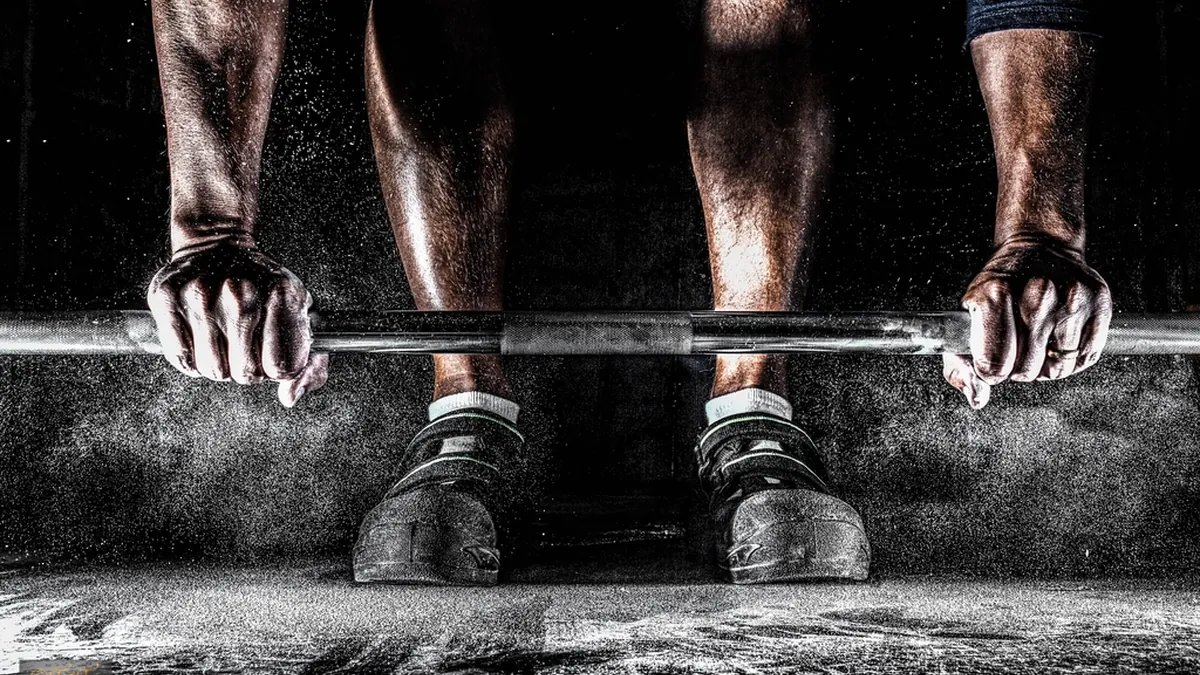
The hip hinge is the pattern where the load is moved through hip extension with minimal knee flexion. It activates the hamstrings, glutes and the whole posterior chain. It is one of the most ignored movement patterns in conventional training programmes.
Key exercises: deadlift, Romanian deadlift (RDL), good morning, hip thrust, kettlebell swing.
Pattern 3: Horizontal and vertical push
The push pattern works the chest, anterior deltoid and triceps. The horizontal variant (bench press) and the vertical variant (overhead press) should both be present in a complete strength programme, since they activate the deltoids in different proportions.
Key exercises: bench press, incline press, overhead press, Arnold press, parallel bar dips, weighted push-ups.
Pattern 4: Horizontal and vertical pull
The pull pattern works the back musculature (lats, rhomboids, traps) and the biceps. Like the push, it should include horizontal and vertical variants for balanced development that prevents postural imbalances.
Key exercises: pull-up/chin-up, lat pulldown, barbell row, cable row, dumbbell row, face pull.
Pattern 5: Loaded carry
Carries are the most forgotten pattern, but one of the most transferable to real life and sporting performance. They develop core stability, grip strength, nervous system capacity under fatigue and integrated coordination.
Key exercises: farmer carry, suitcase carry, overhead carry, walking loaded rows.
The balance rule: in a well-designed strength programme, pull volume should equal or exceed push volume. Most shoulder injuries in strength athletes come from programmes with excess pushing and a pulling deficit.
How to programme the 5 movement patterns
A balanced week of strength training should include at least one variant of each pattern. An example distribution for 4 training days: day 1 (squat + vertical push), day 2 (hinge + horizontal pull), day 3 (squat + vertical pull), day 4 (horizontal push + carries).
This approach lowers the risk of muscular imbalances, helps all the major muscle groups receive enough strength stimulus, and makes the programme sustainable in the long term without increasing injury risk.
How to progress intelligently in each movement pattern
Progression in movement patterns is not just adding weight to the bar. For each pattern there are variants of lower and higher technical and load demand that allow smoother, more sustainable progression.
Squat pattern progression: goblet squat → barbell squat in a rack → back squat → front squat or unilateral variants. Each step requires more motor control and allows more total load.
Hip hinge progression: bodyweight hip thrust → barbell hip thrust → Romanian deadlift → conventional deadlift → sumo deadlift or variants. The progression respects both the technical learning curve and load progression.
Push progression: push-ups → dumbbell bench press → barbell bench press → bench press with resistance bands → weighted dips. In the vertical push: dumbbell overhead press → barbell → single-arm overhead press.
Pull progression: neutral-grip pulldown → pronated-grip pulldown → assisted chin-up → bodyweight pull-up → weighted pull-up. In the horizontal pull: cable row → dumbbell row → Pendlay row → Yates row.
What are the most common mistakes when programming movement patterns?
Knowing the patterns does not guarantee programming them correctly. These are the most frequent mistakes that compromise muscular balance and strength progress:
1. Excess push versus pull: the most common and potentially most injurious error. Most home-made programmes or those designed without scientific criteria include 2-3 times more push volume than pull. The result is a forward posture (internally rotated shoulders) and elevated risk of rotator cuff tendinopathy. Solution: match or exceed push volume with pull volume in any training week.
2. Ignoring carries: the loaded carry pattern is the least popular in commercial gyms but one of the most functional. Including at least one farmer carry variant a week improves grip strength, core stability and nervous system endurance under fatigue, benefits that transfer to every other movement pattern.
3. Only working the dominant pattern: people with a quad-dominant pattern (more squatting than hinging) develop imbalances between quads and hamstrings that raise the risk of anterior cruciate ligament injury. Keeping a 1:1 balance between squat and hinge is especially important in sports with changes of direction.
How to prevent injuries from movement pattern imbalances
The most frequent injuries in strength training have a recognisable pattern: they are almost always the result of muscular imbalances created by ignoring one of the 5 fundamental patterns.
Supraspinatus tendinopathy (shoulder) appears with excess push and a pull deficit. Iliotibial band syndrome in runners is frequently associated with gluteus medius weakness and the absence of unilateral work (split squat, step-up). Hamstring injuries are more frequent in people who train quad-dominant without hip hinge work.
Prevention does not require a special "corrective" programme: simply make sure the 5 patterns are present in your weekly strength programme, with balanced volume between complementary patterns. It is basic programme design, not advanced physiotherapy.
The 7 fundamental patterns and their best exercises
1. Horizontal push: Bench press (flat, incline, decline), parallel bar dips, dumbbell press. Activates pecs, anterior deltoid, triceps.
2. Horizontal pull: Barbell row, dumbbell row, cable or machine row. Activates lats, rhomboids, mid and lower traps, biceps.
3. Vertical push: Barbell or dumbbell overhead press, Arnold press, pike push-up, handstand push-up. Activates medial and anterior delts, upper traps, triceps.
4. Vertical pull: Pull-up and chin-up (pronated and supinated grip), cable lat pulldown. Activates lats, biceps, rhomboids, infraspinatus.
5. Squat (quad-dominant): Back squat, front squat, goblet squat, hack squat, Bulgarian split squat. Activates quads, glutes, core.
6. Hip hinge (posterior chain): Conventional deadlift, Romanian deadlift, hip thrust, good mornings, kettlebell swing. Activates gluteus maximus, hamstrings, spinal erectors.
7. Rotation / anti-rotation (core): Pallof press, cable chop, Russian twist, landmine rotation. Activates obliques, transverse abdominis, multifidus.
Muscular balance: the antagonist principle
For every push pattern, there should be a pull pattern of the same intensity and volume. The imbalance between strong pecs and a weak back produces the hyperkyphotic posture so common in people who do a lot of pressing and little rowing. Practical rule: for every push set, do at least one equivalent pull set. In beginner programmes, tilting the balance slightly towards pulling (1.2-1.5 row sets per press set) is beneficial to compensate for everyday sedentary posture.
How to audit your current programme with the 7 patterns
Take your current programme and categorise each exercise into one of the 7 patterns. If any pattern has twice as many sets as its antagonist, there is an imbalance that will accumulate as injury over time. If a pattern is completely absent for weeks, you are losing stimulus in important muscle groups. A well-balanced programme should have at least 2 exercises per pattern per week, with relatively similar volumes between antagonists. This audit takes 10 minutes and can reveal deficiencies that explain both plateaus in certain muscles and joint discomfort you cannot place. Muscular imbalances are the main cause of chronic gym injuries that come not from accidents but from accumulated asymmetric use.
Integrating the 7 patterns into a 3-day programme
A 3-day Full Body programme covering the 7 patterns can be structured like this:
Monday (session A):
Back squat (pattern: quad-dominant squat): 4×6-8
Romanian deadlift (pattern: hip hinge): 3×8-10
Flat bench press (pattern: horizontal push): 4×6-8
Barbell row (pattern: horizontal pull): 3×8-10
Overhead press (pattern: vertical push): 3×8-10
Lat pulldown (pattern: vertical pull): 3×8-10
Pallof press (pattern: anti-rotation): 3×10 per side
Wednesday (session B):
Conventional deadlift (hinge): 4×4-6
Bulgarian split squat (unilateral quad-dominant): 3×10
Incline dumbbell press (push): 3×10-12
Single-arm dumbbell row (horizontal pull): 3×10-12
Pike push-up or Arnold press (vertical push): 3×10
Pull-up or chin-up (vertical pull): 3×max
Dead bug (core stabilisation): 3×10
Friday (session C):
Barbell hip thrust (hinge/glutes): 4×10-12
Hack squat or leg press (quad-dominant): 3×12
Parallel bar dips (horizontal/vertical push): 3×8-10
Seated cable row (horizontal pull): 3×12
Lateral raises (vertical push isolation): 3×15
Cable face pull (vertical pull, rear delts): 3×15
Hollow body or bird-dog (core stabilisation): 3×20 sec/10 reps
This programme covers the 7 fundamental movement patterns in every training week, with a balanced distribution between push and pull. Each pattern receives roughly 6-10 weekly sets, within the maintenance-to-hypertrophy range for most experience levels.
Movement patterns as the universal language of fitness
One of the advantages of thinking in movement patterns instead of muscles is that the system applies to any modality: calisthenics, olympic lifting, crossfit, functional training or a conventional gym. The 7 patterns do not change with the equipment available; only the specific exercise covering them changes. This makes planning infinitely flexible without sacrificing balance. Whatever your equipment, level or goal, if you cover the 7 patterns with balanced volumes you will have a structurally sound programme. Everything else is detail.
Beyond the 7 patterns: movement as a lifelong practice
The 7 movement patterns are not just a framework for designing programmes: they are the map of fundamental human physical capacities. Someone who can push, pull, sit, stand, hinge, rotate and stabilise with strength and control has the physical base to take part in almost any physical activity or sport. Pattern-based strength training is not just a gym methodology: it is training for an active life at any age.
Starting point
The 7 movement patterns are your compass for intelligent programming. If you cover them all in a balanced way week after week, your body will develop complete functional strength, avoid the imbalances that cause chronic injury and maintain the movement capacity that defines an active quality of life.
Your next step with movement patterns
This week, audit your current programme using the 7 patterns. Count how many weekly sets each pattern has and compare push versus pull. If there are imbalances greater than 2:1, adjust. The exercise you find hardest technically is usually the one from your weakest pattern. Work on it as a priority and watch how your whole programme improves.
A programme balanced across movement patterns is the basis of a complete, functional physique free of chronic injury. The patterns are the structure; specific exercises are the bricks.
Should you switch exercises? Systematically yes, randomly no
Mastering movement patterns raises an immediate question: if you already cover the five patterns, should you stick with the same exercises for months or rotate them? One systematic review separates the two ways of varying, and the distinction is the answer.
Kassiano, Nunes, Costa, Ribeiro, Schoenfeld and Cyrino published a review of eight studies with 241 participants in total in the Journal of Strength and Conditioning Research in 2022. Their conclusion is neither a yes nor a no: some degree of systematic variation appears to enhance regional hypertrophic adaptations and maximise dynamic strength, whereas excessive, random variation may compromise gains.
The two words doing all the work are "systematic" and "random". Varying systematically means choosing exercises that attack the same pattern from different angles and keeping them long enough to progress in load. Varying randomly is what many people do: changing the routine every week out of boredom, never repeating anything long enough to measure whether it improved.
| Type of variation | What it looks like in practice | Described effect |
|---|---|---|
| Systematic | Two or three variants per pattern, rotated in blocks | Enhances regional adaptations and dynamic strength |
| Excessive and random | Different exercises almost every session | May compromise gains |
Why random variation is costly: progressive overload needs repetition to exist. If you never do the same exercise twice in a row, you have nothing to compare against, you do not know whether you progressed, and much of any improvement you see will be technical learning of the new movement, not muscle.
And why some variation helps: within a single pattern, exercises do not distribute load evenly along the muscle. Changing the angle, the grip or body position covers regions that one exercise leaves short — which is exactly what the paper describes as "regional adaptations".
The rule that follows, applied to movement patterns: keep all five patterns always, pick two or three variants of each, and rotate them in blocks of several weeks rather than on weekly whim. Enough variety to cover the whole muscle, enough repetition for progression to be measurable.
- Kassiano W, Nunes JP, Costa B, Ribeiro AS, Schoenfeld BJ, Cyrino ES. Does varying resistance exercises promote superior muscle hypertrophy and strength gains? A systematic review. Journal of Strength and Conditioning Research. 2022;36(6):1753-1762.
- Nunes JP, Grgic J, Cunha PM, Ribeiro AS, Schoenfeld BJ, de Salles BF, Cyrino ES. What influence does resistance exercise order have on muscular strength gains and muscle hypertrophy? A systematic review and meta-analysis. European Journal of Sport Science. 2021;21(2):149-157.
Frequently asked questions
What is the most important movement pattern for overall strength development?
The hip hinge (deadlift, RDL, hip thrust) is arguably the most impactful pattern for full-body strength, as it trains the entire posterior chain — hamstrings, glutes, spinal erectors — which are the largest and strongest muscle groups in the body. The squat is a close second. Together, these two lower-body patterns account for the majority of strength development in well-designed programmes.
Why do most gym-goers have muscle imbalances?
Because most recreational programmes overemphasise push patterns (bench press, overhead press) relative to pull patterns. The chest and anterior deltoid receive much more direct work than the back and posterior deltoid. Over time, this creates forward shoulder posture, rotator cuff dysfunction, and chronic shoulder pain. The fix: ensure pull volume equals or exceeds push volume every week.
Do I need all 5 movement patterns in every session?
No. You need all 5 patterns across your training week, but not necessarily in every session. A 4-day upper-lower split can distribute them well: upper sessions cover push + pull (horizontal and vertical), lower sessions cover squat + hinge, and at least one session per week includes loaded carries. What matters is that all patterns are trained at adequate volume and frequency across the week.
What are the best exercises for the loaded carry pattern?
The farmer carry (both hands loaded, walking) is the most accessible and effective option. The suitcase carry (single arm) is excellent for core anti-lateral flexion training. The overhead carry (loaded above the head) develops shoulder stability and overhead mobility. These exercises train grip strength, core integration, and multi-joint coordination in ways no standard isolation exercise can match.
Can I build a complete body with only bodyweight movement patterns?
Yes. The push pattern can be trained with push-ups and handstand push-up progressions. The pull pattern requires a pull-up bar for the vertical variant. The squat pattern is available with pistol squat progressions. The hinge pattern can use Nordic curls and single-leg hip thrusts. Loaded carries need some form of weight (a loaded backpack works). All five patterns are accessible without a gym.