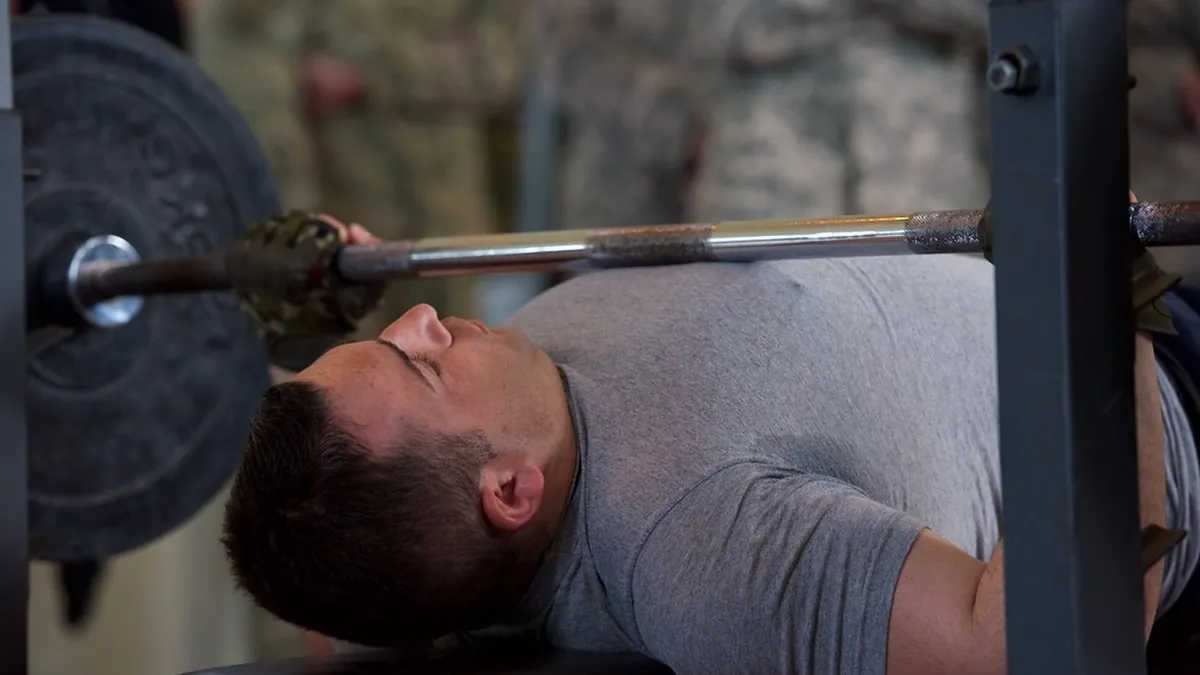
The best chest exercises for hypertrophy according to science
Published on
Not all chest exercises are equal. EMG and hypertrophy research point to which ones build the most pec and how to combine them.
The pectoralis major has two portions (clavicular or upper, and sternocostal or mid-lower), and developing it fully requires stimulus at different angles and, above all, tension in the stretched position. These are the exercises with the strongest scientific backing, ordered by function.
1. Bench press (flat): the foundation builder
The classic. It lets you move heavy loads, which maximises mechanical tension across the whole chest. Dumbbells add a slightly larger range of motion and stabilisation work; the barbell allows more absolute load. Ideally, alternate them in blocks.
2. Incline press: prioritising the upper chest
At an incline of 15-30 degrees, clavicular activation increases without turning it into a shoulder press (which happens above 45 degrees). The upper chest tends to be most people's weak point, so it deserves a fixed place in your routine.
Technical key: retract and depress the scapulae, keep a slight thoracic arch and lower the bar or dumbbells controlling the eccentric phase for 2-3 seconds. Tension in the stretch is where the chest grows most.
3. Flyes and cable crossovers: tension in the stretch
Presses lose tension at the top (the weight shifts onto the joint). Dumbbell flyes and, better still, cable crossovers maintain constant tension throughout the range and maximise the stretch, a factor recent research (Maeo et al.) associates with greater hypertrophy.
4. Parallel bar dips: the underrated one
With a slight forward torso lean, dips load the lower chest intensely and allow progression with added weight. An excellent complement to pressing.
How to combine them in your routine
An effective chest session does not need 8 exercises. Suggested structure (12-16 weekly sets):
- 1 heavy press (flat or incline) 3-4x5-8
- 1 complementary press at the other angle 3x8-12
- 1 stretch-focused exercise (flyes or crossovers) 3x12-15
Split that volume across 2 sessions per week (frequency 2) for better results than cramming it into a single day.
Mistakes that limit your chest
Incomplete range (not lowering all the way), chasing load alone at the expense of technique, neglecting the upper chest, and failing to progress. The mind-muscle connection helps on isolation work, but progressive overload remains the main engine.
The Progrevia generator automatically selects the best chest exercises for your equipment and level, distributing volume at the optimal frequency. Try it for free.
Bench angle: what an eight-week study actually measured
The idea that incline pressing "works the upper chest" gets repeated in every gym, almost always by people who have not checked it. One trial did check it, and its design is exactly the one that was needed.
Chaves and colleagues published a study in the International Journal of Exercise Science in 2020 with forty-seven men with no previous training experience, split into three groups: horizontal press only, incline press only, or both combined. Eight weeks of training, measuring muscle thickness, isometric strength and electromyographic activity of the pectoralis major before and after.
The result that matters: the incline-only group was the only one with a significant increase in upper chest thickness — the clavicular head of the pectoralis major — compared with the other two. On strength, by contrast, there were no differences between groups: all improved similarly, by roughly 10-11 kg of isometric strength.
| Angle | Region emphasised | What was measured |
|---|---|---|
| Flat bench (0°) | Sternocostal head (the bulk of the chest) | Highest electromyographic signal in the sternal portion |
| Incline (around 44°) | Clavicular head (upper chest) | Greatest electromyographic amplitude in the clavicular portion |
| Incline only, 8 weeks | Upper chest | Only group with a significant thickness increase |
| Isometric strength | — | No differences between groups (~10-11 kg improvement) |
Two caveats before you rearrange your chest routine. First: these were untrained participants, who respond to almost any stimulus; in a trained lifter the differences tend to be smaller. Second: the study compared doing only one of the two, not what almost everyone actually does, which is combine them.
Even with those caveats, the practical conclusion holds: if your upper chest is the weak point, adding more flat bench sets will not fix it. You need the angle, and you need it early in the session, while you still arrive fresh at the exercise that costs you most.
- Chaves SFN, Rocha-Júnior VA, Encarnação IGA, Martins-Costa HC, Freitas EDS, Coelho DB, Franco FSC, Loenneke JP, Bottaro M, Ferreira-Júnior JB. Effects of horizontal and incline bench press on neuromuscular adaptations in untrained young men. International Journal of Exercise Science. 2020;13(6):859-872.
Frequently asked questions
What is the best chest exercise?
There isn't a single one: the bench press (flat or incline) builds the base thanks to loading capacity, while flyes or cable crossovers add stretch tension. Combining a heavy press, a press at another angle, and a stretch exercise covers the whole pec.
How do you train the upper chest?
With an incline press at 15-30°. Above 45° the work shifts to the shoulder. The upper (clavicular) chest is usually the weak point, so prioritise it early in the session when fresh.
How many chest sets per week to grow?
Between 12 and 20 weekly sets for most people, split across 2 sessions (frequency 2). Beginners grow with 10-12; advanced lifters may need close to 20. Increase volume progressively.