Hip thrust: correct technique, mistakes and whether it beats the squat
Published on
It activates the glutes more than the squat, but two trials with MRI and ultrasound found no extra growth. Technique step by step, mistakes and how to program it.
In 2015, Bret Contreras, then at Auckland University of Technology, used electrodes to measure what the glutes of 13 trained women did in two exercises with their 10-rep-max load: the barbell back squat and the hip thrust. In the hip thrust, mean activity of the upper glutes was 69.5% versus 29.4% in the squat, and of the lower glutes, 86.8% versus 45.4%. The quadriceps worked similarly in both.
That study turned the hip thrust into the most famous glute exercise in gyms. What came next adds plenty of nuance to the headline. Here is the technique step by step, the most common mistakes and what happened when muscle was actually measured.
How to do the hip thrust step by step
- The bench. Rest your back on a solid bench at the height of the lower edge of your shoulder blades. If the bench moves, put it against a wall or a rack.
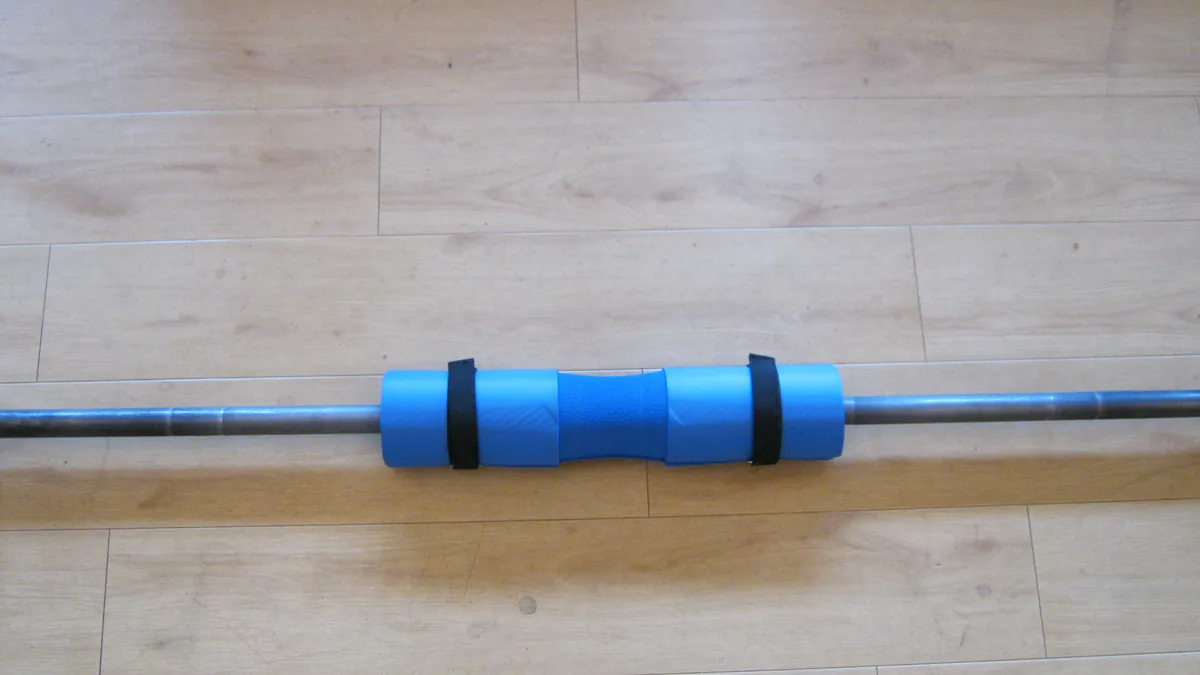
- The bar. Place it over the crease of your hips, with a pad or a folded mat. Hold it with both hands so it does not roll.
- The feet. Hip-width apart, toes turned slightly out. Adjust the distance so that, at the very top, your shins are vertical.
- The drive up. Push through your heels and rise until your hip is extended, in line with your torso and thighs. Look ahead or slightly down: a tucked chin helps you avoid arching your lower back.
- At the top. Squeeze your glutes for 1 second, without flaring your ribs.
- The descent. Lower under control over about 2 seconds until the bar almost touches the floor, then drive up again.
Hip extension is done by the glutes, not the back. If you feel your lower back more than your glutes on the way up, it is almost always because you are arching your back to gain the last few centimetres.
Common hip thrust mistakes
| Mistake | What you notice | Fix |
|---|---|---|
| Arching the lower back at the top | Tension in the lower back | Chin tucked, ribs down and stop when the hip is extended |
| Feet too far away | The hamstrings work a lot, sometimes cramping | Bring them closer until your shins are vertical at the top |
| Feet too close | The quadriceps work more | Move them slightly further away and push through the heel |
| Half reps | Lots of weight, little glute | Lower until almost touching the floor and rise until the hip is extended |
| Bench sliding | Instability and fear of loading | Bench against a wall or a rack, or a dedicated bench |
Read the video text
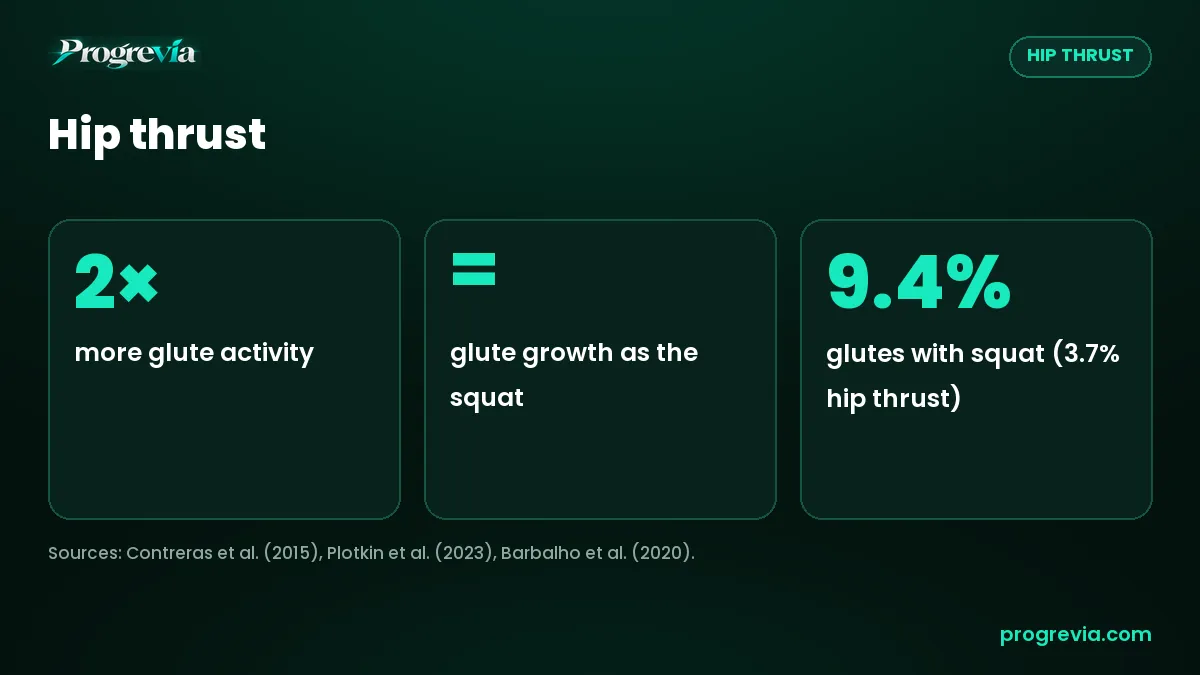
Does it grow the glutes more than the squat? 2× more glute activity than the squat, at the same relative load (Contreras et al., 2015). Same: glute growth with the hip thrust and the squat, measured on MRI (Plotkin et al., 2023). 9.4% glute growth with the squat versus 3.7% with the hip thrust (Barbalho et al., 2020). A complement, not a substitute. The video ends by showing how to create the routine in Progrevia.
Hip thrust or squat: which grows the glutes more?
Activating a muscle more does not guarantee it grows more. Two trials measured it directly:
- Untrained people. In 2023, Daniel Plotkin (Auburn University) and his team trained 34 young adults for 9 weeks, 18 with the hip thrust and 16 with the squat, with the same number of sets. They measured muscle with MRI. The glutes grew similarly in both groups; the quadriceps and adductors grew more with the squat. Each group improved more in its own exercise and both gained equally on the deadlift.
- Trained women. In 2020, Matheus Barbalho (Federal University of Goiás, Brazil) compared 22 experienced women for 12 weeks. Glute thickness increased by 9.4% with the squat and 3.7% with the hip thrust, and quadriceps thickness by 12.2% versus 2%.
The practical conclusion: the hip thrust cannot replace the squat if you want glutes and legs. The hip thrust adds something because it loads the glutes exactly where the squat barely does, with the hip extended, and because it demands less of the back and knees. We cover more exercises in the best glute exercises.
Does the hip thrust make you run faster or jump higher?
It is another common promise. In 2026, Shengfa Lin (Beijing Sport University) and his team pooled 20 trials. The hip thrust mainly improved strength in the hip thrust itself (effect size of 0.53), but it did not carry over to the squat or to jumping. For sprinting the effect was small (0.22) and for changes of direction, also small (0.25). The certainty of the evidence was low.
How to program the hip thrust
- Sets and reps: 3-4 sets of 8-12 reps, finishing 1-3 reps short of failure. You can use ranges from 6 to 15 if you alternate.
- Where to place it: after the main leg exercise, such as the squat or the deadlift.
- Frequency: 1-2 times a week, adding it to the glute volume you already do.
- Progression: more reps first; when you reach the top of the range, add 5-10 kg. It is explained in progressive overload.
Variations depending on equipment: the floor glute bridge with a barbell or dumbbell, the single-leg hip thrust with bodyweight, the hip thrust machine or a resistance band over the hips.
Comfort and safety: a thick pad prevents bruising on the hips. If you feel lower back pain that does not go away when you correct your technique, stop and see a healthcare professional.
The Progrevia generator includes the hip thrust and its variations when your goal and equipment allow it, and places it after the main leg exercise.
- Contreras B, Vigotsky AD, Schoenfeld BJ, Beardsley C, Cronin J. A Comparison of Gluteus Maximus, Biceps Femoris, and Vastus Lateralis Electromyographic Activity in the Back Squat and Barbell Hip Thrust Exercises. Journal of Applied Biomechanics. 2015;31(6):452-458.
- Plotkin DL, Rodas MA, Vigotsky AD, McIntosh MC, Breeze E, Ubrik R, et al. Hip thrust and back squat training elicit similar gluteus muscle hypertrophy and transfer similarly to the deadlift. Frontiers in Physiology. 2023;14:1279170.
- Barbalho M, Coswig V, Souza D, Serrão JC, Hebling Campos M, Gentil P. Back Squat vs. Hip Thrust Resistance-training Programs in Well-trained Women. International Journal of Sports Medicine. 2020;41(5):306-310.
- Lin S, Cheng M, Yi X, Li Y, Liu R. Acute and long-term effects of hip thrust training on athletic performance: a systematic review and meta-analysis. PeerJ. 2026;14:e20785.
Progrevia · · How we write our guides
Frequently asked questions
Which muscles does the hip thrust work?
Mainly the gluteus maximus, helped by the hamstrings and quadriceps. In Contreras's study (2015), glute activity was more than double that of the squat at the same relative load.
Is the hip thrust better than the squat for the glutes?
Not for growing them. In Plotkin's trial (2023) the glutes grew equally with both, and in Barbalho's (2020), with trained women, they grew more with the squat. The hip thrust is a good complement.
Why does my back hurt when I do hip thrusts?
Almost always because you arch your lower back at the top to rise further. Tuck your chin, keep your ribs down and stop when the hip is extended. If the pain persists, see a professional.
How many sets and reps of hip thrust should I do?
3-4 sets of 8-12 reps, 1-3 reps short of failure, after the main leg exercise and 1-2 times a week.
What if I have no bench or barbell?
The floor glute bridge with a dumbbell, the single-leg hip thrust with bodyweight or a resistance band over the hips.
Informational content based on the available scientific evidence: it does not replace advice from a healthcare professional. If you have an injury or a medical condition, or are pregnant, check with one before changing your training or diet.
