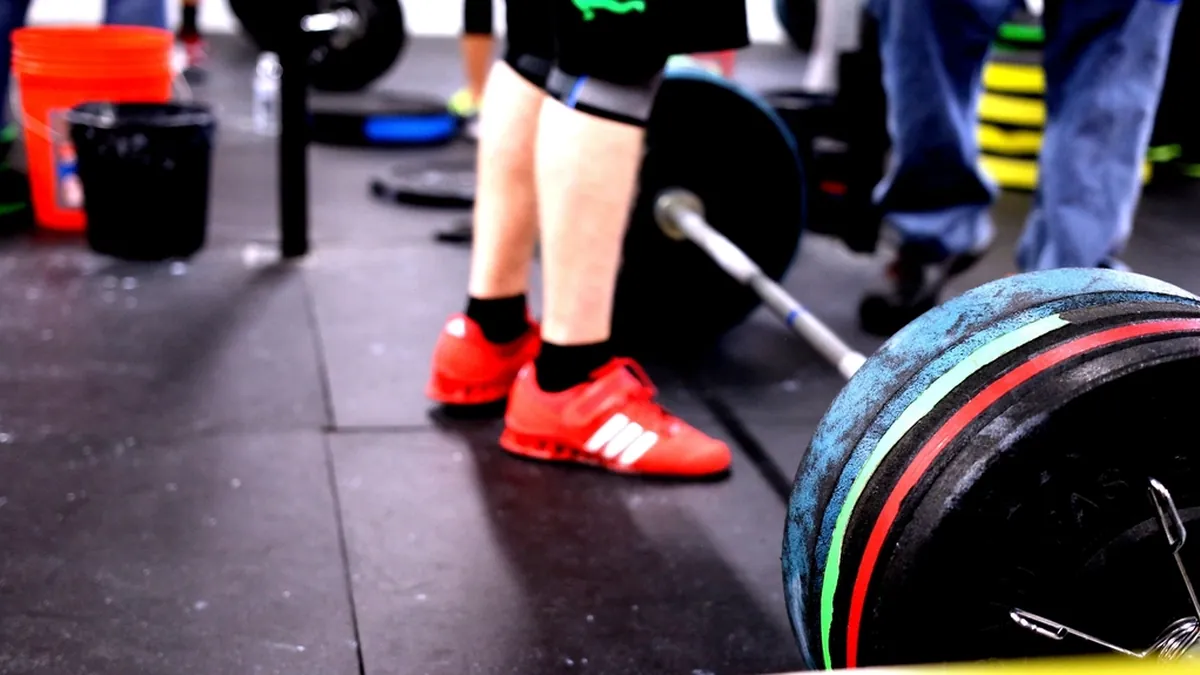
Deadlift: correct technique, variations, and why it is not bad for your back
Published on
No exercise commands as much respect (and misinformation) as the deadlift. How to perform it safely step by step, which variation suits you, and the truth about lumbar risk.
The deadlift recruits more muscle mass in a single movement than any other exercise: the whole posterior chain (hamstrings, glutes, spinal erectors), the grip, the traps and the core all work at once. It is also, unfairly, the exercise with the worst reputation. Let us set the record straight.
Is it bad for your back?
No: it is one of the best things you can do for it, provided it is executed with correct technique and sensible progression. Research shows that strength training of the posterior chain strengthens the spinal erectors and is even used in low back pain rehabilitation programmes. The risk is not in the movement: it is in lifting with a flexed spine under loads you do not yet control.
Step-by-step technique (conventional deadlift)
- 1. Starting position: feet hip-width apart, bar over the middle of the foot (2-3 cm from the shin).
- 2. Grip: hands just outside the legs, arms vertical. Double overhand to start; mixed grip or straps once grip becomes the limiting factor.
- 3. Setup: lower the hips until the shins touch the bar, chest up, back neutral - neither rounded nor hyperextended. The shoulders sit slightly ahead of the bar.
- 4. Pre-tension: before pulling, take the slack out of the bar: tense the whole body as if you were going to rip it off the floor without moving it. Breathe in and brace the abdomen.
- 5. The pull: push the floor away with your legs while the bar travels close to the shins and thighs. Hips and shoulders rise together - if the hips rise first, it turns into a good morning.
- 6. Lockout: at the top, fully extend hips and knees. No hyperextending the lower back and no shrugging.
- 7. The descent: push the hips back first, and the bar comes down straight and controlled. Resting it on the floor between reps is correct: it is a dead lift, not a bounce.
Variants and which suits you
- Conventional: the standard. Maximum range, demands good hip and hamstring mobility.
- Sumo: very wide stance, more upright torso. Less lumbar stress and a shorter range; a good option if your leverages (long femur, short torso) make conventional awkward.
- Romanian (RDL): from the top, legs almost straight, emphasis on hamstrings and glutes under stretch. The best variant for posterior chain hypertrophy.
- Trap bar (hex bar): the easiest to learn and the kindest to the lower back. Ideal for beginners if your gym has one.
Mistakes that really do cause injury
- Rounding the lower back under load: mistake number one. If your back curves to lift the weight, the weight is excessive for your current technique.
- Letting the bar drift away from the body: every centimetre of separation multiplies the lever arm on the lower back.
- Pulling with the back instead of pushing with the legs off the floor.
- Hyperextending at lockout: the movement finishes in a neutral position, not leaning back.
- Progressing too fast: the deadlift lets you add kilos quickly at first; tissue capacity takes longer to adapt than strength does.
Programming
Because of its high recovery demand, 1-2 heavy deadlift sessions per week are enough for most people. A good combination: one heavy day (3-5 reps) and one day of a technical variant or Romanian deadlift (8-12 reps). As with every main lift, logging loads and reps is what turns effort into progress - a structured routine with progression handles that calculation for you.
Sumo or conventional: what was measured at a national championship
The choice between conventional and sumo deadlift gets argued as if it were a matter of taste, but one study measured it in the most realistic setting possible: during a national powerlifting championship, with lifters actually competing.
Escamilla, Francisco, Fleisig and colleagues published a three-dimensional biomechanical analysis of twelve sumo-style and twelve conventional-style lifters in Medicine & Science in Sports & Exercise in 2000. This is not a lab with inexperienced volunteers: these are lifters attempting maximal loads in competition.
The findings describe two different exercises, not two versions of the same one. Peak trunk angle was more horizontal in the conventional style, by 5 to 9 degrees: sumo is lifted with a more upright torso, which reduces shear forces on the spine. In muscular distribution, conventional loads the hamstrings, glutes and calves more; sumo shifts more toward the quadriceps.
| Variable | Conventional | Sumo |
|---|---|---|
| Trunk position | More horizontal (5-9° difference) | More upright |
| Shear on the spine | Higher | Reduced |
| Muscles most involved | Hamstrings, glutes, gastrocnemius and soleus | Glutes, hamstrings, quadriceps and tibialis anterior |
| Bar path | Longer | Around 20-25% shorter |
| Mechanical work | 25-40% greater | Lower |
Those last two rows explain why many people lift more in sumo without being "stronger": the range is shorter and total mechanical work is lower. It is not cheating — it is a regulated sport and both styles are legal — but it is worth knowing if you compare your numbers across styles.
The practical consequence for anyone not competing: choose by your anatomy and your niggles, not by fashion. If you have long femurs and find conventional forces your lower back to round, sumo lets you keep a more upright torso with less shear. If your hip mobility does not allow a wide stance, forcing sumo worsens the position rather than improving it.
- Escamilla RF, Francisco AC, Fleisig GS, Barrentine SW, Welch CM, Kayes AV, Speer KP, Andrews JR. A three-dimensional biomechanical analysis of sumo and conventional style deadlifts. Medicine & Science in Sports & Exercise. 2000;32(7):1265-1275.
Frequently asked questions
Is the deadlift bad for your back?
No. With correct technique and gradual progression it strengthens the spinal erectors and is even used in low-back rehabilitation. The risk lies in poor execution with excessive loads.
Which deadlift variation is best for beginners?
The trap bar deadlift is the easiest to learn and kindest to the lower back. The Romanian deadlift with dumbbells is also an excellent entry point.