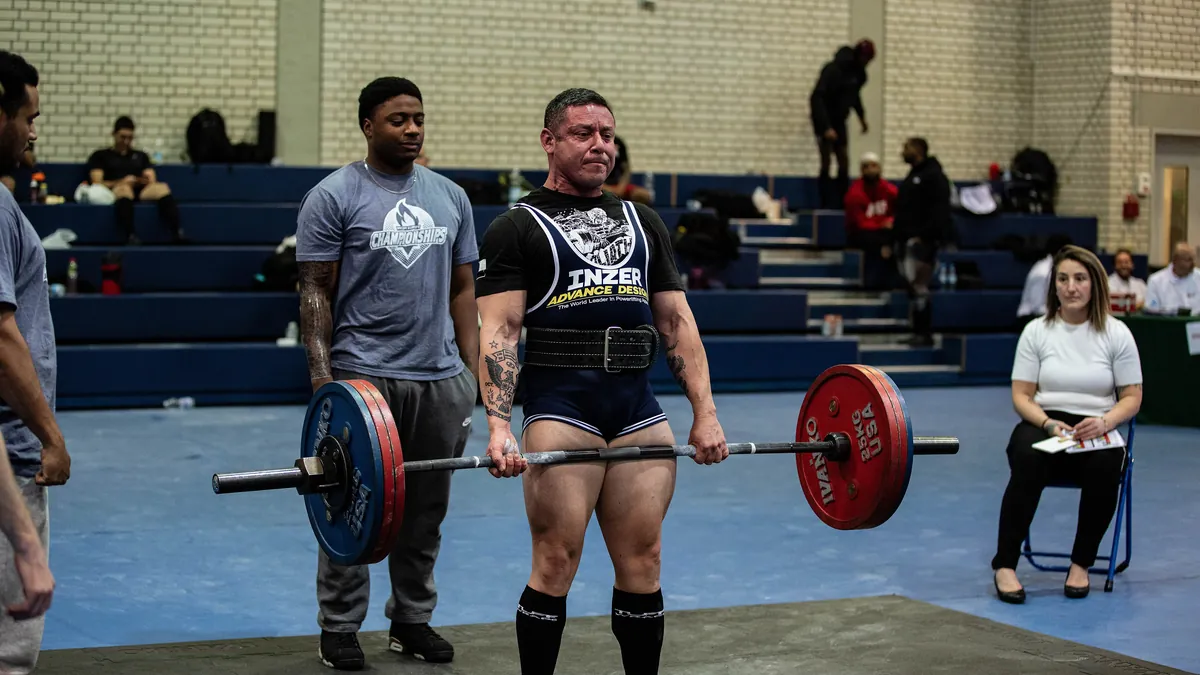
Lifting belt: when to use it and what it really does
Published on
With a belt, people got more squat reps and a max about 5 kg higher in two 2026 studies, but it does not prevent injuries or replace bracing. How it works, which exercises and loads it suits, how to put it on and the most common mistakes.
In 2026, Kirsten Legerlotz's team at Humboldt University of Berlin asked 49 men and women, with and without experience using a belt, to squat to failure with their 6-rep max weight without a belt. With a belt, the average rose from 6.5 to 8.1 reps, and each rep went up faster. It happened in men and women alike, whether or not they had used a belt before.
That same year, another study of 25 trained athletes, with Amador García-Ramos (University of Granada) among its authors, measured the squat max: 119.2 kg with a belt versus 114.0 kg without. The belt works. The question is how, when to use it and what it does not do, because that is where the misunderstandings start.
How a lifting belt works
The classic explanation is intra-abdominal pressure. In 1989, Harman and his team used a catheter to measure the pressure inside the abdomen of 9 people deadlifting at 90% of their max. With a belt, pressure rose sooner and reached higher peaks. That pressure turns the trunk into a stiffer cylinder that transfers the force of the legs to the bar more effectively.
What the belt does not do is the work for you. In the study by Lynch and colleagues (2025), 28 men squatted at 75% of their max in four ways: with nothing, bracing the abdomen, with a belt, and bracing with a belt. Bracing clearly increased abdominal muscle activity, with or without a belt. The belt alone, without bracing, did not change the activation of any muscle.
The key: the belt is a wall to push against. If you do not push, it does nothing. Learn to brace first; then the belt multiplies what you already know how to do.
| Study | What it measured | Result |
|---|---|---|
| Veltzke and Legerlotz (2026) | Squats to failure with and without a belt, 49 people | From 6.5 to 8.1 reps; more perceived stability, but not measured |
| Huang (2026) | Squat max, 25 athletes | 119.2 kg with a belt versus 114.0 kg without |
| Harman (1989) | Pressure inside the abdomen during deadlifts | More pressure, and sooner, with a belt |
| Lynch (2025) | Muscle activation during squats | Bracing activates the abs; the belt alone does not |
Does it give you more stability?
It feels like it does, but the measurements say otherwise. In the Berlin study, participants felt considerably more stable with the belt, yet the force plates did not record less sway; in the more experienced lifters, even slightly more. The performance improvement is real, but it does not come from being more stable.
Does it prevent back injuries?
There is no evidence that it does. The strongest data come from workplace back belts, which are not the same as a lifting belt but are used with the same idea. The study by Wassell and colleagues (2000), with 13,873 workers in 160 stores in the United States, found no fewer back injury claims and no less low back pain among those who wore a belt frequently. The 2008 Cochrane review on lumbar supports concluded, with moderate evidence, that they do not prevent low back pain better than doing nothing or than training people in how to lift.
That is why the belt makes sense as a performance tool, not as insurance. If your back hurts when you train, the useful information is in low back pain and the gym.
When to use a belt (and when not to)
| Situation | Belt? | Why |
|---|---|---|
| Heavy sets of squats and deadlifts | Yes, if it helps you | That is where the most pressure is needed and where studies see improvement |
| Heavy standing overhead press and barbell rows | Optional | They may benefit from a stiffer trunk |
| Warm-up and light sets | No | It is the time to practise bracing without help |
| Machine and isolation exercises | No | They do not load the spine in the same way |
| If you are still learning technique | Not yet | You need to know how to brace first |
How to put it on and brace with it
- Height: around the abdomen, between the lower ribs and the hips. Many prefer it slightly higher for squats and slightly lower for deadlifts.
- Tightness: firm, but loose enough to let you breathe into your abdomen. If you cannot breathe, it is too tight.
- The movement: breathe into your abdomen, push out against the belt in every direction and hold that pressure throughout the rep.
- Types: rigid leather belts of uniform width give more support; Velcro belts are more comfortable and quicker to put on. To start with, either will do.
Bracing hard, with or without a belt, resembles the Valsalva manoeuvre, which sends blood pressure soaring during the effort. If you have hypertension, get advice first and read exercise to lower blood pressure, where we explain how to lift without holding your breath. To practise bracing your trunk without load, the plank is a good starting point.
Common belt mistakes
- Wearing it for every set: you miss the chance to train your trunk with moderate loads, and the belt stops adding anything when you really need it.
- Putting it on instead of bracing: without pressure from the inside, the belt does not change trunk activation.
- Relying on it to load more than your technique allows: a few extra kilos do not make up for a bad position. Review your squat technique and your deadlift.
- Keeping it tight between sets: loosen it when you finish and tighten it again before the next one.
The Progrevia generator gives you a routine with progressive squats and deadlifts matched to your level. If you are starting out, the beginner strength routine helps you build technique first, which is what the belt then enhances.
- Veltzke F, Qiu F, Bey ME, Legerlotz K. A weight lifting belt increases squat performance and subjectively perceived but not objectively measured postural stability. Journal of Strength and Conditioning Research. 2026;40(8):944-952.
- Huang Y, García-Ramos A, Chen Z, et al. The effect of weightlifting belt on the relative load-velocity relationship and one-repetition maximum prediction accuracy in the free-weight back squat. Journal of Strength and Conditioning Research. 2026.
- Harman EA, Rosenstein RM, Frykman PN, Nigro GA. Effects of a belt on intra-abdominal pressure during weight lifting. Medicine & Science in Sports & Exercise. 1989;21(2):186-190.
- Lynch DJ, Drusch AS, Hooper TL, et al. Changes in muscle activation in response to abdominal bracing and stabilization belt use during a loaded squat. Journal of Sports Sciences. 2025;43(20):2434-2446.
- Wassell JT, Gardner LI, Landsittel DP, Johnston JJ, Johnston JM. A prospective study of back belts for prevention of back pain and injury. JAMA. 2000;284(21):2727-2732.
- van Duijvenbode IC, Jellema P, van Poppel MN, van Tulder MW. Lumbar supports for prevention and treatment of low back pain. Cochrane Database of Systematic Reviews. 2008;(2):CD001823.
Progrevia · · How we write our guides
Frequently asked questions
Does a lifting belt help you lift more?
Yes. In a 2026 study, average squat reps to failure rose from 6.5 to 8.1 with a belt, and in another the max went from 114.0 to 119.2 kg.
Does a belt protect your back?
There is no evidence that it prevents injuries. Studies of workplace back belts found no fewer injuries or less low back pain among those who wore them.
When should you wear a belt?
On heavy sets of squats and deadlifts, and optionally on heavy overhead presses or rows. It is not needed for warm-ups, light sets or machine exercises.
Should a beginner use a belt?
Not yet. Learn to brace first, because the belt only works if you push against it: without bracing, it does not change trunk activation.
How tight should a lifting belt be?
Firm, but loose enough to let you breathe into your abdomen and push against it. If you cannot breathe, it is too tight.
Informational content based on the available scientific evidence: it does not replace advice from a healthcare professional. If you have an injury or a medical condition, or are pregnant, check with one before changing your training or diet.
