
Linear vs. undulating periodization: what science says for real strength gains
Published on
You've been progressing with the same scheme for months and suddenly plateau. It's almost always a periodization problem, not effort or motivation.
Periodization is the systematic organisation of training over time to maximise adaptations and minimise stagnation. Far from being a concept exclusive to elite athletes, periodization is relevant to anyone who has been training seriously for more than 3-4 months.
The two most widely used periodization models in strength training are linear periodization and undulating periodization (also called DUP, Daily Undulating Periodization). Each has its strengths, its limitations and its optimal context of application.
Linear periodization: simple and effective for beginners
In classic linear periodization, load increases week by week while training volume progressively decreases. A typical example: week 1 (4x12 at 60%), week 2 (4x10 at 65%), week 3 (4x8 at 70%), week 4 (4x6 at 75%).
Its advantages: it is easy to programme, easy to follow and very effective in the early stages of strength training, when the nervous system and strength respond well to any consistent stimulus. Beginners and early intermediates get excellent results with this model.
Its limitation: as training level rises, the body needs more varied stimuli to keep adapting. Linear periodization has a relatively low ceiling for advanced athletes.
Undulating periodization (DUP): the alternative for intermediate and advanced levels
In undulating periodization, the training variables (reps, load, volume) vary more frequently, often in every session of the week. For example: Monday (5x5 at 80%), Wednesday (4x10 at 70%), Friday (3x15 at 60%). All the ranges within the same training week.
Its advantages: it stimulates muscle fibres with different rep ranges frequently, which can prevent stagnation and maintain motivation. Some meta-analyses suggest advantages for maximum strength development in intermediate and advanced lifters.
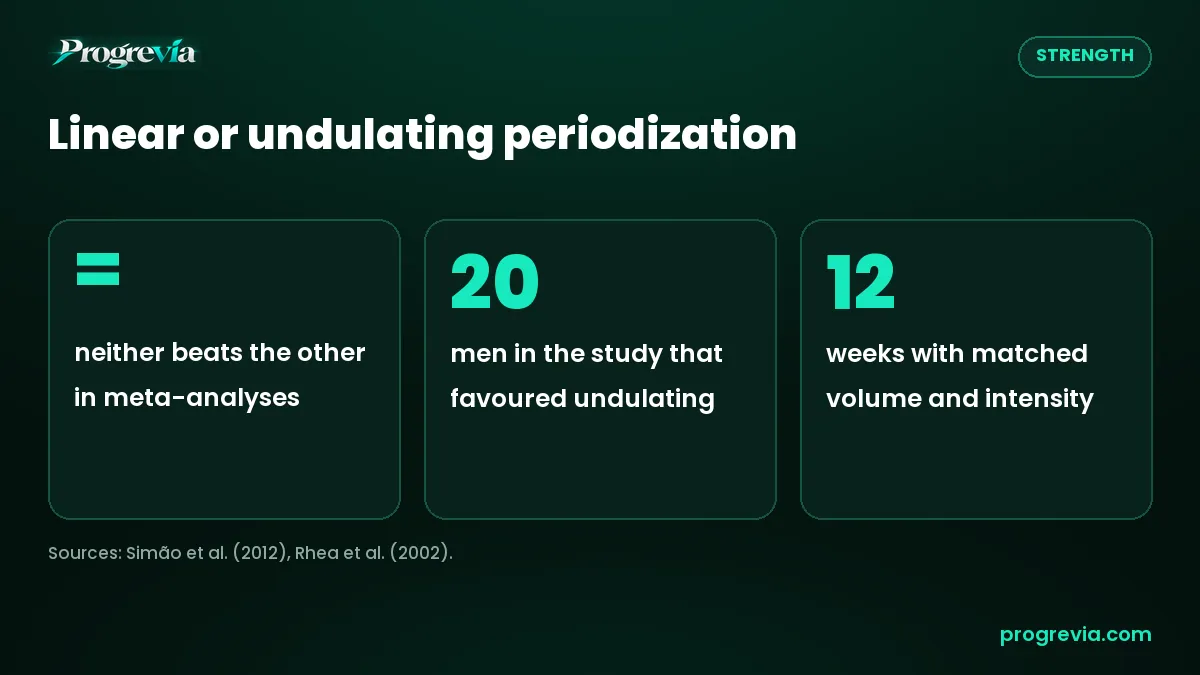
What the evidence says: a systematic review published in the Journal of Strength and Conditioning Research (Simão et al., 2012) and later meta-analyses find no statistically significant differences between the two models in terms of short-term strength gain. Adherence and systematic progression matter more than the model chosen.
Read the video text
Linear or undulating: which periodization builds more strength? Same: meta-analyses find no advantage for either (Simão et al., 2012). 20 men in the study that saw twice the gain with undulating (Rhea et al., 2002). 12 weeks in that trial, with volume and intensity matched (Rhea et al., 2002). What matters: having a plan and adding load. The video ends by showing how to create the routine in Progrevia.
Which should you use?
- Beginner (under 1 year of consistent training): linear periodization. Simple, effective and enough. You do not need more complexity.
- Intermediate (1-3 years of training): start exploring variations. Weekly (not daily) DUP can help break plateaus.
- Advanced (over 3 years, strength close to genetic potential): undulating periodization or more complex conjugate models can offer real advantages.
The common denominator of both models
Whichever periodization model you choose, the factor that most determines progress in strength training is consistency and progressive overload applied over months and years. The best periodization programme is the one you follow consistently and that lets you progress without overtraining.
Change model when you notice stagnation, not because you read that another one is "better". Context, your training history and your recovery capacity determine which model works for you.
Block periodization: the third model you should know
Beyond linear and undulating periodization, there is a third model that is especially effective for intermediate and advanced strength athletes: block periodization, developed by Vladimir Issurin.
Block periodization organises training into consecutive mesocycles with distinct, specific goals. Each block concentrates training on one main capacity:
- Accumulation block (3-4 weeks): high volume, moderate load (65-75% 1RM), emphasis on the strength and hypertrophy base
- Intensification block (2-3 weeks): moderate volume, high load (80-90% 1RM), maximum strength development
- Realisation or peaking block (1-2 weeks): low volume, maximal load (90-97% 1RM), preparation for competition or a strength test
The advantage of block periodization over the linear and undulating models is that it lets you concentrate the specific adaptations of each phase without constant stimulus variation diluting the results. For an intermediate-advanced lifter chasing maximum strength peaks, this model can be superior.
Conjugate periodization: the Westside method
The conjugate method, popularised by Louie Simmons at Westside Barbell, is the most sophisticated periodization system for advanced strength athletes. Instead of periodising over time (high-load weeks, lower-load weeks), the conjugate method works several strength capacities simultaneously on different days of the same week.
The classic Westside model includes: 2 max effort days (work with loads above 90% 1RM in variations of the main lift) and 2 dynamic effort days (explosive work with loads of 50-60% 1RM at maximum possible speed). Accessory work complements both sessions.
The conjugate method is effective but complex. It requires deep programming knowledge and is not appropriate for beginners or intermediates. For most recreational trainees, progressive linear periodization or DUP offer comparable results with far less complexity.
How to detect and overcome a strength training plateau
A plateau in strength training is inevitable if you follow the same stimulus for too long. Recognising it early and acting strategically is more efficient than waiting for the problem to become serious.
Signs of a plateau: you have gone 3-4 consecutive weeks with no increase in load or reps in the main lifts, performance holds but the sense of effort has dropped (training feels "easy" without the load having increased), or performance starts to fall slightly.
Strategies to break it:
- Change the periodization model: if you have spent months on linear, try DUP. If you have been on DUP for a while, try blocks.
- Full deload: sometimes a plateau is not a lack of stimulus but excess accumulated fatigue. A week of complete rest or greatly reduced training can restart progress.
- Change the main exercise: temporarily replacing the squat with the front squat, or the bench press with the incline press, changes the neuromuscular pattern and can restart adaptations.
- Adjust volume: if the plateau comes with fatigue, reduce training volume temporarily. If it comes without fatigue, increase volume or training density.
Daily undulating periodization (DUP): the most flexible model
Daily Undulating Periodization modifies the stimulus in each session of the week instead of doing so in blocks of weeks. Example for bench press with 3 weekly sessions: Monday (strength): 4×4-6, Wednesday (hypertrophy): 4×8-12, Friday (muscular endurance): 3×15-20. This daily variation of stimuli activates different physiological adaptations in the same week and is especially effective for intermediates and advanced lifters who have exhausted linear progression.
A meta-analysis by Rhea et al. (2002) comparing linear versus undulating periodization found that undulating produced 28% more improvement in maximum strength over the same period for trained athletes. For beginners the difference is smaller because linear progression is still possible.
Periodization blocks for advanced lifters
The block periodization model organises training into sequential phases: accumulation (high volume, moderate intensity), transmutation (moderate volume, high intensity), realisation (low volume, maximum intensity). Each block lasts 3-6 weeks. This model is the most widely used among performance and strength-production athletes. It is not necessary for beginners or intermediates, but it is the right tool when linear and undulating models stop producing consistent progress. The average natural athlete reaches this need between 3 and 5 years of systematic training.
How to choose your periodization model: a decision tree
Have you been training less than 12 months? → Simple linear periodization. Weekly weight progression is possible and sufficient; you do not need extra complexity. Have you trained 1-3 years and linear progression has stopped? → Undulating periodization (DUP). Vary the stimulus week to week or session to session. Do you have an event or competition on a specific date? → Block periodization with a peaking phase. Plan backwards from the event date. Do you train for general health with no specific performance goal? → Any model with periodic deloads. The key is consistency, not the specific model. Are you an advanced athlete who has exhausted the previous models? → Conjugate periodization or an advanced block model with a specialised coach. The right model is the one that produces consistent progress with the lowest risk of injury and overtraining. If you are progressing, do not change it.
Periodization for general fitness: simplifying the theory
Periodization theory can seem complex, but its application to general fitness is simple: the fundamental principle is that the body cannot be in a state of maximum effort permanently. It needs cycles of high demand followed by cycles of recovery. For someone training for health and aesthetics (not competition), the simplest implementation is: 3 weeks of progressive training → 1 deload week (volume reduced to 40%). Repeat for 6-12 months. Assess whether you are progressing. If you are, continue. If you stall, introduce variation in exercises or rep ranges. This is essentially what the more complex periodization models do, but without the technical terminology. Most people will never need more complexity than this to reach their fitness goals.
Periodization to prepare for a specific competition
If you have a specific event (a race, a powerlifting meet, a sporting event), periodization should be organised backwards from that date: deload plus peaking (the last 1-2 weeks before the event), high-intensity block (3-6 weeks before), volume and accumulation block (8-16 weeks before the event). This structure is designed to help you arrive at the event in your best shape, with minimal accumulated fatigue and a peak of strength or conditioning. This model is what every competitive athlete uses, whatever the sport.
The most common periodization mistake: changing without evaluating
The most frequent periodization mistake is changing the model before giving it enough time to work. Linear periodization takes 3-6 months to reveal its true limitations. Undulating needs at least 3-4 complete mesocycles (12-16 weeks) to be evaluated properly. Changing model every 4-6 weeks because it "does not work fast enough" is confusing impatience with system ineffectiveness. Give each model enough time, record the results objectively (strength in the main lifts, measurements, photographs), and only change when you have real evidence that the current model has stopped producing progress. Most "plateaus" are actually impatience with a process that is working correctly but more slowly than expected.
Periodization works. Studies confirm it. Elite athletes use it. The question is not whether it works, but whether you have the patience and discipline to apply it correctly for long enough to see the full results. That patience is the hardest skill to develop in training.
The good news: like any skill, patience with the training process improves with practice. Every completed mesocycle strengthens it. Every result observed objectively consolidates it. Over time, patience stops being effort and becomes perspective. And that perspective is what separates the long-term athlete from the one always looking for the next quick fix.
The study that launched the DUP trend, and what happened next
There is one specific paper behind the popularity of undulating periodization, and it deserves telling in full: not just what it found, but what happened when others tried to confirm it.
In 2002, Rhea, Ball, Phillips and Burkett published a head-to-head comparison of linear periodization (LP) and daily undulating periodization (DUP) with volume and intensity equated, in the Journal of Strength and Conditioning Research. Twenty men, twelve weeks, three days a week. The linear group did sets of 8RM in weeks 1-4, 6RM in weeks 4-8 and 4RM in weeks 9-12. The undulating group alternated within the same week: Monday 8RM, Wednesday 6RM, Friday 4RM.
| Exercise | Linear periodization | Daily undulating periodization |
|---|---|---|
| Bench press | +14.4% | +28.8% |
| Leg press | +25.7% | +55.8% |
Seen like that, the numbers are spectacular: double the improvement for the same total load. That produced a decade of undulating programmes and articles declaring DUP superior.
And here is the part almost nobody tells. Once more studies accumulated and were pooled into meta-analyses, the difference between linear and undulating vanished: later reviews find no advantage of one over the other for upper- or lower-body strength. A striking result in twenty participants does not always survive the wider literature.
The useful read is not "DUP does not work", but something more usable: the periodization model matters less than it seemed, provided there is one. What the data do support is varying the stimulus in an organised way and progressing in load. If you prefer undulating within the week because it bores you less, go ahead; if you prefer long blocks because logging is easier, that works too. Adherence decides more than the model.
To put it into practice, the Progrevia routine generator builds a free strength plan with sets, reps and progression adapted to your level and equipment.
- Rhea MR, Ball SD, Phillips WT, Burkett LN. A comparison of linear and daily undulating periodized programs with equated volume and intensity for strength. Journal of Strength and Conditioning Research. 2002;16(2):250-255.
- Simão R, Spineti J, de Salles BF, Matta T, Fernandes L, Fleck SJ, et al. Comparison between nonlinear and linear periodized resistance training: hypertrophic and strength effects. Journal of Strength and Conditioning Research. 2012;26(5):1389-1395.
- Grgic J, Mikulic P, Podnar H, Pedisic Z. Effects of linear and daily undulating periodized resistance training programs on measures of muscle hypertrophy: a systematic review and meta-analysis. PeerJ. 2017;5:e3695.
Progrevia · · How we write our guides
Frequently asked questions
What is the simplest periodization method for a beginner?
Linear periodization is the most straightforward for beginners: increase load each week while slightly reducing reps. For example, week 1 (4×12 at 60%), week 2 (4×10 at 65%), week 3 (4×8 at 70%), week 4 (4×6 at 75%). It is simple to follow, easy to understand, and produces excellent strength gains in the first 1–2 years of training.
When should I switch from linear to undulating periodization?
When linear progression stalls — meaning you can no longer add weight or reps to the bar week over week — it is time to introduce more variation. This typically happens after 1–2 years of consistent training. DUP (Daily Undulating Periodization) provides more variety in rep ranges across the week, which can break through stagnation and maintain motivation for intermediate-level athletes.
Does research show one periodization model is definitively better?
No. Multiple systematic reviews and meta-analyses, including Simão et al. (2012), find no statistically significant differences between linear and undulating models in short-term strength gains when total volume is equated. The best model is the one you follow consistently with adequate progression. Adherence matters more than the model.
Can I combine linear and undulating periodization?
Yes, and this is common in intermediate-advanced programming. A typical approach: use linear progressions within each training week (set to set), but undulate the rep ranges across different days (Monday heavy 5×5, Wednesday moderate 4×10, Friday light 3×15). This "daily undulating" variation preserves the simplicity of weekly progression while providing multi-rep-range stimulus.
What happens if I don't periodize my training at all?
Without systematic progression in load, volume, or intensity over time, your body has no reason to continue adapting beyond its initial response. Most non-periodized programmes lead to stagnation within 4–8 weeks of the initial adaptation phase. You may maintain your current level, but you will not continue building strength or muscle. Progressive overload — the core of any periodization — is what drives long-term progress.
Informational content based on the available scientific evidence: it does not replace advice from a healthcare professional. If you have an injury or a medical condition, or are pregnant, check with one before changing your training or diet.
