
Resistance bands: do they build strength and muscle? Routine and how to progress
Published on
A meta-analysis of 8 studies found no difference in strength between training with bands and with machines or dumbbells. Which exercises suit them, a 3-day routine and how to add load without kilos.
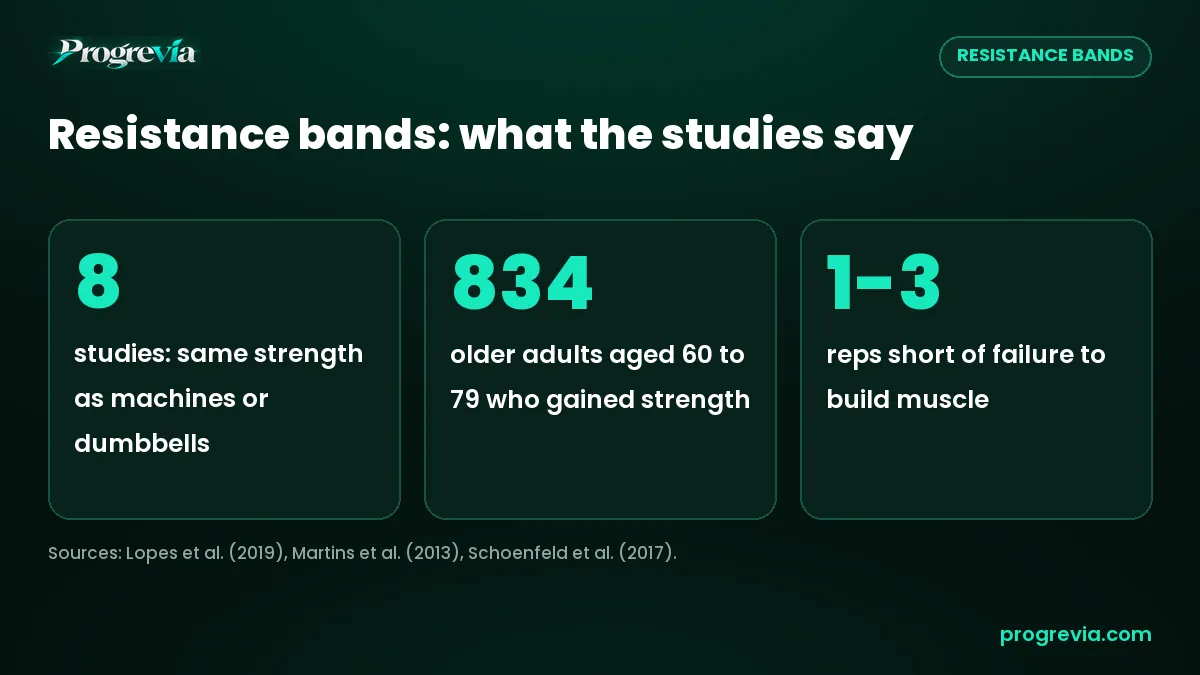
In 2019, Jaqueline Lopes and colleagues from several Brazilian universities pooled the trials that had compared two ways of strength training: with elastic bands or tubes and with machines or dumbbells. There were 8 studies with very different profiles, from sedentary people to athletes. The result was a draw: neither method gained more strength, in the legs or in the arms.
Resistance bands are cheap, fit in a backpack and work at home, in a hotel or in the park. Here is what research says about what they can and cannot do, a complete routine and how to progress with them.
Do resistance bands build strength?
Yes, with results comparable to the gym. Besides Lopes's meta-analysis, specific trials show it:
- Bands versus machines. Juan Carlos Colado (University of Valencia) and Triplett split 45 sedentary middle-aged women into three groups: bands, machines or no training. The two training groups followed the same programme, 2 times a week for 10 weeks with 6 exercises, and improved equally in the push-up and squat tests, with less fat and more fat-free mass.
- Band push-ups versus bench press. In 2015, Joaquín Calatayud, from the same Valencia group, compared 30 university students with gym experience for 5 weeks. Some did the bench press and others did push-ups with an elastic band across the back, both with a 6-rep-max load and similar muscle activation. Both groups raised their 1RM and 6RM by the same amount.
The key to Calatayud's trial is that the band was chosen so that effort was equally high. A loose band does not give the same result as a heavy barbell: what makes the methods equal is enough load.
Can you build muscle with resistance bands?
Fewer band trials measure muscle size, but the general evidence points the same way. The 2017 meta-analysis by Brad Schoenfeld (Lehman College, New York) and his team compared, across 21 studies, light and heavy loads taken to failure: hypertrophy was similar, although maximal strength rose more with heavy loads. What counts for growth is getting close to failure, and a band can get you there.
In practice, a band set builds muscle if you finish 1-3 reps short of being unable to continue. If you do 30 reps and still feel fresh, the band is too light. We explain it in training to failure and in the rep range for hypertrophy.
Read the video text
Is a band worth as much as a dumbbell? 8 studies: the same strength with bands as with machines or dumbbells (Lopes et al., 2019, meta-analysis). 834 people aged 60 to 79 gained strength training with bands (Martins et al., 2013, 11 trials). 1-3 reps short of failure: that way a band also builds muscle (Schoenfeld et al., 2017, 21 studies). Their weak point: measuring the load. Have 3 or 4 bands and note which one you use. The video ends by showing how to create the routine in Progrevia.
Resistance bands for older adults
Bands are one of the most studied tools in older adults. In 2013, Wagner Rodrigues Martins (University of Brasília) and his team analysed 11 trials with 834 people aged 60 to 79. Band training greatly improved strength in healthy older adults (effect size of 1.30) and in those with some functional limitation (1.01), and moderately in those with a disease (0.54). For a complete plan, see the routine for people over 40.
How band resistance works
A dumbbell weighs the same throughout the movement. A band does not: the more it stretches, the more it resists. The exercise is easier at the start of the movement and harder at the end. That has two practical consequences:
- It suits exercises where you are strongest at the end of the range, such as the squat, presses or the glute bridge.
- It suits less those that load the muscle when stretched, such as a curl or a fly, because the band barely pulls there. You can make up for it by starting with the band already slightly stretched, standing further from the anchor.
Colours indicate resistance, but each brand uses its own scale, so they cannot be compared across brands. What helps is having 3 or 4 bands of increasing resistance and noting which one you use for each exercise.
| Muscle group | Suits bands well | Suits them less (or needs adjusting) |
|---|---|---|
| Chest | Push-ups with a band across the back, standing anchored press | Flyes: the band pulls little with the arm open |
| Back | Seated row with the band around the feet, face pull, band pull-apart | Pulldown with a low anchor if the door is not solid |
| Legs | Squat with the band under the feet, banded glute bridge | Full leg work for strong people: very hard bands are needed |
| Shoulders | Shoulder press, lateral raises standing on the band | Overhead exercises with an unsafe anchor |
| Arms | Triceps extension with a high anchor | Biceps curl: almost no tension at the start of the movement |
3-day resistance band routine
This full-body session is repeated 3 days a week with a rest day between sessions. Choose a band that lets you finish each set 1-3 reps short of failure within the given range.
| Exercise | Sets × reps | Rest |
|---|---|---|
| Squat with the band under the feet | 3 × 12-20 | 90 s |
| Push-ups with a band across the back | 3 × 8-15 | 90 s |
| Seated band row | 3 × 12-20 | 90 s |
| Banded glute bridge | 3 × 12-20 | 60 s |
| Shoulder press standing on the band | 2 × 12-20 | 60 s |
| Band pull-apart | 2 × 15-25 | 60 s |
| Triceps extension with a high anchor | 2 × 12-20 | 60 s |
That is 18 sets per session, about 30-35 minutes. For trips with even less equipment, there is the travel or hotel routine, and if you also have dumbbells at home, the dumbbell routine.
How to progress with resistance bands
Without a number in kilos, progressing takes a bit more order. From easiest to hardest:
- More reps with the same band, up to the top of the range.
- More starting tension: step further from the anchor or shorten the band.
- A harder band, or two bands together.
- More time under tension: lower over 3 seconds and pause for 1 second at the top.
Note the band, the distance and the reps for each exercise: without a log you do not know whether you are progressing. The principle is the same as with weights, and you will find it in progressive overload.
Safety: check the band before each session and replace it if it has cracks or white patches. Use a door anchor on the hinge side and never pull with the band pointing at your face: if it slips or snaps, it comes back with a lot of force.
In the Progrevia generator you can choose travel equipment, with bodyweight and resistance bands, and the plan is built only with the exercises you can do with that equipment.
- Lopes JSS, Machado AF, Micheletti JK, de Almeida AC, Cavina AP, Pastre CM. Effects of training with elastic resistance versus conventional resistance on muscular strength: a systematic review and meta-analysis. SAGE Open Medicine. 2019;7:2050312119831116.
- Colado JC, Triplett NT. Effects of a short-term resistance program using elastic bands versus weight machines for sedentary middle-aged women. Journal of Strength and Conditioning Research. 2008;22(5):1441-1448.
- Calatayud J, Borreani S, Colado JC, Martin F, Tella V, Andersen LL. Bench press and push-up at comparable levels of muscle activity results in similar strength gains. Journal of Strength and Conditioning Research. 2015;29(1):246-253.
- Martins WR, de Oliveira RJ, Carvalho RS, de Oliveira Damasceno V, da Silva VZ, Silva MS. Elastic resistance training to increase muscle strength in elderly: a systematic review with meta-analysis. Archives of Gerontology and Geriatrics. 2013;57(1):8-15.
- Schoenfeld BJ, Grgic J, Ogborn D, Krieger JW. Strength and hypertrophy adaptations between low- vs. high-load resistance training: a systematic review and meta-analysis. Journal of Strength and Conditioning Research. 2017;31(12):3508-3523.
Progrevia · · How we write our guides
Frequently asked questions
Do resistance bands work as well as weights?
For strength, yes: Lopes's meta-analysis (2019), with 8 studies, found no difference between bands and machines or dumbbells. You need a band hard enough that every set is genuinely demanding.
Can you build muscle with bands alone?
Yes, if each set ends 1-3 reps short of failure. Light loads taken close to failure give hypertrophy similar to heavy ones. If you do 30 reps without tiring, you need a harder band.
Which resistance bands should you buy to start?
A set of 3 or 4 bands of increasing resistance and a door anchor. Colours are not the same across brands, so check the manufacturer's scale and note which one you use for each exercise.
How do you progress with resistance bands?
First with more reps; then by stepping away from the anchor or shortening the band; then with a harder band or two together, and finally by lowering more slowly.
Are resistance bands good for older adults?
Yes. A meta-analysis of 11 trials with 834 people aged 60 to 79 found large strength gains in healthy older adults and in those with some functional limitation.
Informational content based on the available scientific evidence: it does not replace advice from a healthcare professional. If you have an injury or a medical condition, or are pregnant, check with one before changing your training or diet.
