Home workout without equipment: how to train effectively with your own bodyweight
Published on
No gym, no dumbbells, no excuses. Bodyweight training, done right, can stimulate real hypertrophy and strength. Here is how to build a home workout program that actually works.
Is it possible to build muscle without weights?
Yes, with conditions. Muscle hypertrophy happens when the muscle is exposed to a sufficiently high level of mechanical tension. That tension can come from a loaded barbell, from dumbbells or from body weight - as long as the exercise is challenging enough.
The problem with basic bodyweight training is not its nature, but that most people do not progress the difficulty. 20 easy push-ups for months do not build muscle. Progressive overload also exists in training without equipment.
Progression principles without equipment
Instead of adding kilos, you progress through: 1) Harder variants of the same movement (standard push-up → decline → archer → one-arm push-up). 2) Manipulating time under tension: a slow 3-4 second eccentric. 3) Full range of motion: increasing ROM where possible. 4) Reducing rest: more work density in the same time.
- Push: Push-ups (progression according to level), chair dips, wall shoulder press
- Pull: Row under a table, pull-ups on a bar (if available), towel pulldown in a doorway
- Legs: Bulgarian split squat, lunges, pistol squat progression, glute bridge, isometric squat
- Core: Plank, side plank, hollow hold, mountain climbers
12-week progression: from zero to intermediate without leaving home
Weeks 1-4 (initiation): 3 sessions a week, 30-40 min. Focus on mastering the technique of push-ups, Bulgarian split squats and glute bridges. Use easy variants (knee push-ups, counterweighted squats, two-leg bridges).
Weeks 5-8 (progression): Introduce harder variants: feet-elevated push-ups, sumo squats, single-leg bridges. Increase the volume (4 sets instead of 3).
Weeks 9-12 (consolidation): Start progressing towards archer push-ups, Bulgarian split squats with a backpack, pull-ups if you have a bar. Introduce antagonist supersets to increase training density.
By the end of the 12 weeks you should be able to complete 20 perfect push-ups, 15 Bulgarian split squats per leg and 10 single-leg glute bridges. That is a real intermediate level.
The highest-yield exercises without equipment
Push-ups in their variations: they activate chest, triceps, anterior deltoid and core. Progressing towards one-arm push-ups is a serious strength goal that takes months of work. Pull-ups: if you have a doorway bar (under 20€), they are the best back exercise without equipment. They activate the lats, biceps and core more than any machine. Bulgarian split squat (rear foot elevated): with body weight and the foot on a chair, it provides enough load to stimulate quads and glutes even in intermediates.
The science of bodyweight training
The stimulus for hypertrophy is not the iron itself: it is the mechanical tension on the muscle fibres, the induced muscle damage and the metabolic stress. These three mechanisms can be generated with any form of resistance, including body weight. A 2021 meta-analysis published in the British Journal of Sports Medicine confirmed that well-structured calisthenics programmes produce strength and hypertrophy gains comparable to weight programmes, especially in beginners and intermediates.
The limitation of body weight is not a lack of stimulus: it is a lack of progression if the variables are not manipulated correctly. The key is applying progressive overload by changing the angle, the leverage, the speed or the mechanical difficulty of the movement, instead of adding external weight.
The 6 fundamental movement patterns in calisthenics
A complete programme without equipment should cover the same movement patterns as a gym programme:
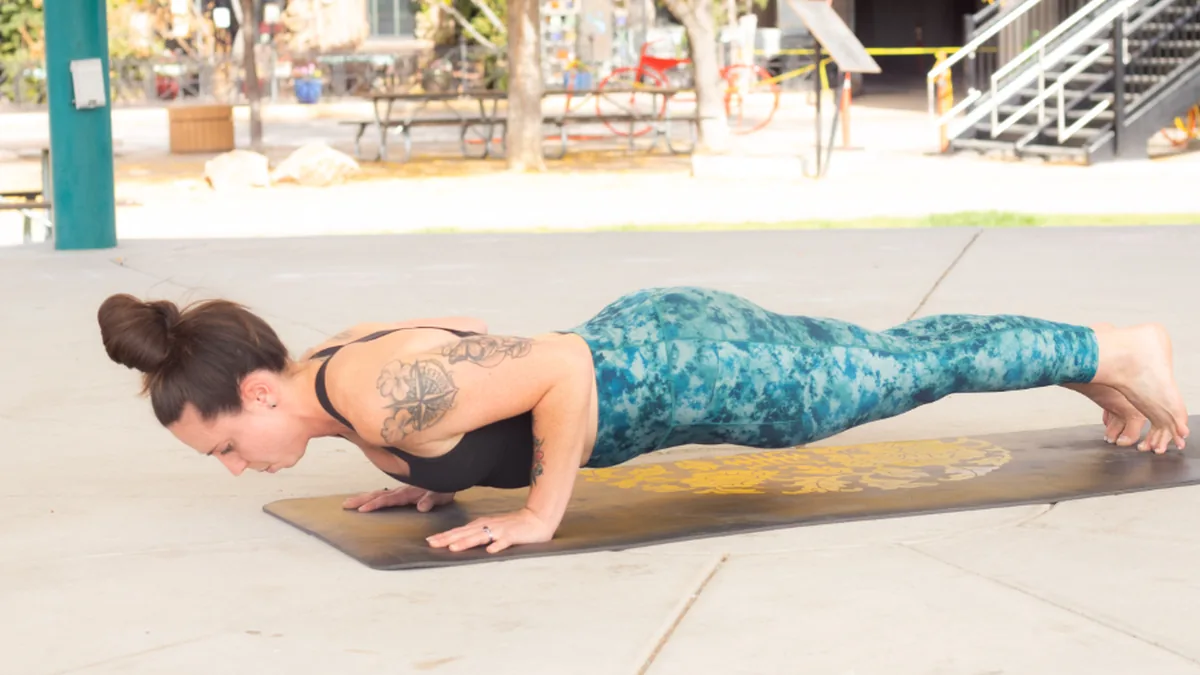
1. Horizontal push: Push-ups in all their variants. The progression runs from knee push-ups to diamond push-ups, archer push-ups, pike push-ups and, at advanced levels, one-arm push-ups. Feet-elevated push-ups redirect more load towards the anterior deltoid and upper chest.
2. Vertical push: Pike push-up (the body forms a 90° angle, the load falls mainly on the deltoid), progressing towards the handstand push-up against a wall. This exercise is the equivalent of the overhead press and the hardest of vertical-push calisthenics.
3. Horizontal pull: The inverted row under a table (Australian pull-up or bodyweight row) is the best substitute for the barbell row. You only need a stable table or a low bar. Progression: row with legs extended → row with feet elevated → row with a head transition.
4. Vertical pull: The pull-up/chin-up is the king of back exercises without equipment. You only need a bar, a door frame or even a tree branch. Progression: negative pull-up → band-assisted pull-up → full pull-up → weighted pull-up.
5. Squat and leg push: Bodyweight squat → sumo squat → Bulgarian split squat (one leg elevated) → pistol squat (single leg). The pistol squat is equivalent in difficulty to a squat with 1.5× body weight.
6. Hip hinge and glutes: Two-leg glute bridge → single-leg bridge → hip thrust with shoulders elevated. Without a barbell, you can use a backpack loaded with books or water bottles to add resistance.
Complete 3-day programme (no equipment)
Day 1 - Upper body push + core:
Push-ups: 4×8-15 (progression according to level)
Pike push-up: 3×8-12
Chair dips: 3×10-15
Front plank: 3×30-60 sec
Side plank: 3×20-40 sec per side
Mountain climbers: 3×20 per leg
Day 2 - Lower body + glutes:
Bulgarian split squat: 4×10-12 per leg
Single-leg glute bridge: 4×12-15 per side
Static lunge: 3×12 per leg
Sumo squat: 3×15-20
Calf raises: 4×20-25
Leg scissors (core): 3×15 per side
Day 3 - Upper body pull + full body:
Pull-ups or inverted rows: 4×6-12
Archer push-ups: 3×6-10 per side
Floor superman: 3×12-15
Assisted pistol squat: 3×8 per leg
Burpees: 3×8-10
Hollow body hold: 3×20-30 sec
How to progress without adding external weight
Calisthenics progression uses four mechanisms:
Mechanical progressions: changing the leverage angle to make the movement harder. E.g. standard push-ups → feet-elevated push-ups → pike push-up → handstand push-up.
Unilateral work: going from two legs/arms to one roughly multiplies the load on the muscle by 1.5-2. Bilateral squat → Bulgarian split squat → pistol squat.
Tempo and time under tension: a slow rep (4 seconds lowering) recruits more motor units and increases time under tension without changing the load. Very useful when you have mastered one variant and cannot yet do the next.
Extra homemade resistance: a backpack loaded with books, water containers in each hand (1.5L = 1.5 kg), elastic bands (available in any sports shop for 10-15 €) let you add real resistance to almost any movement.
Recommended minimum equipment (optional but effective)
If you want to invest a small amount to multiply your home training options:
- Doorframe pull-up bar (15-25 €): the best return on investment in fitness. It opens up pull-ups, chin-ups, inverted rows and shoulder hangs.
- A pair of elastic bands (5-15 €): lets you add resistance to squats, hip thrusts, rows and presses. Also useful for assisting your first pull-ups.
- A pair of adjustable dumbbells (40-80 €): if the budget allows, 5-20 kg dumbbells give access to most gym exercises.
Nutrition for home training: simplifying the essentials
Home training rarely fails because of the training itself. It fails because of nutrition. The same principles apply as in the gym: enough protein (1.6-2.2 g/kg), calories matched to the goal (a moderate surplus to gain mass, a moderate deficit to lose fat) and distribution across 3-5 meals.
One advantage of training at home: you are in your kitchen. You can prepare a protein shake with fruit and oats in 5 minutes before starting. You have no excuse for skipping post-workout nutrition.
Advanced routine for intermediates (6+ months of training)
Once the pistol squat, pull-ups and archer push-ups are under control, the programme can evolve towards more specific goals:
To develop the chest: feet-elevated push-ups on a bench or chair (loads the upper chest, similar to the incline press), dips between chairs with full range of motion (activates the lower chest), close-hand push-ups (isolates the sternal head).
To develop the back without a pull-up bar: floor supermans (back extensors), towel row wedged in a door (horizontal pull), inverted row under a table with a backpack on the chest (activates lats and rhomboids).
For glutes and hamstrings: hip thrust with shoulders on the sofa and a backpack on the hips, Romanian deadlift with a loaded backpack (mimics the gym RDL perfectly), lunges with the backpack held in front.
Measuring progress without machines
Without the number on the bar, use these progression indicators:
- Number of perfect reps per set
- Time until the first failed rep
- The variant level you control (e.g. from standard push-up to archer push-up)
- A monthly photo in the same clothes, same angle, same time of day
- Measuring circumferences: waist, hips, thigh, arm with a tape measure
The scale alone is a poor indicator of progress when you do strength training. Weight can stall or even rise while body composition improves significantly.
Home training as a first stage, not a fallback
For many people, home training is the first stage before moving to a gym, or a permanent alternative because of time, budget or preference. Both are valid options. If home training keeps you consistently active for 6-12 months, it will have achieved more than any gym membership used irregularly. The principle is universal: the best training is the one you actually do.
The 5 best bodyweight exercises ranked by effectiveness
If you had to pick only 5 exercises for a complete programme without equipment, these maximise the muscle worked per unit of time: 1) Bulgarian split squat: the best leg exercise without a barbell, unilateral loading that removes compensation from the dominant side. 2) Pull-up or chin-up: the best back exercise without equipment, activating more back musculature than any barbell-free rowing exercise. 3) Archer push-up or pike push-up: for chest and shoulder development without a bench or barbell. 4) Hip thrust with shoulders elevated: for the gluteus maximus, with no barbell needed if you use a backpack as resistance. 5) Plank with rotation or hollow body: for the functional core that supports every other movement. With these five exercises and their progressions, you can build a complete body without needing a gym.
Calisthenics is not the plan B of training; it is a complete discipline with centuries of history. Many of the best physiques in the world were built without a single kilo of iron. What you need is a plan, consistency and the will to progress the variants. The rest comes with time.
Next step: choose a difficulty level for each of the 5 key exercises, set a rep target for this week, and beat it the following week. That is all you need to start building real results from home.
Well-programmed home training is not inferior; it is different. The difference lies in progression limits at very advanced levels, not in the results for beginners and intermediates. For the first 2-3 years of training, home can be exactly as effective as the best gym in the world.
The difference between people who get results training at home and those who do not is not the equipment available: it is the structure of the programme, systematic progression and weekly consistency. With those three elements, home becomes the best possible gym.
Follow the 3-day programme for a full 12 weeks. Record every session, progress in every exercise, and eat enough protein. If you apply these three pillars with discipline, you will have on your side what matters most for results.
Training without equipment is not a compromise or an emergency plan: it is a complete system. Thousands of athletes worldwide maintain impressive physiques without regular access to a gym. The difference lies in knowledge and application, not in access to equipment.
Low loads and growth: what blood-flow restriction research demonstrated
The usual objection to training at home is that without heavy loads you cannot grow. One line of research attacks that premise directly, and its results are more useful than they look even if you never use the technique it studies.
Lixandrão, Ugrinowitsch, Berton and colleagues published a meta-analysis in Sports Medicine in 2018 comparing high-load training against low loads with blood-flow restriction, pooling twelve studies and 460 participants. Their finding: hypertrophy was similar between the two methods; maximal strength, by contrast, increased significantly more with high loads.
What this demonstrates — and what matters for training without equipment — is that heavy load is not a requirement for hypertrophy. Muscle grows when fibres are recruited and work close to fatigue; weight is one way of getting there, not the only one.
| Goal | Achievable without heavy loads? | How it is done at home |
|---|---|---|
| Hypertrophy | Yes | Sets close to failure, more reps, more time under tension |
| Maximal strength | Only partly | Harder variations: single-leg, elevated, isometric holds |
| Long-term progression | Yes, with conditions | Change variation when the exercise stops being hard |
The second row is the honest limitation: if your goal is a 140-kilo squat, you will not get there at home without equipment. That requires heavy loads, and no amount of repetitions fully substitutes for it.
But if your goal is to build muscle and stay strong for life, the evidence says equipment is not the barrier it is assumed to be. The real barrier of home training is usually a different one: staying on the same variation for months because there is no 2.5-kilo plate to add. Progression, at home, happens by changing exercise, not weight.
- Lixandrão ME, Ugrinowitsch C, Berton R, Vechin FC, Conceição MS, Damas F, Libardi CA, Roschel H. Magnitude of muscle strength and mass adaptations between high-load resistance training versus low-load resistance training associated with blood-flow restriction: a systematic review and meta-analysis. Sports Medicine. 2018;48(2):361-378.
Frequently asked questions
Can bodyweight training really build significant muscle?
Yes, provided you apply progressive overload — progressively harder exercises, more reps, slower tempo, or reduced rest. Elite calisthenics athletes demonstrate that impressive physiques are achievable without any external load.
How much space do I need for a home workout?
A yoga-mat-sized area (roughly 2 m x 1 m) is sufficient for the vast majority of bodyweight exercises. A slightly larger area helps if you include lateral movements or skipping.
What if I cannot do a full push-up yet?
Start with incline push-ups (hands on a table or wall). As you get stronger, lower the surface progressively until you reach the floor. This regression ladder keeps you training at the right difficulty level.