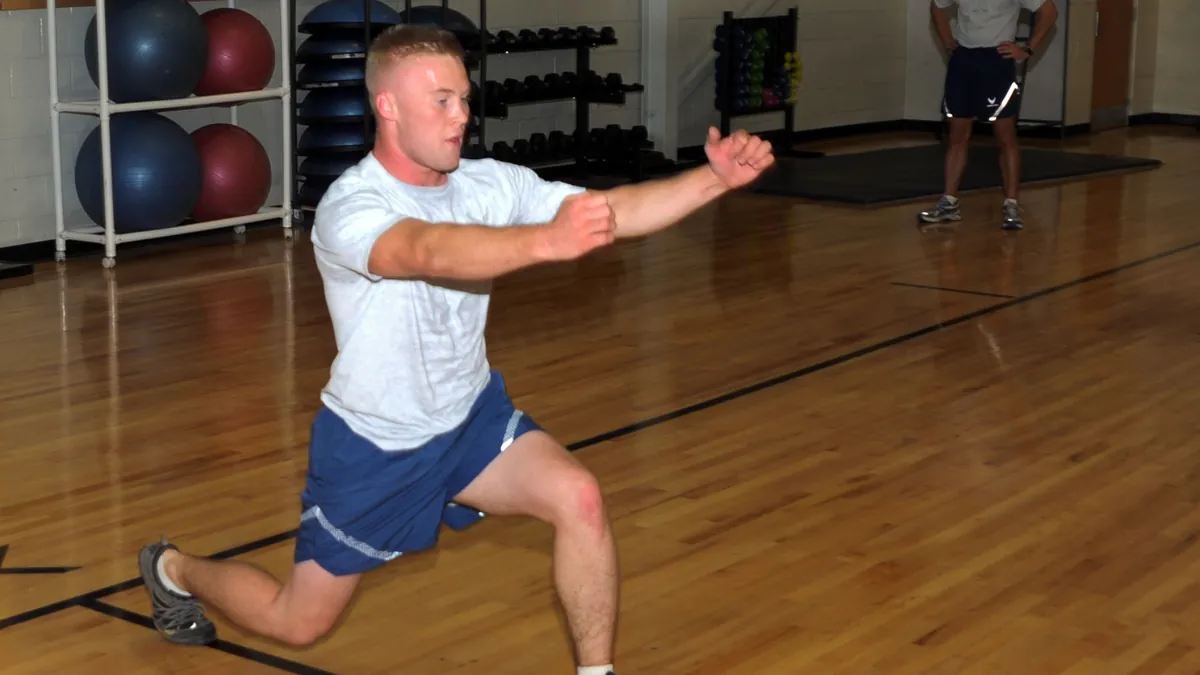
Lunges: correct technique, types of lunge and the most common mistakes
Published on
Leaning your torso slightly makes the glutes and hamstrings work more. How to do the lunge, its variations (forward, reverse, walking, lateral) and what studies say.
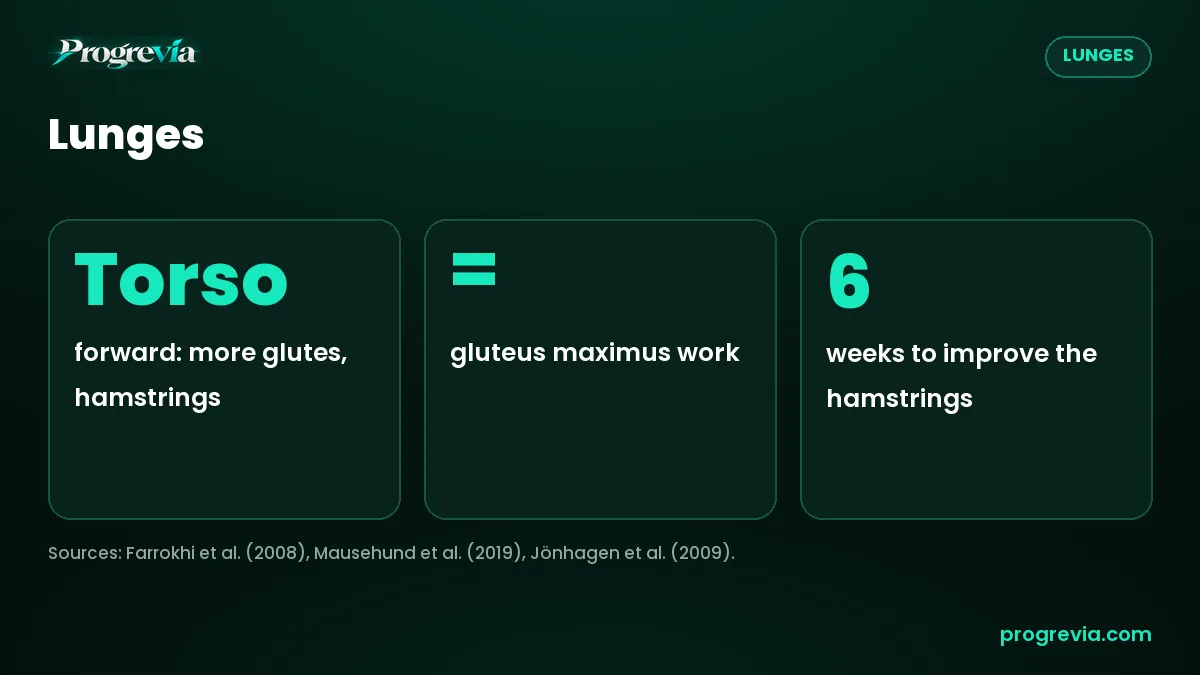
In 2008, Shawn Farrokhi and his team at the University of Southern California filmed 10 adults doing lunges three ways: with the torso upright, leaning forward and leaning back. With the torso leaning forward, hip flexion, hip extensor work and gluteus maximus and biceps femoris activity all increased. Leaning back barely changed anything.
A detail as small as torso position changes which muscle does the work. Here is the lunge technique, its variations and the mistakes that come up most often.
How to do the lunge step by step
- The start. Standing, feet hip-width apart, with dumbbells at your sides or the bar across your back.
- The step. Take a long step forward. As you lower, both knees should be bent to around 90 degrees.
- The descent. Lower straight down until your back knee almost brushes the floor. Weight mostly on the front foot, heel down.
- The knee. The front knee follows the direction of your toes, without caving inward.
- The return. Push through the front foot to return to the start and switch legs, or do all the reps on the same leg.
The front knee passing slightly beyond the toes is not a mistake in itself: it depends on your leg length and your step. What to avoid is the heel lifting or the knee caving inward.
Types of lunge and what changes in each
| Variation | How it is done | What it is for |
|---|---|---|
| Forward lunge | Step forward and back to the start | Braking the body: lots of eccentric quadriceps work |
| Reverse lunge | Step backward and return | Easier to control; usually more comfortable for the knees |
| Walking lunge | One step after another, moving forward | Lots of volume in little time; needs space |
| Lateral lunge | Step to the side, the other leg straight | Adductors and movement in another plane |
| Bulgarian split squat | Back foot resting on a bench | More load on the front leg and more hamstrings |
The Bulgarian split squat has its own guide: the Bulgarian split squat step by step.
Read the video text
How do you work your glutes more with lunges? Torso slightly forward: more glutes and hamstrings (Farrokhi et al., 2008). Same: gluteus maximus work in the lunge, Bulgarian and single-leg squat (Mausehund et al., 2019). 6 weeks of lunges improved the hamstrings in footballers (Jönhagen et al., 2009). Long step, knee in line. The video ends by showing how to create the routine in Progrevia.
Which lunge works the glutes most?
It depends on the variation less than people think. In 2019, Lasse Mausehund (Oslo and Akershus University College) compared three single-leg barbell exercises in 11 experienced people: the static split squat, the single-leg squat and the Bulgarian split squat, each with its 6-8 rep-max load and to failure. The gluteus maximus and quadriceps worked similarly in all three. The differences were in other muscles:
- The gluteus medius worked more in the single-leg squat (81.9%) than in the Bulgarian (54.9%) and in the static split squat (46.2%).
- The hamstrings worked more in the Bulgarian (76.1%) than in the static split squat (62.3%).
For the glutes, what matters most is getting close to failure with a suitable load and, if you want to prioritise them, leaning your torso slightly and taking a slightly longer step. You will find more options in glute exercises.
Lunges outside the gym: running and injury prevention
In 2009, Sven Jönhagen (Stockholm Söder Hospital) added lunges to the training of 32 young footballers, 2 times a week for 6 weeks. The walking lunge improved hamstring strength and the jumping lunge improved sprinting. The authors propose them as an eccentric exercise without machines to prevent and rehabilitate muscle injuries. If you run, we cover it in strength training for runners.
Common lunge mistakes
- Step too short: the front knee travels far forward and the heel lifts. Lengthen your step.
- Knee caving in: push the knee in the direction of your foot and lower the weight if you cannot control it.
- Feet in the same line: like walking a tightrope, it throws you off balance. Keep hip width between your feet.
- Half reps: lower until your back knee almost touches the floor.
- Pushing with the back leg: the front leg does the work; the back one only balances.
How to program lunges
- Sets and reps: 2-4 sets of 8-12 reps per leg, 1-3 reps short of failure.
- Where to place them: after the squat or the deadlift, as the second or third leg exercise.
- Progression: master the bodyweight version first, then dumbbells and, if you want more load, a barbell. We explain it in progressive overload.
Safety: if your knee hurts on the way down, try the reverse lunge with a shorter range and see a healthcare professional if the discomfort continues.
The Progrevia generator includes lunges and their variations on leg days according to your equipment, at home with bodyweight too.
- Farrokhi S, Pollard CD, Souza RB, Chen YJ, Reischl S, Powers CM. Trunk position influences the kinematics, kinetics, and muscle activity of the lead lower extremity during the forward lunge exercise. Journal of Orthopaedic and Sports Physical Therapy. 2008;38(7):403-409.
- Jönhagen S, Ackermann P, Saartok T. Forward lunge: a training study of eccentric exercises of the lower limbs. Journal of Strength and Conditioning Research. 2009;23(3):972-978.
- Mausehund L, Skard AE, Krosshaug T. Muscle Activation in Unilateral Barbell Exercises: Implications for Strength Training and Rehabilitation. Journal of Strength and Conditioning Research. 2019;33(Suppl 1):S85-S94.
Progrevia · · How we write our guides
Frequently asked questions
Which muscles do lunges work?
Mainly the quadriceps and gluteus maximus of the front leg, helped by the hamstrings, adductors and gluteus medius to keep your balance.
Is the forward or reverse lunge better?
Both work the same muscles. The reverse lunge is easier to control and usually more comfortable for the knees; the forward lunge demands more braking from the quadriceps.
Can the knee go past the toes in a lunge?
Yes, it depends on your leg length and your step. What to avoid is the heel lifting or the knee caving inward.
How do I work my glutes more with lunges?
By leaning your torso slightly forward and taking a slightly longer step. In Farrokhi's study (2008), this increased gluteus maximus and hamstring activity.
How many sets of lunges should I do?
2-4 sets of 8-12 reps per leg, 1-3 reps short of failure, after the main leg exercise.
Informational content based on the available scientific evidence: it does not replace advice from a healthcare professional. If you have an injury or a medical condition, or are pregnant, check with one before changing your training or diet.
