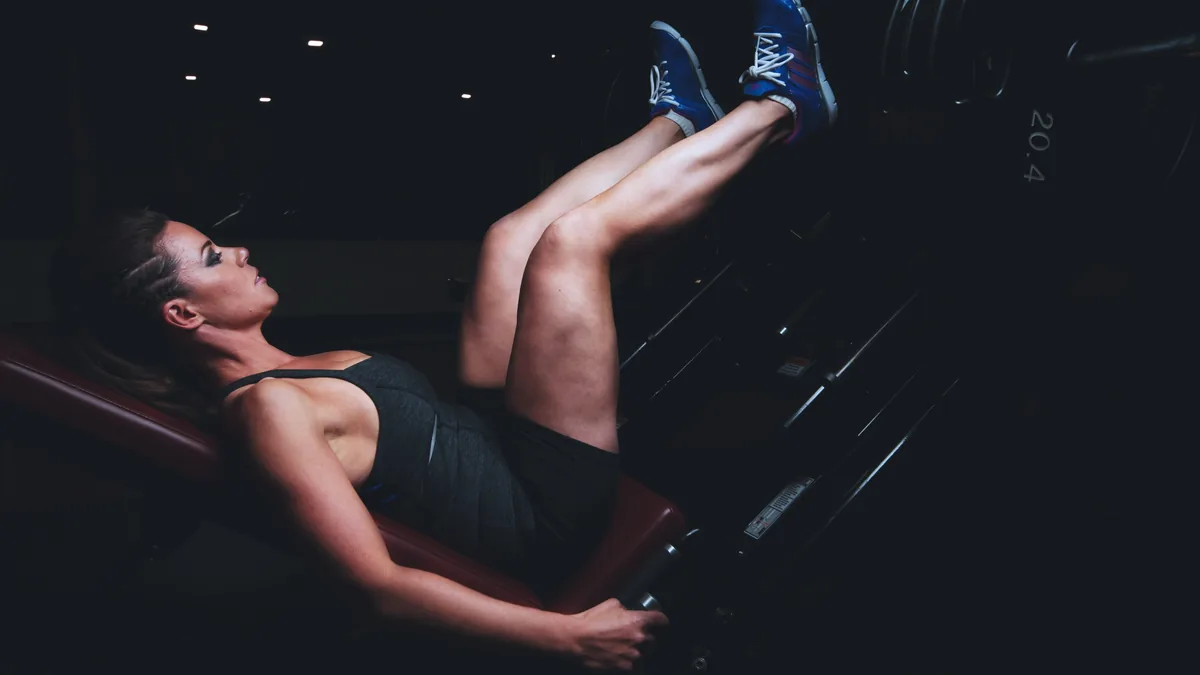
Leg exercises: the best for quads, hamstrings and calves according to science
Published on
Squats are not enough: they leave the hamstrings, rectus femoris and calves half-trained. The exercises that best work each leg muscle and how to combine them in the gym or at home.
Leg day has a bad reputation and even worse execution. Most people get it done with squats, leg presses and leg extensions, and go home convinced they have trained their whole legs. They have not: that session loads almost everything onto the quads and half-trains three muscles that also make up the leg, which research has studied in some detail in recent years: the hamstrings, the rectus femoris and the calves.
In this guide you will see which muscles make up the leg and which movement loads each one, the best exercises for each area according to the studies, how many sets you need per week, and a sample routine for the gym and another for home. The glutes have their own complete guide, glute exercises, so here we focus on the rest.
Which muscles make up the leg and which movement loads each one
Understanding this saves months of poorly distributed training. Each muscle grows when it is loaded in its main function, and two of them have an important feature: they cross two joints, so the position of the other joint changes how much they work.
| Muscle | Main function | Movement that loads it | Reference exercise |
|---|---|---|---|
| Quadriceps (vasti) | Extend the knee | Squat, leg press, lunge | Back squat |
| Rectus femoris | Extend the knee and flex the hip | Knee extension with the hip flexed | Leg extension |
| Hamstrings | Flex the knee and extend the hip | Leg curl and hip hinge | Seated leg curl |
| Gastrocnemius | Extend the ankle with a straight knee | Standing calf raise | Standing calf raise |
| Soleus | Extend the ankle with a bent knee | Seated calf raise | Seated calf raise |
Look at the rectus femoris: it is the only one of the four quad heads that also flexes the hip. In a squat, as the knee straightens the hip also extends, so the muscle shortens at one end while it lengthens at the other and barely changes length. That is why it grows little with squats, and why the leg extension is not a filler exercise.
The best quad exercises
Squats: deep if you can
The back squat is still the foundation of leg training, and depth matters. In the study by Kubo and colleagues (2019), published in the European Journal of Applied Physiology, 17 men trained for 10 weeks with either full squats or half squats, and the researchers measured the volume of each muscle with MRI. The quads grew similarly with both depths, but full squats grew the adductors and gluteus maximus considerably more. And in strength, the full-squat group improved its deep-squat max by 31.8%, versus 11.3% in the half-squat group.
The same study confirmed what we said about the rectus femoris: neither variant grew it meaningfully, and the same went for the hamstrings. If you want the technique step by step, it is in the back squat technique guide.
Leg press and hack squat: quads without the back as the limit
The leg press and the hack squat let you load the quads heavily without your lower back or balance setting the ceiling. They are a great second option after squats, or the first if you have back discomfort. Place your feet lower on the platform to give the knee more range and the quads more work, and go as deep as you can without your pelvis lifting off the backrest.
Leg extension: the one that completes the rectus femoris
The leg extension is the exercise that trains the rectus femoris with the hip flexed, exactly what squats do not do. And there is a practical nuance: the part of the range that matters most is the bottom, with the knee bent. Pedrosa and colleagues (2022) compared, in the European Journal of Sport Science, full-range knee extensions with partial versions. The initial half, between 100° and 65° of knee flexion, produced more hypertrophy in several regions of the quads than the full range and the final half. In gym terms: do not cut the bottom part short and do not obsess over locking out the knee at the top.
Lunges, Bulgarian split squats and step-ups
Single-leg exercises train quads and glutes, correct asymmetries and require very little load, which makes them ideal for home training. Speirs and colleagues (2016) compared, in rugby players, five weeks of training with back squats versus Bulgarian split squats, and both groups improved equally in strength on both exercises, 40-metre speed and agility. The Bulgarian split squat, dumbbell lunges and the dumbbell step-up are not a plan B: they are a fully valid alternative.
The full technique, its variations and how to bias glutes or quads are in our Bulgarian split squat guide.
The quad rule: one deep squat or leg press exercise as the base, plus a leg extension for the rectus femoris. With those two pieces you have all four heads covered.
Hamstrings: the muscle almost everyone trains badly
The hamstrings do two things: flex the knee and extend the hip. That is why they need two types of exercise, a curl and a hinge, and why squats, which do not load either function significantly, barely develop them.
Seated leg curls beat lying leg curls
This is one of the clearest findings of recent years. Maeo and colleagues (2021) had 20 adults train for 12 weeks with one leg on the seated leg curl and the other on the lying leg curl, with the same load and volume. On MRI, the hamstrings of the leg trained seated grew by 14%, versus 9% for the leg trained lying down. The explanation is hip position: seated, with the hip flexed, the hamstrings work in a more stretched position, and training in stretched positions favours hypertrophy.
If your gym has both machines, prioritise the seated leg curl. If it only has the lying one, the lying leg curl still works: the study shows it grows less, not that it does not grow.
Romanian deadlift: the hip hinge
The Romanian deadlift loads the hamstrings in their other function, extending the hip, and does so with the muscle highly stretched at the bottom. Lower the bar close to your legs by pushing your hips back, with your knees slightly bent, until you feel strong tension behind the thigh; then stand up. All the details are in the deadlift technique guide.
Nordic curl: insurance against tears
The Nordic curl is an eccentric exercise done kneeling, with your ankles anchored, letting your body fall forward as slowly as possible. Its value lies in prevention. Van der Horst and colleagues (2015) tested it in a randomised trial with 579 amateur football players: the teams that did 25 Nordic sessions over 13 weeks had a hamstring injury rate of 0.25 per 1,000 hours, versus 0.8 in the teams that did not. If you play a sport with sprints, two sets a week are a cheap investment.
Calves and soleus: why they do not grow and how to fix it
Calves have a reputation for being "genetic", and in part they are. But they often fail to grow because they are trained with short bounces at the top of the movement, exactly where they get the least stimulus. Kassiano and colleagues (2023) compared three ways of doing calf raises over 8 weeks: full range, only the bottom half with the ankle stretched, and only the top half. The bottom half grew the inner head of the gastrocnemius by 15.2%, versus 6.7% with the full range and 3.4% with the top half.
The practical application is simple: lower your heel as far as it goes, pause for one or two seconds at the bottom and do not bounce. The standing calf raise, with a straight knee, mainly trains the gastrocnemius. The seated calf raise, with a bent knee, shifts the work to the soleus. For complete legs, do both.
The 12 best leg exercises at a glance
| Exercise | Main muscle | Equipment | Level | Sets × reps |
|---|---|---|---|---|
| Back squat | Quads, glutes, adductors | Barbell and rack | Intermediate | 3-4 × 5-10 |
| Leg press | Quads | Machine | Beginner | 3 × 8-15 |
| Hack squat | Quads | Machine | Beginner | 3 × 8-12 |
| Goblet squat | Quads, glutes | Dumbbell or kettlebell | Beginner | 3 × 10-15 |
| Leg extension | Quads (rectus femoris) | Machine | Beginner | 3 × 10-15 |
| Bulgarian split squat | Quads, glutes | Bench and dumbbells | Intermediate | 3 × 8-12 per leg |
| Lunges | Quads, glutes | Dumbbells or none | Beginner | 3 × 10-12 per leg |
| Seated leg curl | Hamstrings | Machine | Beginner | 3 × 8-12 |
| Romanian deadlift | Hamstrings, glutes | Barbell or dumbbells | Intermediate | 3 × 6-10 |
| Nordic curl | Hamstrings | Ankle anchor | Advanced | 2-3 × 3-6 |
| Standing calf raise | Gastrocnemius | Machine, step or dumbbell | Beginner | 3-4 × 10-15 |
| Seated calf raise | Soleus | Machine or dumbbells | Beginner | 3 × 12-20 |
How many leg sets you need per week
Weekly volume is the variable that most influences how much a muscle grows, within what you can recover from. In the meta-analysis by Schoenfeld, Ogborn and Krieger (2017), each additional weekly set was associated with 0.37% more muscle gain, and higher-volume protocols produced 3.9% more growth than lower-volume ones. It is a dose-response relationship: more sets work better, up to the limit of what you can recover from.
As a practical starting point, aim for around 10 weekly sets for each leg group: quads, hamstrings and calves, spread over two sessions. If you are new, start with 6-8 and build up gradually. The guide on how many sets you need per muscle group gives the ranges by level.
Sample leg routine for the gym
Two leg days a week, one prioritising the quads and the other the hamstrings, fit into a 4-day upper/lower routine or the 4-day hypertrophy routine.
| Day | Exercise | Sets × reps | Rest |
|---|---|---|---|
| A · Quads | Back squat | 4 × 6-8 | 2-3 min |
| A · Quads | Leg press | 3 × 10-12 | 2 min |
| A · Quads | Leg extension | 3 × 12-15 | 90 s |
| A · Quads | Seated leg curl | 2 × 10-12 | 90 s |
| A · Quads | Standing calf raise | 4 × 10-15 | 60-90 s |
| B · Hamstrings | Romanian deadlift | 4 × 6-10 | 2-3 min |
| B · Hamstrings | Bulgarian split squat | 3 × 8-12 per leg | 2 min |
| B · Hamstrings | Seated leg curl | 3 × 8-12 | 90 s |
| B · Hamstrings | Nordic curl | 2 × 3-6 | 2 min |
| B · Hamstrings | Seated calf raise | 3 × 12-20 | 60 s |
With this week each group gets around 9-11 sets. Increase the weight when you reach the top of the rep range with good technique, leaving one or two reps in reserve.
Leg exercises at home, with or without equipment
At home, the challenge is getting enough load for legs that move a lot of weight in the gym. The solution is to work one leg at a time, with full ranges and slow tempos:
- Bulgarian split squat with your back foot on a chair or the sofa, holding a backpack or water jugs if you need more load.
- Goblet squat with a dumbbell, a kettlebell or a loaded backpack, lowering over three seconds.
- Step-up onto a stable chair or a high step.
- Single-leg Romanian deadlift with dumbbells or water jugs, for the hamstrings.
- Nordic curl with your ankles under the sofa and a cushion under your knees.
- Single-leg calf raise on the edge of a step, with a pause at the bottom.
If you have no equipment, the guide to building muscle at home explains how to progress with bodyweight alone.
The most common leg training mistakes
- Doing only squats and leg presses. You leave the hamstrings, rectus femoris and calves without enough stimulus.
- Cutting the range short. In squats, leg extensions and calf raises alike, the deepest part is the one that contributes most.
- Bouncing on calf raises. The Achilles tendon does the work and the muscle barely notices. Pause at the bottom.
- Training legs once a week with 20 sets in a row. The last sets arrive with no strength left. Two shorter sessions work better.
- Not progressing the load. If you have used the same weight for months, your legs have no reason to change.
Conclusion
Complete legs need more than squats. Use a deep squat or leg press as the base, add leg extensions for the rectus femoris, train the hamstrings with seated curls and a hip hinge, and work the calves from the stretch, without bouncing. Around 10 weekly sets per group, over two sessions, are enough to grow. If you want all of this adjusted to your level, equipment and days, Progrevia's routine generator organises it for you.
- Kubo K, Ikebukuro T, Yata H. Effects of squat training with different depths on lower limb muscle volumes. European Journal of Applied Physiology. 2019;119(9):1933-1942.
- Pedrosa GF, Lima FV, Schoenfeld BJ, et al. Partial range of motion training elicits favorable improvements in muscular adaptations when carried out at long muscle lengths. European Journal of Sport Science. 2022;22(8):1250-1260.
- Speirs DE, Bennett MA, Finn CV, Turner AP. Unilateral vs. bilateral squat training for strength, sprints, and agility in academy rugby players. Journal of Strength and Conditioning Research. 2016;30(2):386-392.
- Maeo S, Huang M, Wu Y, et al. Greater hamstrings muscle hypertrophy but similar damage protection after training at long versus short muscle lengths. Medicine & Science in Sports & Exercise. 2021;53(4):825-837.
- van der Horst N, Smits DW, Petersen J, Goedhart EA, Backx FJ. The preventive effect of the Nordic hamstring exercise on hamstring injuries in amateur soccer players: a randomized controlled trial. The American Journal of Sports Medicine. 2015;43(6):1316-1323.
- Kassiano W, Costa B, Kunevaliki G, et al. Greater gastrocnemius muscle hypertrophy after partial range of motion training performed at long muscle lengths. Journal of Strength and Conditioning Research. 2023;37(9):1746-1753.
- Schoenfeld BJ, Ogborn D, Krieger JW. Dose-response relationship between weekly resistance training volume and increases in muscle mass: a systematic review and meta-analysis. Journal of Sports Sciences. 2017;35(11):1073-1082.
Progrevia · · How we write our guides
Frequently asked questions
What are the best leg exercises?
A deep squat or leg press for the quads, the leg extension for the rectus femoris, the seated leg curl and Romanian deadlift for the hamstrings, and standing and seated calf raises for the gastrocnemius and soleus.
Is the seated or lying leg curl better?
Seated. In Maeo's study (2021) the hamstrings grew 14% with seated curls versus 9% with lying curls, because with the hip flexed the muscle works in a more stretched position. The lying version still works, just somewhat less.
Do squats train the whole leg?
No. They develop the quad vasti, adductors and glutes well, but barely the rectus femoris and hamstrings, as Kubo's MRI study (2019) showed. You need to add leg extensions and specific hamstring work.
How many leg sets should you do per week?
Around 10 weekly sets per muscle group (quads, hamstrings and calves) is a good starting point, spread over two sessions. If you are new, 6-8 is enough and you can build up gradually.
How do you make your calves grow?
Lower your heel as far as it goes, pause at the bottom and do not bounce. In Kassiano's study (2023) training the bottom part of the range grew the calf by 15.2%, more than double the full range. Combine standing and seated calf raises.
Informational content based on the available scientific evidence: it does not replace advice from a healthcare professional. If you have an injury or a medical condition, or are pregnant, check with one before changing your training or diet.
