How to build muscle at home: the complete guide with and without equipment
Published on
Building real muscle at home is possible. You don't need a gym if you apply the correct principles of progression, volume, and recovery.
The pandemic proved something fitness experts had known for decades: you can build real muscle at home, without machines, without heavy weights and without a gym membership. The key is not the equipment available but understanding how muscle hypertrophy actually works and applying those principles to any context.
The fundamental principle: progressive mechanical tension
The most frequent misconception is believing you need heavy weights to build muscle. In reality, muscle responds to progressive mechanical tension, not to the number on the dumbbell. The key is approaching muscular failure progressively, with enough volume and rest.
A study by Schoenfeld et al. (2015) showed that sets of 25-35 reps with light weights produce hypertrophy statistically equivalent to sets of 8-12 reps with moderate weights, provided the effort (proximity to failure) is the same. This has direct implications for home training: you do not need loaded barbells to stimulate muscle growth.
Minimum worthwhile equipment for building muscle at home
The difference between training with pure bodyweight and having a minimum of equipment is significant in terms of long-term progression. These are the investments with the best return:
- Doorway pull-up bar (15-20€): the most complete exercise for back and biceps without needing machines. Pull-ups activate the entire lat, the rhomboids, the lower trapezius and the biceps in a single movement.
- Resistance bands (15-30€): they allow progression in any exercise, add resistance to the final part of the range of motion and work for glute activation, auxiliary shoulder work and pulling exercises.
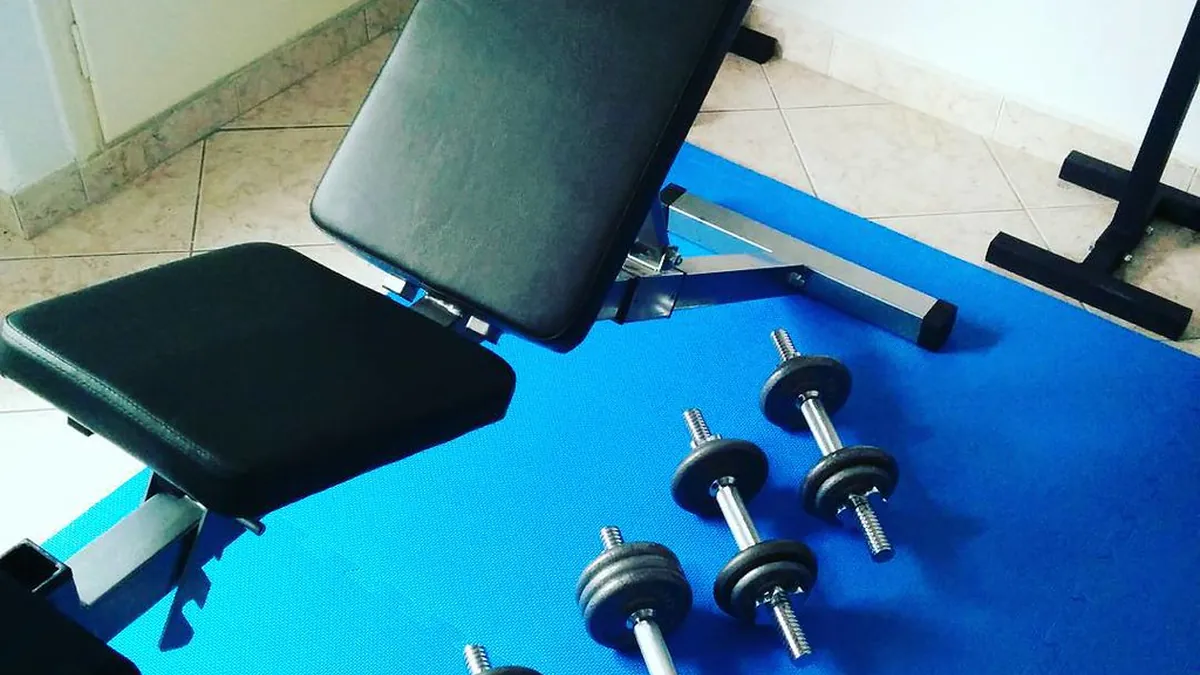
- A pair of adjustable dumbbells (50-80€): the most versatile equipment per euro invested. It multiplies the possibilities for pressing, rowing and isolation. Plate-loaded adjustable dumbbells are cheaper than dial models.
3-day Full Body programme for hypertrophy at home:
Day A: Pull-ups 4×6-10 · Diamond push-ups 3×12 · Bulgarian split squat 3×10 per leg · Hip thrust with backpack 4×12 · Band curl 3×15
Day B: Decline push-ups 4×10 · Towel row in a doorway 3×12 · Dumbbell Romanian deadlift 4×12 · Lunges 3×10 per leg · Band triceps extension 3×15
Day C: Archer push-ups 3×8 per side · Chin-ups 3×8 · Assisted pistol squat 3×6 per leg · Single-leg hip raises 3×12 per leg · Dumbbell shoulder press 3×12
How to progress when you cannot add weight
Progression is the key to hypertrophy and one of the biggest challenges of home training. When you cannot add more load, these progression strategies keep the stimulus growing:
- More reps: if you do 3×8 this week, aim for 3×9 next week. When you reach 3×12, look for a difficulty progression instead of more reps.
- Harder variants: from standard push-up → feet-elevated push-up → archer push-up → assisted one-arm push-up. Each variant increases the mechanical demand on the chest and triceps.
- Tempo and time under tension: a push-up with a 3-second descent, a 1-second pause and a 1-second ascent produces more muscle tension than the same push-up done at 1-1-1.
- Reducing rest: going from 90 seconds to 60 seconds between sets increases metabolic stress while keeping the same volume.
- Adding resistance bands: bands add variable load across the range of motion, especially in the peak contraction phase where bodyweight exercises tend to be easiest.
The most effective exercises for building muscle at home
Not all bodyweight exercises are equal for hypertrophy. The most effective are those that allow systematic progression and work the muscles in the stretched range (maximum tension in the lengthened position):
- Pull-ups: back and biceps work. Progression: band-assisted pull-ups → full pull-ups → weighted pull-ups with a backpack → neutral-grip pull-ups with a pause at the top.
- Chair dips: lower chest and triceps. Progression: dips with bent knees → dips with legs extended → dips with feet elevated → dips with a weighted backpack.
- Bulgarian split squat: quads, glutes and hamstrings with a large range of motion. Progression: bodyweight → with dumbbells → with a weighted backpack → with a pause at the bottom.
- Supported hip thrust: gluteus maximus. Progression: bilateral bodyweight → unilateral → with a backpack or dumbbell over the hips.
Nutrition for building muscle at home
Nutrition does not change according to where you train. To gain muscle mass, at home or in the gym, you need:
- Moderate caloric surplus: 200-400 kcal above your maintenance expenditure. A bigger surplus increases fat gain without accelerating muscle gain.
- Enough protein: 1.6-2.2g per kg of body weight a day, spread across 3-5 meals. Quality sources are eggs, chicken, fish, legumes and dairy.
- Peri-workout carbohydrates: eating carbs in the 1-2 hours before training improves performance and muscle glycogen availability.
When is it time to move to a gym?
Home training has its limits. Beyond a certain level of muscular development (generally after 12-18 months of consistent training), the difficulty of progressing without specific equipment becomes a glass ceiling. Advanced lifters need access to barbells, squat racks and machines to keep stimulating hypertrophy effectively.
If you have been training at home for less than 12 months and have minimal equipment (pull-up bar, bands, adjustable dumbbells), you can build muscle very effectively without needing a gym. If you already have more than a year of consistent experience and progression stalls despite optimising nutrition and recovery, it is time to consider a space with more equipment.
Progrevia generates complete home training routines adapted to your available equipment, with built-in progression and automatic periodisation to maximise results wherever you train.
How to structure long-term progression at home
Progression in home training requires more creative planning than in the gym, where you simply add plates to the bar. Below is a long-term progression for the most important exercises:
Push-up progression (chest, triceps, front delts):
- Weeks 1-4: Standard push-ups 3×10-15
- Weeks 5-8: Feet-elevated push-ups on a chair 3×10-12 (more upper chest)
- Weeks 9-12: Diamond push-ups 3×8-12 (more triceps) + pike push-ups 3×10 (shoulders)
- Weeks 13-16: Archer push-ups 3×6-10 per side
- Weeks 17+: One-arm push-ups assisted with the other hand on the floor at different angles
Pull-up progression (back, biceps):
- No initial capacity: towel/band pulldown in a doorway or inverted row under a table
- 3-5 pull-ups: band-assisted pull-ups
- 5-10 pull-ups: volume sets (3×5-8) and grip variants (supinated, neutral, wide)
- 10+ pull-ups: weighted pull-ups with a backpack + assisted unilateral variants
The best exercises for each muscle group without equipment
This list optimises muscle activation with zero or minimal equipment:
- Legs/quads: Bulgarian split squat > assisted single-leg squat > squat with a pause at the bottom > jump squat
- Glutes/hamstrings: single-leg hip thrust with shoulders on the sofa > glute bridge with a weighted backpack > bodyweight good mornings > towel hamstring curl on the floor (nordic curl)
- Chest: feet-elevated push-ups > explosive push-ups > diamond push-ups > archer push-ups
- Back: doorway bar pull-ups > inverted row under a table > towel row tied to a door
- Shoulders: pike push-up > pike push-up with feet elevated > wall-assisted handstand push-up
- Biceps: chin-ups > backpack biceps curl > band biceps curl
Home muscle-building routine: a 12-week programme
This programme assumes a pull-up bar and optionally a pair of adjustable dumbbells. Each session lasts 45-60 minutes:
Block 1 (weeks 1-4): Base and technique
- Day A: Pull-ups 4×submaximal · Push-ups 4×12 · Bulgarian split squat 3×10 · Single-leg hip thrust 3×12 · Plank 3×45s
- Day B: Pike push-up 4×10 · Inverted row 4×12 · Lunges 3×10 · Single-leg glute bridge 3×15 · Bicycle crunch 3×20
Block 2 (weeks 5-8): Variant progression
- Day A: Neutral-grip pull-ups 4×6-8 · Feet-elevated push-ups 4×10 · Bulgarian split squat with dumbbells 4×10 · Weighted hip thrust 4×12 · Ab wheel 3×8
- Day B: Feet-elevated pike push-up 4×8 · Chin-ups 4×6-8 · Dumbbell Romanian deadlift 4×10 · Assisted nordic curl 3×6 · Side plank 3×40s
Block 3 (weeks 9-12): Intensification
- Day A: Weighted pull-ups with backpack 4×5 · Archer push-ups 3×6 per side · Assisted pistol squat 3×5 per leg · Heavy weighted hip thrust 4×8 · Full ab wheel 3×6
- Day B: Assisted handstand push-up 3×5 · Paused pull-ups 3×5 · Heavy dumbbell deadlift 4×8 · Nordic curl 3×5 · Weighted plank 3×40s
The right mindset for building muscle at home
The biggest obstacle in home training is not the lack of equipment: it is the lack of structure and discipline. Without the gym environment (training partners, coaches, infrastructure), intrinsic motivation has to be greater. These strategies improve adherence to home training:
- Set up a dedicated space, even a small one (2m²), with the mat and the few implements you need
- Train at the same time on the same days to build the habit
- Record every session - visible progress is the best motivator
- Celebrate small wins: your first full pull-up, the first weighted Bulgarian split squats, the first pike push-up with feet on a chair
Frequently asked questions: building muscle at home
Can I build the same muscle at home as in the gym? In the first 12-18 months yes, if you have minimal equipment (pull-up bar, adjustable dumbbells and bands). With pure bodyweight exercises, there is a difficulty ceiling that advanced lifters reach sooner. Beginners and intermediates can build muscle very effectively at home.
Which is better: bodyweight or dumbbells at home? Adjustable dumbbells offer better long-term progression because they allow precise load increments. Bodyweight has advantages in mobility and functionality. The combination (pull-ups + dumbbells + bands) is more effective than either on its own.
How many square metres do I need to train at home? With 4-6 m² you can install a pull-up bar in a doorframe and have enough space to lie down with your arms extended for all floor exercises. You do not need a dedicated room.
Is a pull-up bar worth it? It is the equipment with the best value-for-money ratio for home training. 15-25€ for a doorway bar and you gain access to the most effective exercise for back and biceps without a machine. If you can only buy one implement for home, this is it.
Conclusion: building muscle at home is possible and effective
The evidence and practice confirm it: home training, with minimal equipment and a well-designed programme, can produce hypertrophy results very close to those of the gym, especially in the first 12-18 months of training. The limitations of home training are real but late: they appear once you already have a solid base of strength and muscle that requires higher loads to keep progressing.
The greatest asset of home training is the removal of barriers: no travel, no closing times, no monthly fees. For many people, those removed barriers are the difference between training consistently and not training at all. And consistency, as always, is the variable that matters most.
Home training is not an inferior substitute for the gym forever, but neither is it a temporary solution while you can "afford" a membership. It is a completely valid option with its own advantages and limitations. For beginners and intermediates with good discipline and minimal equipment, home training can be as effective as the gym for producing real hypertrophy and significant physical change.
No barbell, no plates: what has been measured when the external load is removed
The perennial objection to training at home is that without enough external load there is no hypertrophy. It is a reasonable objection, which is why it is worth looking at the two experiments that have tested it in the most uncomfortable way possible: removing the weight almost entirely and measuring the muscle afterwards.
The most radical was authored by Counts, Buckner, Dankel and colleagues in 2016 in Physiology & Behavior. Thirteen participants completed 18 sessions of elbow flexion, with an ingenious design: each arm of the same person received a different treatment, which wipes out genetic, dietary and rest differences between subjects in one stroke. One arm trained at 70% of 1RM. The other lifted absolutely nothing: just contracting as hard as possible through the full range of motion, repeatedly. The result: contracting the muscle through a full range with no external load increased size similarly to high-load training. High load was superior, and clearly so, in maximal strength gains and muscular endurance.
The second is more applicable to what you will actually do in your living room. Kikuchi and Nakazato published a trial in the Journal of Exercise Science and Fitness in 2017 with 18 young men randomised to bench press at 40% of 1RM or push-ups adjusted to an equivalent load, twice a week for eight weeks. The conclusion: the push-up produced comparable hypertrophy and strength gains to the low-load bench press over that period.
| Study | Protocol | Duration | Effect on size | Effect on strength |
|---|---|---|---|---|
| Counts et al., 2016 | Elbow flexion with no load at all versus 70% of 1RM, one arm each | 18 sessions | Similar increase | Lower than with high load |
| Kikuchi and Nakazato, 2017 | Push-ups versus bench press at 40% of 1RM | 8 weeks, 2 sessions a week | Comparable | Comparable |
What these data license you to claim and what they do not, because the difference matters. They license saying that muscle size responds to effort close to failure through a full range, even when the weight is ridiculous or non-existent. They do not license saying it makes no difference whether you train with load or without: maximal strength is what loses most, the samples are small and the periods eight weeks long, and neither study measured what happens in the second or third year.
There is also a nuance that explains why so many people train at home without results. In both experiments the stimulus was genuine maximal effort: contracting as hard as possible, right up close to failure. Twenty comfortable push-ups while watching an episode is not that stimulus. Low load works on the condition that the set is taken to the limit, which is precisely the part the comfort of home invites you to skip.
The practical conclusion is encouraging and demanding at once: to build muscle at home you do not need a squat rack, you need full range of motion, proximity to failure and some method of progression — more reps, slower tempo, harder variations, a resistance band. What you will need serious external loads for is developing maximal strength; that is the real ceiling of home training, and it is better known from the start than discovered in frustration.
- Counts BR, Buckner SL, Dankel SJ, Jessee MB, Mattocks KT, Mouser JG, Laurentino GC, Loenneke JP. The acute and chronic effects of «NO LOAD» resistance training. Physiology & Behavior. 2016;164(Pt A):345-352.
- Kikuchi N, Nakazato K. Low-load bench press and push-up induce similar muscle hypertrophy and strength gain. Journal of Exercise Science and Fitness. 2017;15(1):37-42.
More frequently asked questions
Can I build as much muscle at home as at the gym?
For beginners and intermediate trainees, yes. A 2021 meta-analysis found no significant differences in hypertrophy between home free-weight training and gym training when volume and effort were equivalent. The gym advantage appears at advanced levels where the ability to load maximum weights limits possible home adaptations.
What is the single most important exercise to do at home?
Pull-ups. They are the most complete pulling exercise available without a gym and effectively train lats, rhomboids, biceps, and core. If you cannot do one yet, start with resistance band lat pulldowns and work toward your first full pull-up.
How do I progress without more weight at home?
Progression without adding weight: increase reps, reduce rest between sets, add a pause at the hardest point (2 seconds), use full range of motion, advance to harder variations (single-leg, single-arm), or add higher-resistance bands. Progression is the principle; equipment is secondary.