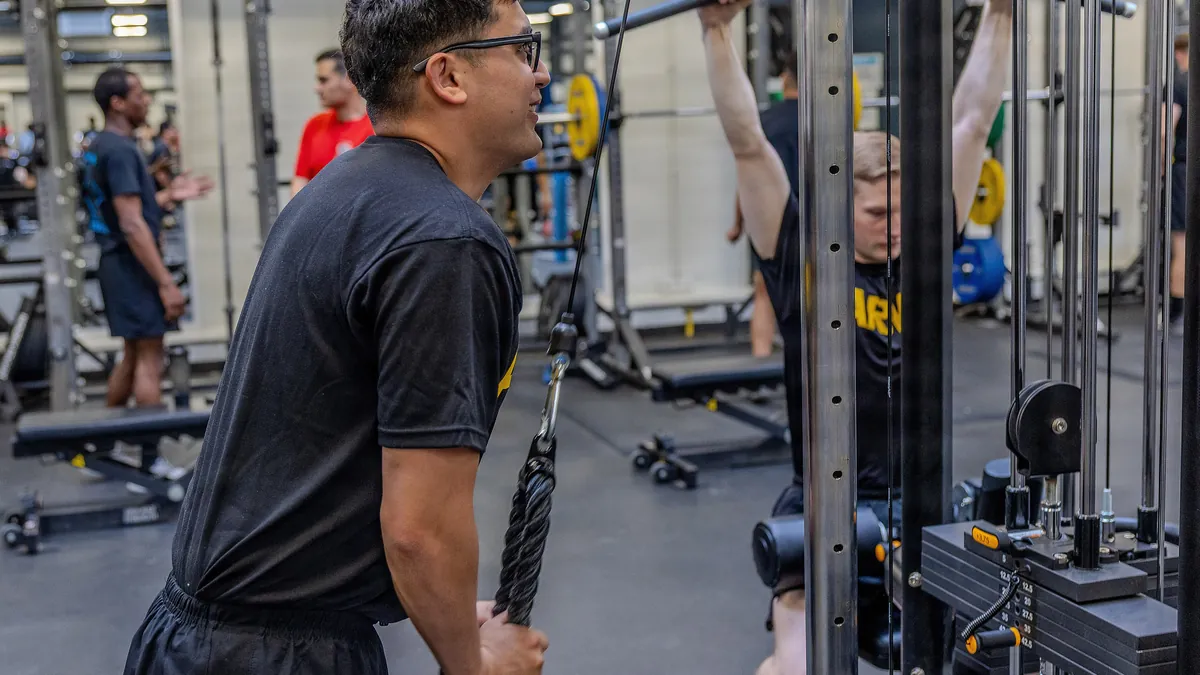
Machines or free weights: which is better for building muscle and strength
Published on
A meta-analysis of 13 studies with over 1,000 adults found no differences between machines and free weights in strength or muscle when compared directly. What does matter is specificity: you improve at what you train. When each option makes sense, their risks and how to combine them.
There are two camps in every gym that rarely agree: those who say “machines are useless for real strength” and those who never touch a barbell because “machines isolate the muscle better”. In 2023, a Norwegian team including Thomas Bjørnsen (University of Agder) and Roland van den Tillaar (Nord University) pooled every study that directly compared both options for at least 6 weeks: 13 trials with 1,016 adults.
The result disarms both camps. In the direct comparison, there were no differences in dynamic strength, isometric strength, jumping or muscle growth. What did appear was a specificity effect: each group improves most in what it trains with. Let us take it step by step.
Which builds more muscle, machines or free weights?
Both equally, according to the available data. In the meta-analysis by Haugen and colleagues, the 5 studies that measured hypertrophy found no differences between modalities. A concrete example: in the trial by Schwanbeck and Chilibeck (2020), 46 young adults, 26 of them women, trained for 8 weeks with free weights or machines, working each muscle group 2-3 times a week with 3-4 sets of 4-10 reps. Biceps and quadriceps thickness increased equally in both groups.
Interestingly, in men training with free weights, free testosterone rose more right after each session. It did not translate into more muscle.
| Study | Participants and duration | Main result |
|---|---|---|
| Haugen (2023), meta-analysis | 13 studies, 1,016 adults, at least 6 weeks | No differences in strength, jumping or hypertrophy in the direct comparison; each modality improves more in its own tests |
| Schwanbeck (2020) | 46 young adults, 8 weeks | Same muscle gain; the machine press rose more in the machine group (13.9% vs 8.6%) |
| Rossi (2018) | Squat, leg press or both, 10 weeks | The squat transferred more to the maximal squat; both improved functional outcomes |
Strength is specific: you improve at what you train
Here is the important nuance. In the 2023 meta-analysis, strength measured with free weights increased more when training with free weights, and strength measured on machines tended to increase more when training on machines. In Schwanbeck's study, the barbell bench press and squat improved in both groups (by 11% to 19%), but the machine press improved more in those using machines.
The study by Rossi, Schoenfeld and colleagues (2018) saw it with two leg exercises. For 10 weeks, with 2 weekly sessions of 6 sets of 8-12 rep maximum, one group did only squats, another only leg presses and another both. The squat transferred more to the maximal squat than the leg press. For jumping, effect sizes favoured the squat groups; for dynamic balance, the leg press groups, although no difference was statistically significant.
The practical rule: if you are going to compete or test yourself on a specific lift, train it. If your goal is to build muscle or general strength, use whatever is most comfortable, safe and consistent for you.
Are free weights more dangerous?
Not in general, but their risks are different. Gray and Finch (2015) analysed 2,873 injuries that occurred in gyms in Victoria (Australia) and were treated in emergency departments. The most common cause was overexertion, at 36.2% of the total, and it was also the main cause in free-weight exercises (52.6%). Crush injuries from falling weights appeared across all free-weight activities. And trips and falls happened throughout the gym, cardio machines included.
The practical translation: with free weights, the risk lies in loading more than you can control and in dropping the weight. Machines reduce that risk when you train alone and want to get close to failure, because there is no barbell that can end up pinning you.
When to choose each option
| Situation | Most practical option | Why |
|---|---|---|
| You want to improve your squat, bench press or deadlift | Free weights | Strength is specific to the exercise trained |
| You want to build muscle | Either, or a mix | No differences in hypertrophy in the studies |
| You train alone and want to get close to failure | Machines and cables | You can push the set without getting stuck under the load |
| You are starting from scratch | Both, with basic free-weight technique from the start | Machines build confidence; free weights teach load control |
| You are coming back from an injury | Machines and cables at first | Guided path and easily adjusted load |
| You train at home | Dumbbells | The most versatile free weight in a small space |
The review by Vegard Iversen and Marius Fimland (2021), of the Norwegian University of Science and Technology, on how to train in little time reaches the same conclusion: exercises can be done with machines, free weights or both, depending on your goal, what is available and your preferences.
How to combine them in the same routine
The most common combination, and one of the most logical, is to start the session with a multi-joint free-weight exercise while you are fresh, and finish with machines and cables, where it is easier to push sets without losing technique.
- Leg day: barbell squat, then leg press and seated machine leg curl.
- Push day: barbell or dumbbell bench press, then machine incline press and cable triceps extensions.
- Pull day: pull-ups or barbell row, then lat pulldown and cable row.
To brush up on the basics, see barbell squat technique and the bench press. To decide how hard to push machine sets, read training to failure, and if you only have dumbbells, the dumbbell workout plan is designed for that.
In the Progrevia generator you choose your equipment: “Full gym” mixes barbells, machines, cables and pulleys; “Dumbbells” and “At home” adapt to what you have. The routine comes out with exercises for your equipment and the sets and reps for your goal.
- Haugen ME, Vårvik FT, Larsen S, Haugen AS, van den Tillaar R, Bjørnsen T. Effect of free-weight vs. machine-based strength training on maximal strength, hypertrophy and jump performance: a systematic review and meta-analysis. BMC Sports Science, Medicine and Rehabilitation. 2023;15(1):103.
- Schwanbeck SR, Cornish SM, Barss T, Chilibeck PD. Effects of training with free weights versus machines on muscle mass, strength, free testosterone, and free cortisol levels. Journal of Strength and Conditioning Research. 2020;34(7):1851-1859.
- Rossi FE, Schoenfeld BJ, Ocetnik S, et al. Strength, body composition, and functional outcomes in the squat versus leg press exercises. The Journal of Sports Medicine and Physical Fitness. 2018;58(3):263-270.
- Gray SE, Finch CF. The causes of injuries sustained at fitness facilities presenting to Victorian emergency departments: identifying the main culprits. Injury Epidemiology. 2015;2(1):6.
- Iversen VM, Norum M, Schoenfeld BJ, Fimland MS. No time to lift? Designing time-efficient training programs for strength and hypertrophy: a narrative review. Sports Medicine. 2021;51(10):2079-2095.
Progrevia · · How we write our guides
Frequently asked questions
Do free weights build more muscle than machines?
No. In the meta-analysis by Haugen (2023), the studies that measured hypertrophy found no differences between the two, and in the trial by Schwanbeck (2020) muscle grew equally in both groups.
Are machines any good for building strength?
Yes. In the direct comparison there were no strength differences between modalities. Strength is specific, though: if you want to improve your barbell squat or bench press, train them with a barbell.
Are you more likely to get injured with free weights?
Their risks are different. In the analysis by Gray and Finch (2015), overexertion was the main cause of free-weight injuries, and crush injuries from falling weights were common. Controlling the load and not training to failure without help reduces that risk.
Can a beginner start with machines only?
They can, and it builds confidence, but it is worth learning basic free-weight technique early, for example with dumbbells. Ideally, combine both from the start.
What should come first in a session, free weights or machines?
The usual approach is to start with the multi-joint free-weight exercise while you are fresh and finish with machines and cables, where it is easier to push sets without losing technique.
Informational content based on the available scientific evidence: it does not replace advice from a healthcare professional. If you have an injury or a medical condition, or are pregnant, check with one before changing your training or diet.
