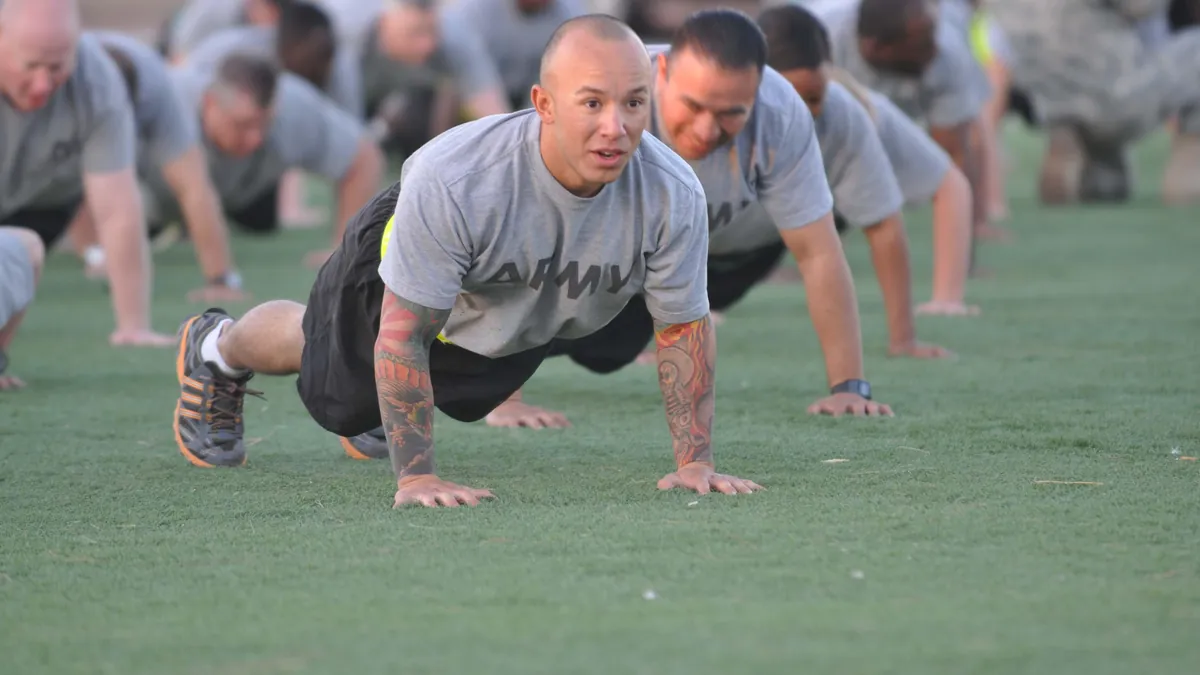
Push-ups: correct technique, variations by level and how many to do to build muscle
Published on
In a study of 1,104 firefighters, those who could do more than 40 push-ups had 96% fewer cardiovascular events than those who could not reach 10. How to do them properly, which variation suits your level and how many sets to do.
Push-ups are probably the most performed strength exercise in the world: they need no equipment, fit anywhere and can be adapted to almost any level. And yet they carry a reputation as a "warm-up" exercise, useful for getting started but not serious enough for building muscle. The studies say otherwise.
In this guide you will see why push-ups matter beyond the chest, what the studies comparing them with the bench press say, how to do them with good technique, which variation suits your level and how many sets and reps to do for your goal.
A striking finding
Yang and colleagues published a study in JAMA Network Open in 2019 with 1,104 male firefighters from Indiana, with an average age of 40, whom they followed for 10 years. At the start of the study they counted how many push-ups each could do. Those who could do more than 40 had a 96% lower incidence of cardiovascular events than those who could not reach 10, after adjusting for age and body mass index.
It should be read carefully: it is an association study, it does not prove that push-ups protect the heart, and it only included active men. What it does suggest is that your push-up capacity reflects something important about your overall fitness, and that measuring it is free.
Do push-ups build muscle?
Yes, as much as the bench press if the difficulty is matched. Three trials compared them directly:
- Kikuchi and Nakazato (2017) trained 18 young men twice a week for 8 weeks: half with the bench press at 40% of their maximum and the other half with push-ups adjusted to an equivalent load, for example by resting on the knees. Both groups increased chest and triceps thickness and their bench press maximum comparably.
- Calatayud and colleagues (2015) compared, over 5 weeks in 30 students with resistance training experience, the bench press with a 6-repetition-maximum weight and push-ups with an elastic band that made them just as hard. Both groups gained strength similarly.
- Kotarsky and colleagues (2018) trained 23 men 3 days a week for 4 weeks, some with the bench press and others with increasingly difficult push-ups. Both groups improved their bench press maximum.
The key is the same as in any exercise: getting close to failure. The meta-analysis by Schoenfeld and colleagues (2017) showed that, with sets taken to muscular failure, low and high loads produce similar hypertrophy, although high loads win for maximal strength. That is why a set of 25 hard push-ups works for growth, but when you can do 30 or 40 without effort it is time to move to a harder variation.
The key idea: push-ups are not a second-rate exercise. If you adjust the variation so that each set is demanding, they give results comparable to the bench press.
Correct technique step by step
- Hands placed slightly wider than your shoulders, fingers pointing forwards.
- Body in a straight line from head to heels: squeeze your glutes and abs so your hips neither sag nor rise.
- Lower under control until your chest is a few centimetres from the floor, with your elbows at an angle of about 45 degrees to your torso, not flared out.
- Push the floor away until your arms are fully straight, without losing your body line.
- Breathe: in on the way down, out on the way up.
The hardest point is at the bottom. Suprak and colleagues (2011) measured with a force plate that the arms support a greater percentage of body weight in the low position than in the high one, in both the standard and the knee push-up. If you shorten the range, you are skipping exactly the part that works hardest.
Variations: from easiest to hardest
Ebben and colleagues (2011) measured the force you have to push in six variations. Push-ups with the hands elevated and knee push-ups were the lightest, and feet-elevated push-ups the most demanding. That is the ladder for progressing:
| Variation | Difficulty | Who it is for |
|---|---|---|
| Hands on a wall | Very low | If you cannot yet manage the knee version |
| Hands elevated on a bench or table | Low: less load than the standard | Beginners; the higher the support, the easier |
| Knee push-up | Low: less load than the standard | Beginners who want the full range |
| Standard push-up | Reference | When you can do 3 sets of 8-12 of the above |
| Feet elevated | High: the most demanding variation measured | When you can do more than 20 standard ones |
| With an elastic band or added weight | High and adjustable | To keep progressing with load |
| Archer, assisted one-arm | Very high | Advanced trainees without loading equipment |
Close-grip push-ups (diamond) load the triceps more, and wide-grip push-ups the chest a little more. They are good for variety, but the main way to progress is to climb the difficulty ladder.
How many push-ups to do
| Goal | Sets | Reps | When to move to a harder variation |
|---|---|---|---|
| Getting started | 2-3 | 5-12 of the variation you can do | When you can do 3 sets of 12 with good technique |
| Building muscle | 3-4 | 6-30, stopping 1-3 reps short of failure | When you go past 30 per set |
| Endurance | 2-3 | As many as possible with good technique | For the test, better the standard version |
2-3 pushing sessions a week is plenty. How many total sets to do per muscle is explained in training volume, and how often to repeat the stimulus in training frequency.
How to use them in your routine
- At home, as the main pushing exercise. Combined with pull-ups or rows and squats, they cover almost the whole body. There are examples in the home workout with no equipment and in how to build muscle at home.
- At the gym, as an extra. At the end of a chest session, after the bench press, or as an alternative on a day when no bench is free. More ideas in the best chest exercises.
- To balance pulling. If you do a lot of push-ups, balance them with pulling. If you cannot yet do a pull-up, see pull-ups from scratch.
Common mistakes
- Letting the hips sag. It loads the lower back and takes work away from the chest. Squeeze your glutes and abs.
- Doing half reps. The bottom is the hardest part; if you do not go down, you do not train it.
- Flaring the elbows out. It tends to bother the shoulders. Keep them at about 45 degrees.
- Doing endless sets. Beyond 30-40 easy reps, a harder variation beats adding more.
- Staying on the same variation for months. Without progression there is no new stimulus.
Conclusion
Push-ups build strength and muscle as well as the bench press if you adjust the difficulty so that each set is demanding: three trials showed comparable results between the two exercises. Start with the variation that lets you do 5-12 reps with good technique, take it close to failure and move up a level when you go past 30. And if you want a routine with push-ups adapted to your equipment, the Progrevia routine generator creates it in a minute, including for training at home.
- Yang J, Christophi CA, Farioli A, et al. Association between push-up exercise capacity and future cardiovascular events among active adult men. JAMA Network Open. 2019;2(2):e188341.
- Kikuchi N, Nakazato K. Low-load bench press and push-up induce similar muscle hypertrophy and strength gain. Journal of Exercise Science & Fitness. 2017;15(1):37-42.
- Calatayud J, Borreani S, Colado JC, et al. Bench press and push-up at comparable levels of muscle activity results in similar strength gains. Journal of Strength and Conditioning Research. 2015;29(1):246-253.
- Kotarsky CJ, Christensen BK, Miller JS, Hackney KJ. Effect of progressive calisthenic push-up training on muscle strength and thickness. Journal of Strength and Conditioning Research. 2018;32(3):651-659.
- Schoenfeld BJ, Grgic J, Ogborn D, Krieger JW. Strength and hypertrophy adaptations between low- vs. high-load resistance training: a systematic review and meta-analysis. Journal of Strength and Conditioning Research. 2017;31(12):3508-3523.
- Suprak DN, Dawes J, Stephenson MD. The effect of position on the percentage of body mass supported during traditional and modified push-up variants. Journal of Strength and Conditioning Research. 2011;25(2):497-503.
- Ebben WP, Wurm B, VanderZanden TL, et al. Kinetic analysis of several variations of push-ups. Journal of Strength and Conditioning Research. 2011;25(10):2891-2894.
Progrevia · · How we write our guides
Frequently asked questions
Do push-ups build muscle?
Yes. Three trials (Kikuchi 2017, Calatayud 2015 and Kotarsky 2018) found strength or muscle gains comparable to the bench press when push-ups were adjusted to be just as demanding. The key is taking each set close to failure and progressing the variation.
How many push-ups should I do a day?
More than a daily number, what counts is the weekly total of demanding sets. To build muscle, 3-4 sets of 6 to 30 reps, stopping 1-3 short of failure, in 2-3 sessions a week. If you go past 30 per set, move to a harder variation.
What if I cannot do a single push-up?
Start with your hands on a wall, a table or a bench, or on your knees. According to Ebben (2011), hands-elevated and knee push-ups are the variations with the least load. When you can do 3 sets of 12 with good technique, lower the support or move to the standard push-up.
How many push-ups is a good level?
In Yang's study (2019) of 1,104 firefighters, those who could do more than 40 had 96% fewer cardiovascular events over 10 years than those who could not reach 10. It is an association in active men, not proof of cause, but it shows it is a good measure of fitness.
Which muscles do push-ups work?
Mainly the chest, the triceps and the front of the shoulder, with the abs and glutes as stabilisers to keep the body straight. With the hands close together, the triceps is loaded more.
Informational content based on the available scientific evidence: it does not replace advice from a healthcare professional. If you have an injury or a medical condition, or are pregnant, check with one before changing your training or diet.
