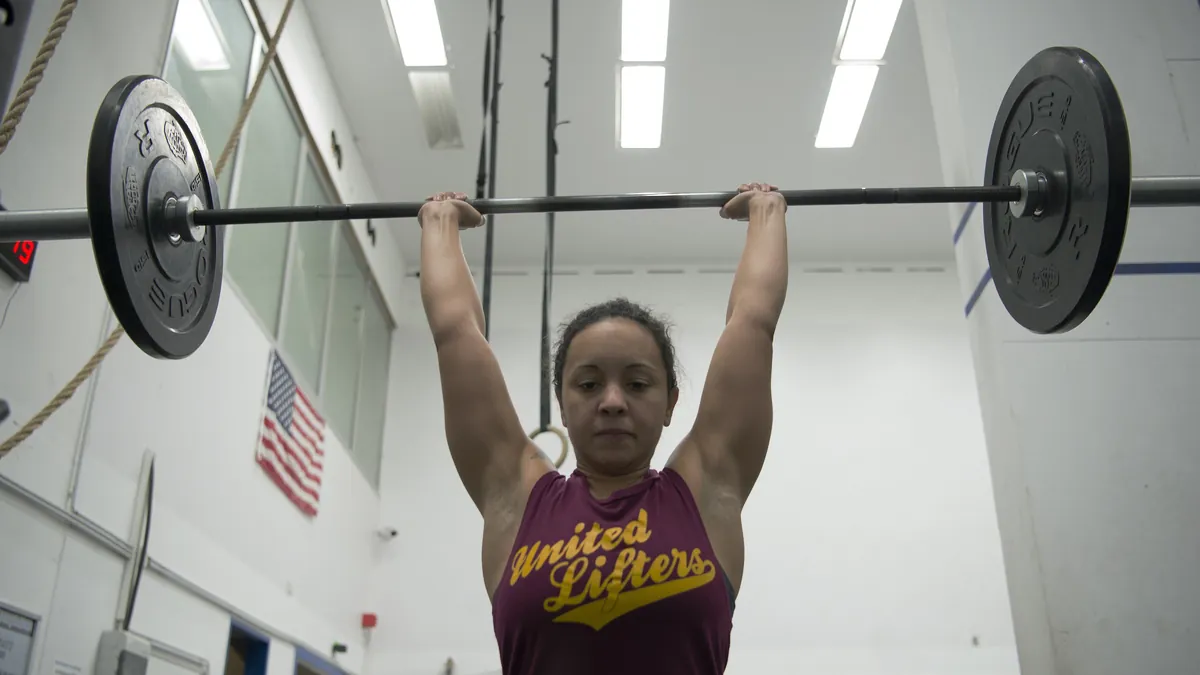
Overhead press: correct technique, mistakes and which variation to choose
Published on
Standing with a barbell you lift the most; standing with dumbbells the deltoids work hardest. Step-by-step technique, typical mistakes and what studies say about each variation.
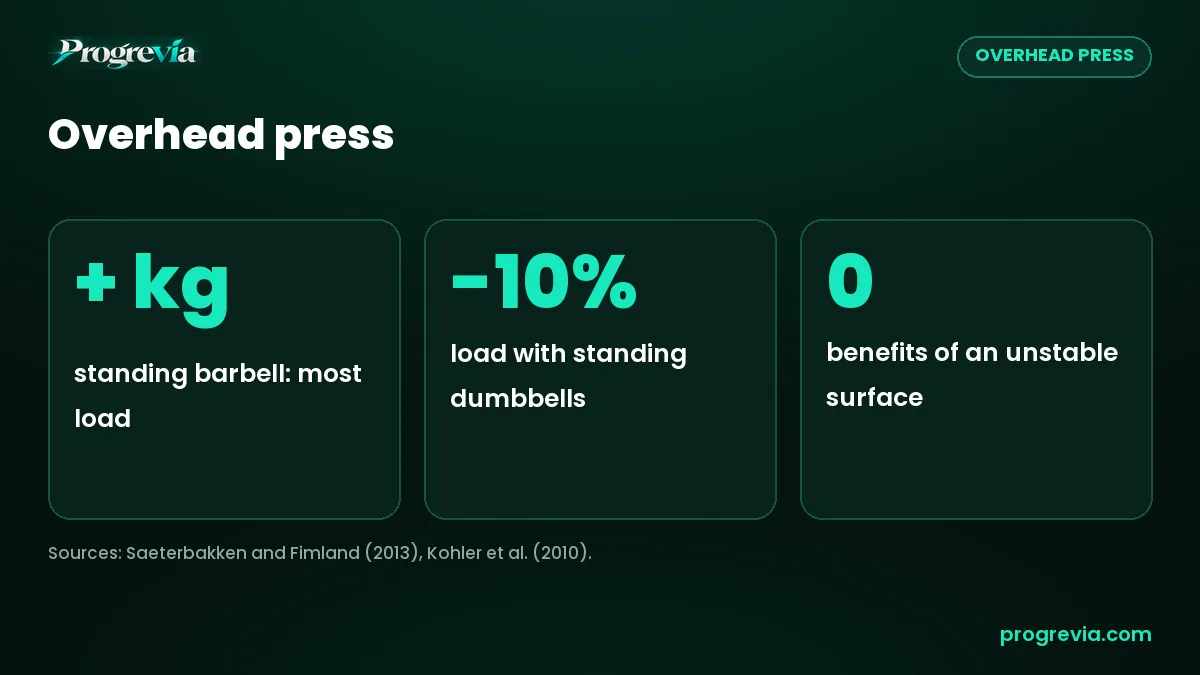
In 2013, Atle Saeterbakken, from Sogn og Fjordane University College (Norway), had 15 men do the shoulder press four ways: standing or seated, and with a barbell or with dumbbells. He measured how much weight they lifted and how much each part of the shoulder worked at 80% of their maximum. The version with the most weight was the standing barbell press; the one that worked the deltoids hardest was the standing dumbbell press, which was also the one with the least weight: 7% less than the standing barbell and 10% less than seated dumbbells.
That is the first dilemma of the overhead press: more kilos or more shoulder work. Here is how to do it well, the typical mistakes and which variation to choose depending on what you want.
How to do the overhead press step by step
- The unrack. Take the bar out of the rack at collarbone height. Grip slightly wider than your shoulders, with your forearms vertical seen from the front.
- The base. Feet hip-width apart, glutes and abs tight. That way your torso does not arch as the bar rises.
- The start. Move your head slightly back so the bar passes close to your chin, without going around it.
- The press. Push the bar straight up. Once it passes your forehead, bring your head forward, "between your arms".
- At the top. Arms straight, bar over the middle of your foot and biceps close to your ears.
- The descent. Lower under control to your collarbones, moving your head out of the way again.
Common overhead press mistakes
| Mistake | What happens | Fix |
|---|---|---|
| Arching the lower back a lot | The press turns into an incline press and loads the back | Glutes and abs tight; if you cannot, lower the weight |
| Bar drifting forward | You lose strength and the shoulder suffers more | Straight path: move your head instead of going around it with the bar |
| Elbows flared at the start | Less drive and more shoulder tension | Forearms vertical and elbows slightly in front of the bar |
| Using leg drive | It becomes a push press | Knees locked; if you need your legs, the load is too heavy |
| Short range | Less work at the bottom | Lower to your collarbones on every rep |
Read the video text
Standing or seated, barbell or dumbbells? + kg standing with a barbell: the version with the most load (Saeterbakken and Fimland, 2013). -10% load standing with dumbbells, but more deltoid work (Saeterbakken and Fimland, 2013). 0 benefits from doing it on a Swiss ball: less weight, nothing in return (Kohler et al., 2010). Straight bar path, no arched back. The video ends by showing how to create the routine in Progrevia.
Standing or seated, barbell or dumbbell overhead press
Each version has its reason. What Saeterbakken measured, in short:
- Standing with a barbell: the one that allows the most load. A good option if you are after strength.
- Standing with dumbbells: the one that worked the deltoids hardest, with less weight.
- Seated: with dumbbells more load was lifted than standing, but the rear deltoid worked around 25% less with a barbell and 24% less with dumbbells.
What extra instability does not add is benefit. In 2010, James Kohler (California State University, Northridge) compared, in 30 trained people, the seated shoulder press on a bench or on a Swiss ball, with a barbell or with dumbbells. The more unstable the condition, the less weight could be lifted, and the triceps worked most with a barbell on the bench. The authors concluded there is little support for training with lighter loads on unstable surfaces.
Overhead press in front of or behind the neck
In 2026, Riccardo Padovan (University of Milan) compared both versions in 14 trained men with their 8-rep-max load. In front, the front deltoid and the chest worked more; behind the neck, the rear deltoid, the upper trapezius and the triceps. The authors consider both useful. In practice, the behind-the-neck press demands more shoulder mobility: only do it if you can lower the bar without forcing your posture or feeling discomfort.
How to program the overhead press
- For strength: 3-5 sets of 4-6 reps with a standing barbell, 1-3 reps short of failure.
- For muscle: 3-4 sets of 6-12 reps; dumbbells fit well here.
- Where to place it: at the start of a push or upper-body session, before or after the bench press, depending on your priority.
- The rest of the shoulder: the press mainly loads the front deltoid. The side and rear deltoids need raises and flyes, which you will find in the best shoulder exercises.
To work out your training loads from one set, use the 1RM calculator, and to add weight week after week, progressive overload.
Safety: if your shoulder hurts when you raise your arms overhead, do not force it: try the neutral-grip dumbbell press or the landmine press and see a healthcare professional if the pain continues.
The Progrevia generator chooses between the barbell, dumbbell or machine overhead press according to your level and equipment, and avoids it if you flag a shoulder injury.
- Saeterbakken AH, Fimland MS. Effects of body position and loading modality on muscle activity and strength in shoulder presses. Journal of Strength and Conditioning Research. 2013;27(7):1824-1831.
- Kohler JM, Flanagan SP, Whiting WC. Muscle activation patterns while lifting stable and unstable loads on stable and unstable surfaces. Journal of Strength and Conditioning Research. 2010;24(2):313-321.
- Padovan R, Toninelli N, Longo S, Tornatore G, Esposito F, Cè E, Coratella G. High-Density Surface Electromyography Excitation in Front vs. Back Overhead Press Prime Movers. Journal of Human Kinetics. 2026;103:81-96.
Progrevia · · How we write our guides
Frequently asked questions
Which muscles does the overhead press work?
Mainly the front deltoid and the triceps, helped by the side deltoid, the trapezius and the upper chest. The trunk muscles work to hold your posture.
Is the overhead press better standing or seated?
Standing with a barbell you lift more and the rear of the shoulder works more. Seated is easier to control and with dumbbells allows more load. Both work.
Barbell or dumbbells?
With a barbell you load more; with dumbbells standing the deltoids worked harder in Saeterbakken's study (2013), although with less weight. Alternating them is a good option.
Is the behind-the-neck press dangerous?
It demands more shoulder mobility. If you can lower the bar without forcing it or feeling discomfort, it is a valid variation; if not, stick with the front press.
Why does my lower back hurt in the overhead press?
It is usually from arching your lower back to push. Tighten your glutes and abs, lower the weight and, if it still hurts, try the seated version with back support.
Informational content based on the available scientific evidence: it does not replace advice from a healthcare professional. If you have an injury or a medical condition, or are pregnant, check with one before changing your training or diet.
