
Parallel bar dips: correct technique, chest or triceps and how to protect your shoulders
Published on
On parallel bars the triceps works harder than on a bench, and the bench strains the shoulder most. Technique, variations, how low to go and how to get your first dip.
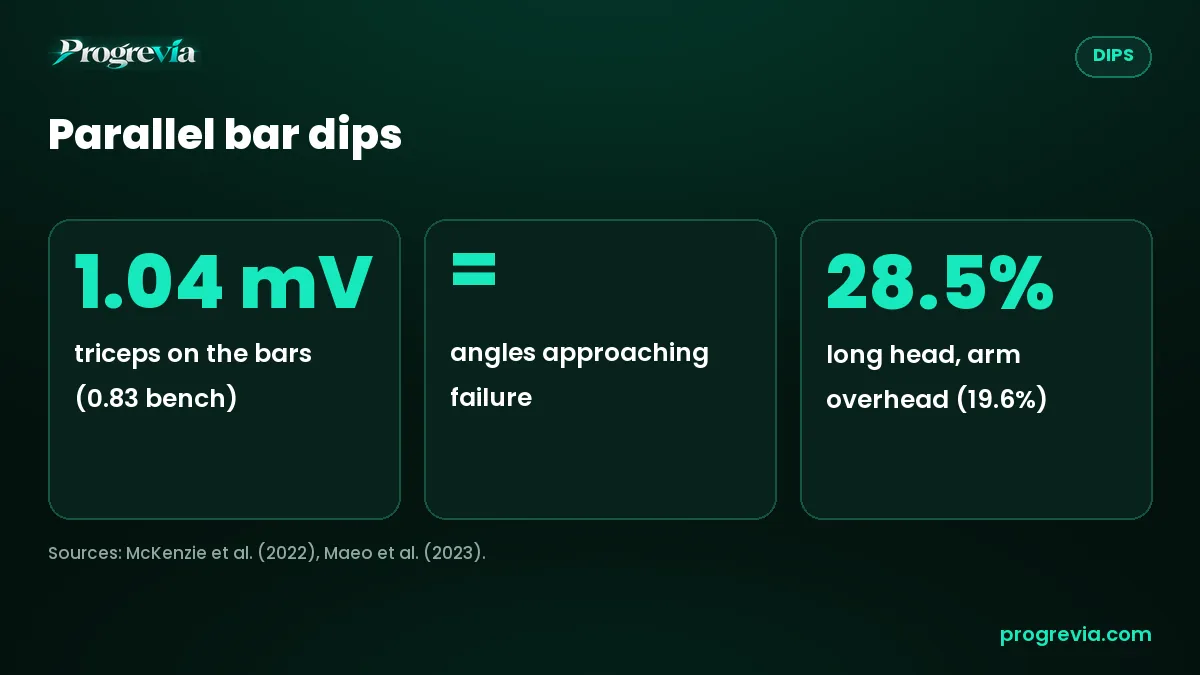
In 2022, Alec McKenzie and colleagues at Southern Cross University (Australia) used 3D motion capture and electromyography to record 13 experienced men doing three types of dips: on a bench, on parallel bars and on rings. Peak triceps activity was higher on the bars (1.04 mV) and the rings (1.05 mV) than on the bench (0.83 mV). And the bench dip, the one that looks easiest, was the one that took the shoulder furthest back.
Dips are one of the best bodyweight exercises for chest and triceps, and also one of the most often done badly. Here is the technique, what changes between variations, how low to go to protect your shoulder and how to progress if you cannot do a single one yet.
How to do parallel bar dips step by step
- The start. Grip the bars with your palms facing in and push up until your arms are straight, without snapping your elbows into lockout. Shoulders down, away from your ears.
- The descent. Bend your elbows and lower under control, with your elbows pointing back rather than flaring out to the sides.
- The bottom. Stop when your upper arm is roughly parallel to the floor, or earlier if you feel a pull at the front of the shoulder.
- The ascent. Push the bars down until your arms are straight again, without swinging your legs.
- Breathing. Breathe in at the top, hold it on the way down and breathe out as you finish the push.
Dips for chest or for triceps: torso angle
Dips work the chest, triceps and front of the shoulder at the same time. Changing your posture shares out the work differently:
- Torso leaning forward, legs slightly behind you and elbows a little wider: more chest, especially its lower part.
- Torso upright, legs under your body and elbows tucked: more triceps.
You do not have to pick one style forever. If dips are your main chest exercise, lean forward; if they come after the bench press to finish off the triceps, stay more upright. You will find the other options in the best chest exercises.
Read the video text
Bench, bars or rings? 1.04 mV peak triceps on the bars, more than on the bench (0.83 mV) (McKenzie et al., 2022). Same: maximum joint angles as you approach failure (McKenzie et al., 2022). 28.5% growth of the triceps long head with the arm overhead (19.6% by the side) (Maeo et al., 2023). Upper arm parallel to the floor, not an inch lower. The video ends by showing how to create the routine in Progrevia.
Bench, bar or ring dips
| Variation | Difficulty | What the study measured | Who it suits |
|---|---|---|---|
| Bench dips | The easiest | Less triceps activity (0.83 mV) and more shoulder extension | Beginners with no shoulder discomfort |
| Parallel bar dips | Intermediate | More triceps activity than on the bench (1.04 mV) | The next step when the bench falls short |
| Ring dips | The hardest | Triceps similar to the bars (1.05 mV) and three muscles even more active | Those who have mastered the bars |
The authors conclude that the bars are the logical progression from the bench and that the rings go one step further. About the bench they warn of something counter-intuitive: it forces the shoulder further back, so it is not the gentlest option if you have had shoulder pain.
Does your dip technique fall apart near failure?
The same team repeated the test that year with 15 men who did one set of parallel bar dips until they could not do any more. By the end of the set each rep took longer and the bottom position came earlier, but the maximum joint angles did not change. What did increase was the activity of the chest, the triceps and three stabiliser muscles.
In practice, dip technique holds up well under fatigue and sets close to failure keep working what you are after. What is worth watching is your position at the top: with fatigue, body position changed at the end of each rep. We explain it in training to failure.
Dips and your shoulders: how low to go
The shoulder is the joint that complains most during dips: at the bottom the upper arm sits behind the body and the front of the shoulder is stretched with all your weight on it. Three simple rules:
- Lower until your upper arm is parallel to the floor. Below that point the shoulder is stretched much more; if your mobility is not good, it is not worth it.
- Shoulders down and back. If they creep up towards your ears or roll forward, end the set.
- Bars at shoulder width. Very wide bars force your arms apart and load the joint more.
If you already have a shoulder injury, start with exercises that stretch it less and read how to train with a shoulder injury.
Are dips enough for your triceps?
Dips are among the exercises that load the triceps most, but they work it with the arm by your side. In 2023, Sumiaki Maeo (Ritsumeikan University, Japan) trained 21 adults for 12 weeks with cable elbow extensions: one arm overhead and the other by the side. With the arm overhead, the long head of the triceps grew 28.5% versus 19.6%, and the whole triceps 19.9% versus 13.9%, even while lifting less weight.
If you want to prioritise your triceps, pair dips with an overhead extension. You will find the full list in biceps and triceps exercises.
If you cannot do a single dip yet
- Bench dips with your knees bent, if your shoulder tolerates them.
- Assisted dips with a resistance band or on the counterweighted dip machine.
- Negative dips: jump to the top and lower slowly, over 3-5 seconds.
- Full dips with your bodyweight.
- Weighted dips: a belt with a plate, or a dumbbell held between your feet.
We develop the same logic of progressing with your bodyweight in calisthenics for beginners.
Common dip mistakes
- Going too low: more range is not always better; stop with your upper arm parallel to the floor.
- Shoulders up by your ears: push the bars down and keep your neck long.
- Elbows flared wide: they shift the load onto the shoulder; point them back.
- Swinging: momentum from the legs takes work away from the chest and triceps.
- Half reps at the top: finish every rep with your arms straight.
How to program dips
- Sets and reps: 2-4 sets of 6-12 reps, 1-3 reps short of failure. Once you go past 12 with your bodyweight, add weight.
- Where to put them: as the main pushing exercise in a routine without a bench, or after the bench press to finish off chest and triceps.
- Progression: more reps first, then more weight. We explain it in progressive overload.
Safety: if you feel pain at the front of the shoulder or in the breastbone, shorten the range or switch to a press, and see a healthcare professional if the discomfort continues.
The Progrevia generator can include dips when you train in a gym and leaves them out if you mark a shoulder, elbow or rotator cuff injury.
- McKenzie A, Crowley-McHattan Z, Meir R, Whitting J, Volschenk W. Bench, Bar, and Ring Dips: Do Kinematics and Muscle Activity Differ? International Journal of Environmental Research and Public Health. 2022;19(20):13211.
- McKenzie A, Crowley-McHattan Z, Meir R, Whitting J, Volschenk W. Fatigue Increases Muscle Activations but Does Not Change Maximal Joint Angles during the Bar Dip. International Journal of Environmental Research and Public Health. 2022;19(21):14390.
- Maeo S, Wu Y, Huang M, Sakurai H, Kusagawa Y, Sugiyama T, et al. Triceps brachii hypertrophy is substantially greater after elbow extension training performed in the overhead versus neutral arm position. European Journal of Sport Science. 2023;23(7):1240-1250.
Progrevia · · How we write our guides
Frequently asked questions
Which muscles do parallel bar dips work?
The chest, the triceps and the front of the shoulder. Leaning forward works the chest more; staying upright with elbows tucked works the triceps more.
Are dips bad for your shoulders?
Not if you control the range. At the bottom the shoulder is stretched with all your weight on it, so lower until your upper arm is parallel to the floor and stop if you feel a pull at the front.
Which is better, bench dips or bar dips?
In McKenzie's study (2022), the triceps worked harder on the bars and the bench took the shoulder further back. The bench is a starting point if your shoulder tolerates it; the bars are for progressing.
How many dips should I do?
2-4 sets of 6-12 reps, 1-3 reps short of failure. Once you go past 12 with your bodyweight, add weight with a belt or a dumbbell.
How do I get my first dip?
With assisted dips (resistance band or counterweighted machine) and negative dips, lowering over 3-5 seconds. Once you control the descent, move on to full dips.
Informational content based on the available scientific evidence: it does not replace advice from a healthcare professional. If you have an injury or a medical condition, or are pregnant, check with one before changing your training or diet.
