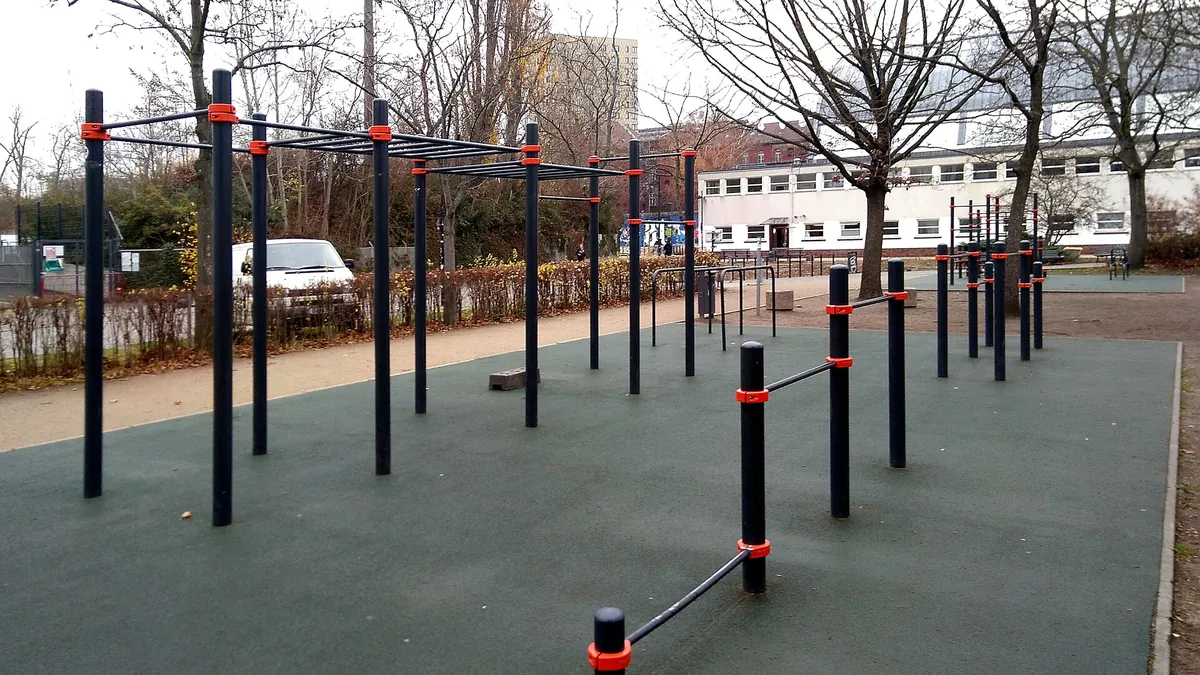
Calisthenics for beginners: routine, progressions and how much muscle you can build without weights
Published on
In four weeks, a group that only did progressive push-ups also improved its bench press, just like the group that trained on the bench. Calisthenics works if you progress by changing the exercise, not the weight. Here are the progression ladders and a routine to start with.
In 2018, Kotarsky and colleagues compared two groups over four weeks: one trained the bench press and the other did only push-ups, moving to harder variations as they progressed. Both groups significantly improved their maximum bench press. Three years earlier, Calatayud (2015) had seen something similar with band-resisted push-ups: when muscle activation was comparable, the strength gained was too.
Calisthenics, training with your own bodyweight, is not a watered-down version of the gym. It has a different rule: you do not progress by adding plates, but by making the exercise harder. Once you understand that, you can build strength and muscle with a bar, a set of parallel bars and the floor.
Can you build muscle with calisthenics alone?
Yes, especially in the first years. Muscle responds to effort close to failure, not to where the load comes from. The meta-analysis by Schoenfeld and colleagues (2017) found that muscle growth was similar with low and high loads when sets were taken to failure; maximal strength, on the other hand, improved more with heavy loads.
For push-ups there is direct data: in the study by Kikuchi and Nakazato (2017), eight weeks of push-ups adjusted to equal 40% of the bench press maximum increased chest and triceps thickness just like bench pressing with that same load. And in the trial by Thomas and colleagues (2017), eight weeks of calisthenics improved strength, posture and body composition compared with a control group, with no machines.
The real limit: the studies are small and short, and almost all were done with young men. For the upper body, calisthenics is more than enough for years; the legs are its weak spot, because bodyweight squats quickly fall short.
What you need to get started
- A pull-up bar: at home, in a door frame, or in any calisthenics park.
- Something for dips and rows: park parallel bars, two sturdy chairs or a solid table.
- Optional: resistance bands to assist pull-ups, and rings or a suspension trainer for inverted rows.
If you do not have a bar, you can start with the no-equipment home workout and add pulling once you get one.
The progression ladders
Each movement pattern has a ladder. Start on the step where you can do at least 3 sets with good technique, and move up when you hit the target in the right-hand column.
| Level | Exercise | Move on when you can do |
|---|---|---|
| 1 | Wall push-ups | 3 × 15 |
| 2 | Incline push-ups on a bench or table | 3 × 15 |
| 3 | Knee push-ups | 3 × 15 |
| 4 | Full push-ups | 3 × 12-15 |
| 5 | Feet-elevated or diamond push-ups | 3 × 12 |
| 6 | Parallel bar dips / archer push-ups | 3 × 10 |
| Level | Exercise | Move on when you can do |
|---|---|---|
| 1 | Inverted row with the body steeply inclined (high bar) | 3 × 12 |
| 2 | Inverted row with the body almost horizontal (low bar) | 3 × 12 |
| 3 | Pull-up negatives (lower over 3-5 s) | 3 × 5 |
| 4 | Band-assisted pull-ups | 3 × 8 |
| 5 | Full pull-ups | 3 × 8-10 |
| 6 | Weighted or archer pull-ups | 3 × 6-8 |
| Level | Exercise | Move on when you can do |
|---|---|---|
| 1 | Squat to a chair or box | 3 × 15 |
| 2 | Full squat | 3 × 20 |
| 3 | Alternating lunges | 3 × 12 per leg |
| 4 | Bulgarian split squat | 3 × 12 per leg |
| 5 | Assisted single-leg squat (holding a post) | 3 × 8 per leg |
| 6 | Pistol squat | 3 × 5-8 per leg |
The technique for each step is covered in push-ups: technique and variations, pull-ups from zero and Bulgarian split squat.
Beginner calisthenics routine (3 days)
Three full-body sessions a week, with a rest day between them (for example, Monday, Wednesday and Friday). Alternate sessions A and B. For each exercise, pick the step that matches your level.
| Session A | Sets × reps | Session B | Sets × reps |
|---|---|---|---|
| Push (your level) | 3 × 8-15 | Pull (your level) | 3 × 5-12 |
| Pull (your level) | 3 × 5-12 | Push (your level) | 3 × 8-15 |
| Legs (your level) | 3 × 10-20 | Single-leg work | 3 × 8-12 per leg |
| Glute bridge | 3 × 15-20 | Pike push-up (shoulders) | 3 × 6-12 |
| Plank | 3 × 20-45 s | Hollow body hold or hanging knee raise | 3 × 20-30 s / 8-12 |
Rest 1.5-2 minutes between sets. Finish every set with 1-3 reps in reserve: with bodyweight it is easy to let technique slip while chasing one more rep. The reasoning is in training to failure.
How to progress without weights
Progressive overload exists here too; only the levers change. From easiest to hardest to apply:
- More reps within the range (from 8 to 12, for example).
- More sets, up to 4 per exercise.
- A slower tempo: lowering over 3-4 seconds increases time under tension.
- Pauses at the hardest point (at the bottom of a push-up, at the top of a pull-up).
- Moving up a step on the progression table: the change in leverage is your new plate.
- Adding weight: a backpack with books or a dip belt with plates once the full version falls short.
The weak spot: legs
Bodyweight squats stop being enough of a stimulus within a few weeks. The fix is to move early to single-leg exercises (Bulgarian split squats, lunges, assisted pistols), which double the relative load, and to add slow tempo and pauses. If you want more over time, a loaded backpack or a pair of dumbbells changes the equation. There are more ideas in leg exercises.
Calisthenics or weights: which to choose
| Aspect | Calisthenics | Weights |
|---|---|---|
| Cost and access | Almost free; parks and home | Gym membership or equipment |
| Progression | Through leverage and variations: more of a learning curve | Add weight: simple and measurable |
| Upper body | Excellent for years | Excellent |
| Legs | Falls short without single-leg work or added load | Very easy to load |
| Maximal strength | Relative (moving your body) | Absolute (moving more kilos) |
| Skills | Pull-ups, dips, handstand, muscle-up | Not the goal |
It is not a choice for life: plenty of people combine both. If the no-gym approach appeals to you, carry on with how to build muscle at home and strength without a gym.
Common beginner mistakes
- Skipping steps to do pull-ups or dips too early: technique breaks down and your elbows and shoulders pay for it.
- Only training push because push-ups can be done anywhere. Without pulling, posture and shoulders get out of balance.
- Chasing skills before a base: the muscle-up comes much faster with solid pull-ups and dips.
- Not logging anything. Without a log you cannot tell whether you are progressing; write down the step, sets and reps.
The Progrevia generator builds routines for training at home with no equipment or with dumbbells, with exercises adapted to your level and your days, and week-by-week progression already planned.
- Kotarsky CJ, Christensen BK, Miller JS, Hackney KJ. Effect of progressive calisthenic push-up training on muscle strength and thickness. Journal of Strength and Conditioning Research. 2018;32(3):651-659.
- Calatayud J, Borreani S, Colado JC, Martin F, Tella V, Andersen LL. Bench press and push-up at comparable levels of muscle activity results in similar strength gains. Journal of Strength and Conditioning Research. 2015;29(1):246-253.
- Kikuchi N, Nakazato K. Low-load bench press and push-up induce similar muscle hypertrophy and strength gain. Journal of Exercise Science and Fitness. 2017;15(1):37-42.
- Schoenfeld BJ, Grgic J, Ogborn D, Krieger JW. Strength and hypertrophy adaptations between low- vs. high-load resistance training: a systematic review and meta-analysis. Journal of Strength and Conditioning Research. 2017;31(12):3508-3523.
- Thomas E, Bianco A, Mancuso EP, Patti A, Tabacchi G, Paoli A, et al. The effects of a calisthenics training intervention on posture, strength and body composition. Isokinetics and Exercise Science. 2017;25(3):215-222.
Progrevia · · How we write our guides
Frequently asked questions
Can you build muscle with calisthenics alone?
Yes. Muscle growth is similar with low and high loads if sets get close to failure (Schoenfeld, 2017), and progressive push-ups have produced strength gains comparable to the bench press (Kotarsky, 2018). The legs are the weak spot: they need single-leg exercises or added load.
How many days a week should a beginner do calisthenics?
Three full-body days with a rest day between them is a good starting point: enough stimulus for every muscle and time to recover and learn technique.
What if I cannot do a single pull-up?
Start with inverted rows, then pull-up negatives (lowering over 3-5 seconds) and then band-assisted pull-ups. Most people get their first full pull-up within a few weeks by following that ladder.
Is calisthenics better than weights?
For the upper body both work very well. Weights are easier to progress and to load for the legs; calisthenics is almost free and builds skills with your own body. Many people combine the two.
How do I progress in calisthenics without adding weight?
By adding reps and sets, lowering more slowly, pausing at the hardest point and moving to harder variations, such as from knee push-ups to full push-ups or feet-elevated push-ups.
Informational content based on the available scientific evidence: it does not replace advice from a healthcare professional. If you have an injury or a medical condition, or are pregnant, check with one before changing your training or diet.
