Barbell row: correct technique, mistakes and when to swap it for another row
Published on
It works the whole back, but it is the row that loads the lower back most according to McGill's measurements. Step-by-step technique, typical mistakes and which row to choose.
In 2009, Stuart McGill's team at the University of Waterloo (Canada) compared three rows in 7 men: the inverted row hanging from a bar, the standing bent-over barbell row and the one-arm cable row. They measured muscle activity and the load on the lumbar spine. The barbell row strongly and symmetrically activated the whole back, from top to bottom, but it was also the one that loaded the lower back most. The inverted row activated the lats most with the lowest load on the spine.
That is why the barbell row has a reputation as a complete exercise and, at the same time, as one that punishes the lower back when done badly. Here is the technique, the typical mistakes and when to swap it for another row.
How to do the barbell row step by step
- The position. Feet hip-width apart, bar over the middle of your foot. Grip slightly wider than your shoulders, palms facing you.
- The hinge. Bend your knees slightly and push your hips back until your torso is between 30 and 45 degrees above horizontal. Neutral back: neither rounded nor heavily arched.
- The pull. Pull the bar towards your abdomen, below your chest, with your elbows going back and fairly close to your body.
- At the top. Squeeze your shoulder blades together for an instant without lifting your torso.
- The descent. Lower under control until your arms are straight, without your back rounding at the end.
Your torso should stay still for the whole set. If it rises and falls to help the bar, the weight is too heavy.
Common barbell row mistakes
| Mistake | What happens | Fix |
|---|---|---|
| Rounded back | More load on the lower back | Chest out and abs braced; reduce the load |
| Torso rising on each rep | Momentum instead of back work | Fix your torso angle and lower the weight |
| Pulling to the upper chest | More arm and shoulder work | Pull the bar to your abdomen, elbows going back |
| Short range | The shoulder blades neither squeeze nor spread | Arms straight at the bottom and shoulder blades together at the top |
| Neck craned up | Neck tension | Eyes on the floor, about a metre in front of your feet |
Read the video text
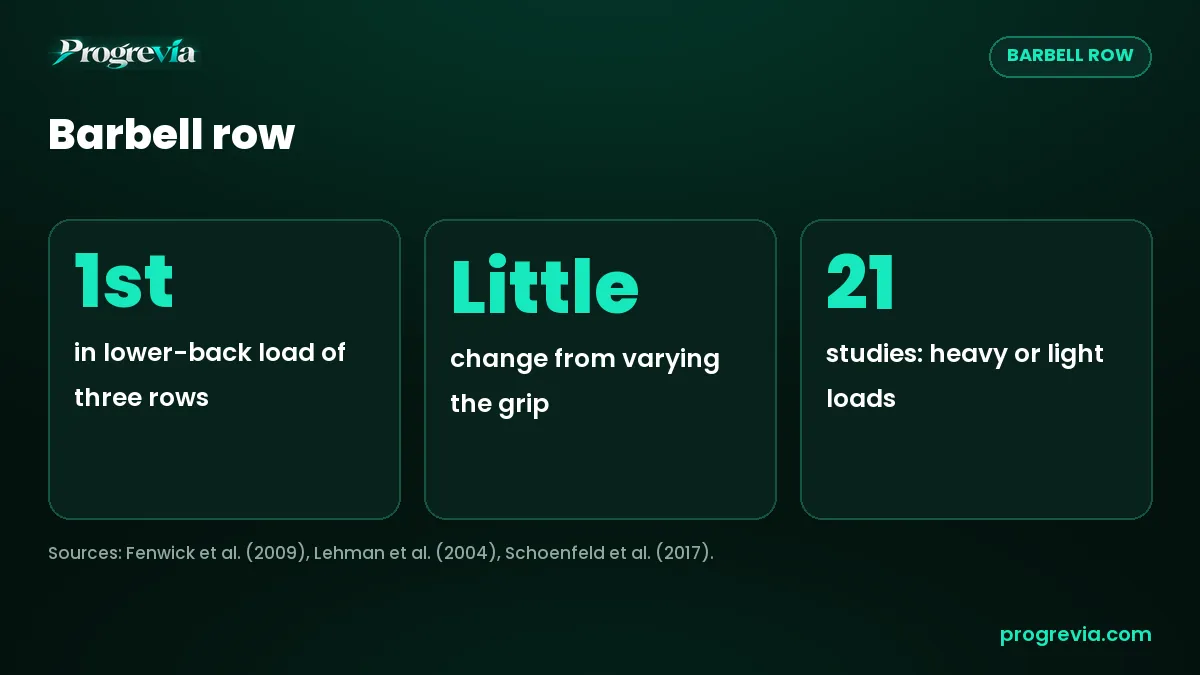
Does the barbell row punish your back? 1st in lower-back load of the three rows measured, with lots of back work (Fenwick et al., 2009). Little change in activation when you vary the grip: pick the comfortable one (Lehman et al., 2004). 21 studies: heavy and light loads to failure give similar muscle (Schoenfeld et al., 2017). Lower-back discomfort? Supported row. The video ends by showing how to create the routine in Progrevia.
Does grip matter in the barbell row?
Less than people usually say. In 2004, Gregory Lehman (Canadian Memorial Chiropractic College, Toronto) measured the lats, the biceps and the middle trapezius in pulldowns and seated rows with different grips. The seated row gave the highest activity of the mid back, and actively squeezing the shoulder blades did not change it. His conclusion was that these variations only produce small changes. In practice, choose the grip that lets you pull most comfortably and without elbow or wrist discomfort.
Barbell row or supported row: which to choose
| Row | For | Against |
|---|---|---|
| Barbell, bent over | Heavy load and work for the whole back | The highest lower-back load of the three McGill measured |
| Inverted (hanging) | More lats and less lower-back load | Hard to load for strong people |
| Chest-supported | No lower-back load, easy to take close to failure | Needs an incline bench or a machine |
| One-arm cable or dumbbell | Works each side separately | Slower: one set per side |
If you are coming from a deadlift or heavy squat day, the supported row is a better choice to avoid piling up fatigue in your lower back. We explain it in lower back pain at the gym.
How to program the barbell row
- Sets and reps: 3-4 sets of 6-12 reps, 1-3 reps short of failure.
- Heavy or light loads: the meta-analysis by Brad Schoenfeld (Lehman College, New York), with 21 studies, found similar hypertrophy with light and heavy loads taken to failure, and more maximal strength with heavy ones. In the row, moderate loads make it easier to hold your posture.
- Balance across the week: pair a row with a vertical pull, such as pull-ups or the pulldown. The full guide is in the best back exercises.
- Grip: if the bar slips before your back gives out, work on grip strength or use straps for the last sets.
Safety: if you have a lower back injury or back pain when you bend over, start with the chest-supported row and see a healthcare professional before going back to the barbell row.
The Progrevia generator alternates barbell, dumbbell, cable and supported rows depending on your equipment and avoids the bent-over row if you flag a lower back injury.
- Fenwick CM, Brown SH, McGill SM. Comparison of different rowing exercises: trunk muscle activation and lumbar spine motion, load, and stiffness. Journal of Strength and Conditioning Research. 2009;23(5):1408-1417.
- Lehman GJ, Buchan DD, Lundy A, Myers N, Nalborczyk A. Variations in muscle activation levels during traditional latissimus dorsi weight training exercises: An experimental study. Dynamic Medicine. 2004;3(1):4.
- Schoenfeld BJ, Grgic J, Ogborn D, Krieger JW. Strength and hypertrophy adaptations between low- vs. high-load resistance training: a systematic review and meta-analysis. Journal of Strength and Conditioning Research. 2017;31(12):3508-3523.
Progrevia · · How we write our guides
Frequently asked questions
Which muscles does the barbell row work?
The lats, mid trapezius, rhomboids and rear deltoids, helped by the biceps. The spinal erectors work to hold the bent-over torso.
Is the barbell row bad for the lower back?
It is not bad, but it is the row that loads the lower back most of those McGill's team measured. With good technique and a suitable load it is safe; if you have discomfort, use a supported row.
Overhand or underhand grip for the row?
Activation differences between grips are small. Choose the one that lets you pull comfortably and without elbow or wrist discomfort.
How far should I bend over in the barbell row?
Between 30 and 45 degrees above horizontal is a good starting point. What matters is keeping that angle fixed throughout the set.
How many sets of barbell rows should I do?
3-4 sets of 6-12 reps, 1-3 reps short of failure, combined during the week with a vertical pull such as pull-ups.
Informational content based on the available scientific evidence: it does not replace advice from a healthcare professional. If you have an injury or a medical condition, or are pregnant, check with one before changing your training or diet.
