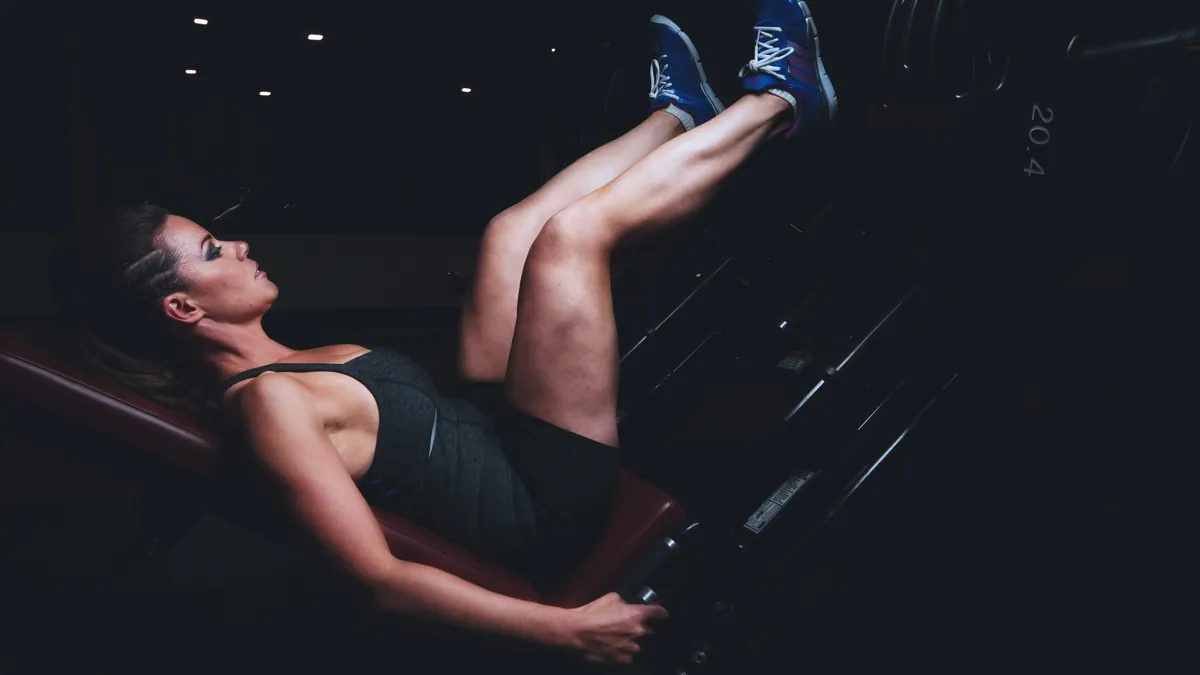
Leg press: correct technique, foot position and whether it can replace the squat
Published on
In 12 weeks, the leg press grew the quadriceps almost as much as the leg extension, plus the glutes by 15.4%. How to do it, where to put your feet and when to swap it for the squat.
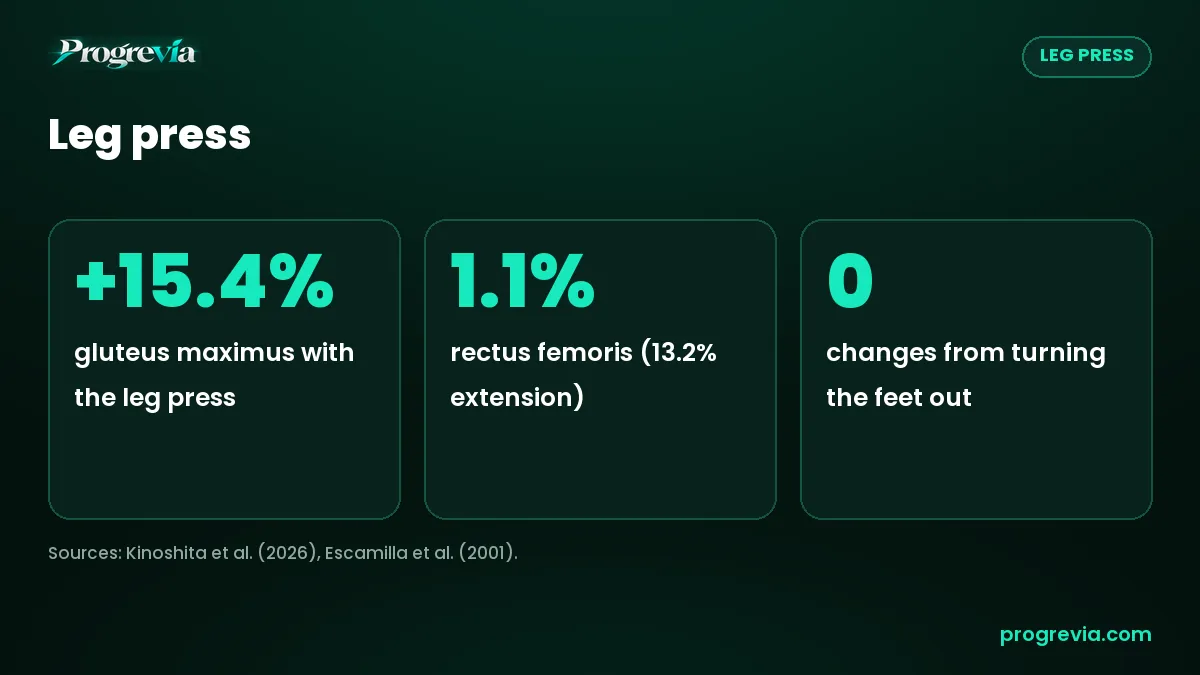
In 2026, Momoka Kinoshita and colleagues at Ritsumeikan University (Japan) had 17 untrained adults train for 12 weeks in an unusual way: one leg did machine leg extensions and the other did the leg press. They then measured 17 muscles with MRI. The quadriceps grew similarly with both exercises (4.9% with the leg press and 7.1% with the extension, a difference that was not significant), but the leg press also grew the gluteus maximus by 15.4% and the adductor magnus by 6.2%. The extension did not.
The leg press is one of the most useful machines in the gym and also one of the most misused: lots of weight, little range and the pelvis lifting off the pad. Here is how to do it well, what changes with foot position and when it can replace the squat.
How to do the leg press step by step
- The seat. Back and hips firmly against the pad. Adjust it so that, at the very bottom, your pelvis does not have to lift.
- The feet. In the middle of the platform, hip-width apart or slightly wider, toes turned out a little.
- The descent. Release the safeties and lower the platform by bending your knees and hips, with your knees tracking the direction of your feet.
- The bottom. Go as deep as you can without your lower back leaving the pad or your heels leaving the platform.
- The ascent. Push through your whole foot, especially the heel and midfoot, and finish without snapping your knees into lockout.
Which muscles the leg press works (and which one it misses)
The leg press mainly works the vasti, the three heads of the quadriceps that only cross the knee. A 2020 systematic review led by Isabel Martín-Fuentes (University of Almería) gathered the electromyography studies of the leg press and its variations: the vastus lateralis and vastus medialis were the most active muscles, closely followed by the rectus femoris, and quadriceps activity rose the more the knee bent.
Kinoshita's study adds the detail that matters for building muscle: the rectus femoris, the head of the quadriceps that also crosses the hip, barely grew with the leg press. In exchange, the leg press grew the gluteus maximus and adductor magnus, which the extension did not.
| Muscle | Leg press | Leg extension |
|---|---|---|
| Whole quadriceps | +4.9% | +7.1% |
| Rectus femoris | +1.1% | +13.2% |
| Gluteus maximus | +15.4% | No increase |
| Adductor magnus | +6.2% | No increase |
Read the video text
Can the leg press replace the squat? +15.4% gluteus maximus growth with the leg press; with the extension, none (Kinoshita et al., 2026). 1.1% rectus femoris growth with the leg press, versus 13.2% with the extension (Kinoshita et al., 2026). 0 changes from turning the feet out: not in the muscles or the knee (Escamilla et al., 2001). Go down as far as your back stays on the pad. The video ends by showing how to create the routine in Progrevia.
Leg press foot position: high, low, wide or narrow
In 2001, Rafael Escamilla (Duke University, United States) measured muscle activity and knee forces in 10 experienced lifters with their feet high and low on the platform, narrow and wide, and straight or turned out 30 degrees. These were the results:
- Turning the feet out changed neither muscle activity nor knee forces.
- With the feet high, a wider stance increased hamstring activity.
- Knee forces were similar with the feet high and low, and the leg press produced no strain on the anterior cruciate ligament.
- With a narrow stance, knee compression was greater than with a wide stance.
| Position | What changes | When to use it |
|---|---|---|
| Feet low | More knee bend: more range for the quadriceps | If you are after quadriceps and your ankles and knees tolerate it |
| Feet high | Less knee bend and more hip bend | If your knee bothers you when it bends a lot |
| Wide stance | More hamstrings when the feet are high | To share the work with the back of the thigh |
| Narrow stance | More knee compression | With care if you have knee discomfort |
Martín-Fuentes's review warns that there are few studies on the variations and they do not always agree, so there is no need to obsess: choose the position that lets you go deepest without discomfort and keep it so you can compare your progress.
Leg press or squat?
In Escamilla's study, the squat activated the quadriceps and hamstrings more than the leg press, and it also loaded the knee more. In Kinoshita's, the leg press grew the quadriceps and glutes without having to balance a bar. The two facts fit together:
- The squat demands balance, technique and trunk stability, and the strength you gain carries over more outside the gym.
- The leg press lets you load your legs when your back, your technique or fatigue limits the squat, and it is easy to progress.
To build muscle, you can base your leg days on either one or combine them. We cover it in machines or free weights and in squat technique.
Your lower back on the leg press: the costliest mistake
When you go deeper than your mobility allows, your pelvis rotates and your lower back lifts off the pad. At that moment your spine bends with the whole load of the machine on top. To avoid it:
- Adjust the backrest and depth so your pelvis stays down.
- Move your feet a little higher on the platform if you struggle to go down without rounding your back.
- Hold the side handles to keep your hips pressed into the seat.
If you already have low back pain, the leg press can be an alternative to the barbell squat; we look at it in low back pain and the gym.
Common leg press mistakes
- Lots of weight, little range: a few centimetres with the whole stack loaded works little muscle. Take weight off and go deeper.
- Snapping the knees into lockout: finish with your knees almost straight and under control.
- Knees caving in: they should track the direction of your feet.
- Heels lifting: push through your whole foot.
- Holding your breath for the whole set: in long sets, breathe out at the end of each push.
How to program the leg press
- Sets and reps: 2-4 sets of 8-15 reps, 1-3 reps short of failure.
- Where to put it: as your main leg exercise or after the squat.
- What to pair it with: to develop the whole quadriceps, add the leg extension, which is what grows the rectus femoris, and a hamstring exercise. You will find ideas in leg exercises.
- Progression: more reps with the same weight and, when you reach the top of the range, more weight. We explain it in progressive overload.
Safety: always set the machine's safeties and do not let your lower back lift off the pad. If you feel knee or back pain, shorten the range and see a healthcare professional if the discomfort continues.
The Progrevia generator can include the leg press on your leg days when you have machines, and keeps it if you mark a lower back injury, which does rule out the squat and the deadlift.
- Kinoshita M, Maeo S, Kobayashi Y, Eihara Y, Nishizawa N, Kusagawa Y, et al. Hypertrophic Effects of Single- versus Multi-Joint Exercise: A Direct Comparison between Knee Extension and Leg Press. Medicine and Science in Sports and Exercise. 2026;58(7):1566-1580.
- Escamilla RF, Fleisig GS, Zheng N, Lander JE, Barrentine SW, Andrews JR, et al. Effects of technique variations on knee biomechanics during the squat and leg press. Medicine and Science in Sports and Exercise. 2001;33(9):1552-1566.
- Martín-Fuentes I, Oliva-Lozano JM, Muyor JM. Evaluation of the Lower Limb Muscles' Electromyographic Activity during the Leg Press Exercise and Its Variants: A Systematic Review. International Journal of Environmental Research and Public Health. 2020;17(13):4626.
Progrevia · · How we write our guides
Frequently asked questions
Which muscles does the leg press work?
Mainly the vasti of the quadriceps. In Kinoshita's study (2026) it also grew the gluteus maximus and adductor magnus, but barely the rectus femoris.
Where should I put my feet on the leg press?
In the middle of the platform, hip-width or slightly wider. Low feet give the quadriceps more range; high feet mean less knee bend. Turning them out did not change muscle activity in Escamilla's study (2001).
Can the leg press replace the squat?
For building quadriceps and glute muscle, yes. The squat activates more muscle and demands more technique and balance; the leg press is easier to load when your back or technique is the limit.
How deep should I go on the leg press?
As deep as you can without your lower back leaving the pad or your heels leaving the platform. If your pelvis lifts, adjust the seat or move your feet a little higher.
How many sets of leg press should I do?
2-4 sets of 8-15 reps, 1-3 reps short of failure, as your main leg exercise or after the squat.
Informational content based on the available scientific evidence: it does not replace advice from a healthcare professional. If you have an injury or a medical condition, or are pregnant, check with one before changing your training or diet.
