
How many days a week should you go to the gym? By goal and time
Published on
For health, 2 strength days are enough; to build muscle, 3 or 4 work for almost everyone. What the WHO and meta-analyses say, and how to spread 1 to 6 days.
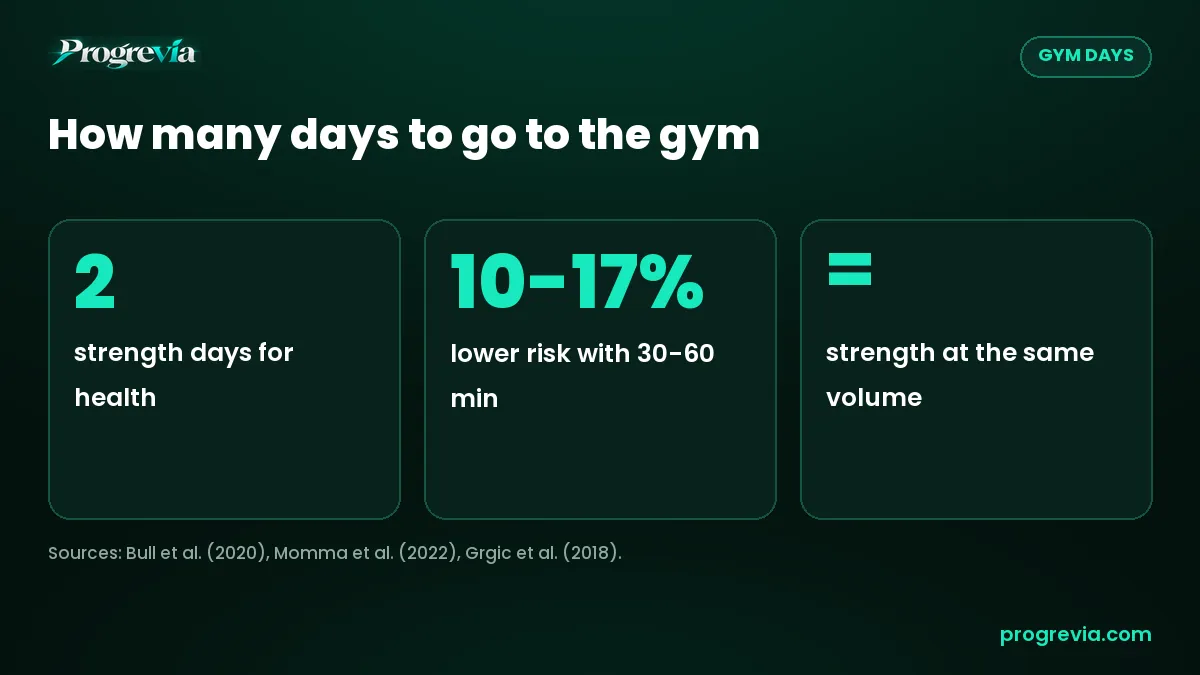
In 2022, Haruki Momma and his team at Tohoku University (Japan) pooled 16 studies that followed healthy adults for years. Those who did strength exercise had a 10% to 17% lower risk of death from any cause, cardiovascular disease, cancer and diabetes. The largest reduction, around 10-20%, appeared with 30-60 minutes of strength training a week.
Half an hour or an hour a week fits into one or two gym days. Building muscle takes a bit more, but not as much as people usually think. Here is how many days to go depending on what you want and how to spread them.
How many days a week should you go to the gym?
It depends on your goal and the time you have. As a starting point:
| Goal | Strength days | How to spread them |
|---|---|---|
| General health | 2 | Full body on those 2 days, plus walking or cardio the rest of the week |
| Starting from scratch | 2-3 | Full body, with a rest day between sessions |
| Building muscle | 3-4 | Full body or upper/lower |
| Building strength | 3-4 | The main lifts 2 times a week |
| Losing fat | 3 | Strength to keep muscle, plus steps and diet |
| Experienced and with time | 5-6 | Push/pull/legs or repeated upper/lower |
The World Health Organization, in its 2020 guidelines coordinated by Fiona Bull, recommends that adults do 150 to 300 minutes of moderate aerobic activity a week, or 75 to 150 of vigorous activity, and strength exercises for all major muscle groups on at least 2 days a week.
Do more gym days give better results?
Only if they mean more work. Two meta-analyses show it:
- Strength. In 2018, Jozo Grgic (Victoria University, Melbourne) pooled 22 studies. Strength rose slightly more the more often people trained (effect sizes of 0.74, 0.82, 0.93 and 1.08 for 1, 2, 3 and 4 or more times a week), but when volume was the same, frequency no longer mattered.
- Muscle. In 2016, Brad Schoenfeld (Lehman College, New York) analysed 10 studies: training each muscle 2 times a week gave more hypertrophy than 1 time (0.49 versus 0.30) with the same volume. Whether 3 times beats 2 remained unresolved.
The practical conclusion: days are for spreading your sets. If you do the sets you need in 3 days, going 5 will not make you grow more. We explain it in training volume and in frequency per muscle.
Read the video text
How many days should you go to the gym? 2 strength days a week at least for health (Bull et al., 2020, WHO). 10-17% lower risk of death and disease with 30-60 minutes of strength a week (Momma et al., 2022). Same: strength with more or fewer days if the volume is the same (Grgic et al., 2018). The days you can keep up. The video ends by showing how to create the routine in Progrevia.
How many days to go to the gym if you are short on time
Momma's data suggest that much of the health benefit comes with 30-60 minutes of strength training a week. If you can only go one day, make it full body; if you can go two, even better. The sessions are ready in the 1-day routine and the 2-day routine, and to adjust the length, how long a workout should last.
How to spread your training days
- 2 or 3 days: full body on alternate days, for example Monday, Wednesday and Friday. It is in the 3-day routine.
- 4 days: upper and lower body twice each. We detail it in the 4-day routine and in upper/lower.
- 5 or 6 days: push/pull/legs or similar combinations, for experienced people who recover well. See the 5-day routine and the 6-day one.
The same muscle group needs rest between hard sessions; that is why 2- or 3-day splits alternate training and rest days, and 4-day or longer splits alternate muscle groups.
Signs you are going too many days
- Performance drops for several weeks in a row even though you sleep and eat well.
- Soreness and fatigue have not gone when you train the same muscle again.
- You struggle to stick to the plan and often miss sessions.
In any of these three cases, dropping a day usually works better than forcing it. The signs of doing too much are in overtraining.
What counts most: the best number of days is the one you can keep up for months. Three days a week kept up for a year bring more results than six days abandoned within a month.
In the Progrevia generator you choose from 1 to 6 days and the engine spreads the structure and weekly sets per muscle across those days.
- Bull FC, Al-Ansari SS, Biddle S, Borodulin K, Buman MP, Cardon G, et al. World Health Organization 2020 guidelines on physical activity and sedentary behaviour. British Journal of Sports Medicine. 2020;54(24):1451-1462.
- Momma H, Kawakami R, Honda T, Sawada SS. Muscle-strengthening activities are associated with lower risk and mortality in major non-communicable diseases: a systematic review and meta-analysis of cohort studies. British Journal of Sports Medicine. 2022;56(13):755-763.
- Grgic J, Schoenfeld BJ, Davies TB, Lazinica B, Krieger JW, Pedisic Z. Effect of Resistance Training Frequency on Gains in Muscular Strength: A Systematic Review and Meta-Analysis. Sports Medicine. 2018;48(5):1207-1220.
- Schoenfeld BJ, Ogborn D, Krieger JW. Effects of Resistance Training Frequency on Measures of Muscle Hypertrophy: A Systematic Review and Meta-Analysis. Sports Medicine. 2016;46(11):1689-1697.
Progrevia · · How we write our guides
Frequently asked questions
How many days a week do you need to go to the gym to see results?
With 2 strength days there are already health benefits and strength gains when starting out. To build muscle, 3 or 4 days are usually enough if you do the sets you need.
Is going to the gym every day bad?
No, if you alternate muscle groups and recover well. But with the same weekly volume it gives no more results than training 3 or 4 days.
How many days does the WHO recommend?
Strength exercises for all major muscle groups on at least 2 days a week, plus 150-300 minutes of moderate aerobic activity.
How many days at the gym to lose fat?
3 strength days to keep your muscle are usually enough. Fat loss is decided mainly by diet and daily activity, such as steps.
If I can only go one day, is it worth it?
Yes. Studies link 30-60 minutes of strength training a week with a lower risk of disease. Do a full-body session.
Informational content based on the available scientific evidence: it does not replace advice from a healthcare professional. If you have an injury or a medical condition, or are pregnant, check with one before changing your training or diet.
