What to eat before training: when, how much and the best foods for your goal
Published on
What you eat before training matters more for a long run than for a weights session. How long before to eat, which foods to choose and when coffee makes a difference.
Few questions come up in the gym as often as "what should I eat before training?". The short answer is that it depends on two things: how long you have until the session and what type of training you are going to do. An hour of weights and a two-hour bike ride do not call for the same thing, and what works at 7 in the morning is not what works at 7 in the evening.
In this guide you will see what the official sports nutrition position stands say, how many hours before you should eat and how much, specific meal examples depending on how much time you have, what happens if you train fasted, how to use coffee and how to avoid stomach trouble.
What the pre-workout meal is for
The pre-workout meal has three functions: making sure you arrive with energy, above all with muscle and liver glycogen topped up; making sure you are not hungry during the session; and making sure it does not upset you. Protein also starts supplying amino acids for recovery.
The key question is how much it matters. The systematic review and meta-analysis by Aird, Davies and Carson (2018) analysed 46 studies comparing fasted training with training after eating. Eating beforehand improved performance in prolonged aerobic exercise, lasting over an hour, but not in shorter aerobic efforts. In other words: the longer and more intense the session, the more what you eat beforehand matters.
The main idea: for a one-hour strength session, what counts most is what you eat across the whole day. For a long endurance session, the pre-workout meal can make a real difference.
How long before to eat and how much
The joint position of the US Academy of Nutrition and Dietetics, Dietitians of Canada and the American College of Sports Medicine, by Thomas, Erdman and Burke (2016), recommends between 1 and 4 grams of carbohydrate per kilo of body weight for the pre-exercise meal, taken between 1 and 4 hours beforehand. The closer to the session, the smaller the amount and the easier to digest.
| Time before | Type of meal | Guideline carbohydrate | What to avoid |
|---|---|---|---|
| 3-4 hours | Full meal: carbs, protein, vegetables and some fat | 1.5-3 g/kg (about 100-200 g) | Very large or very fatty dishes |
| 1-2 hours | Light meal: carbs and some protein | 1 g/kg (about 70 g) | Lots of fibre and lots of fat |
| 30-60 minutes | Quick-digesting snack | 15-30 g | Legumes, fried food, heavy dairy |
| Under 30 minutes | Nothing, or something liquid or very light | 0-15 g | Anything you have not tried before |
What about protein?
The International Society of Sports Nutrition position stand on nutrient timing, by Kerksick and colleagues (2017), states that taking protein before and after training can help increase strength and improve body composition, and that doses of 20-40 grams of quality protein maximally stimulate muscle protein synthesis. It also makes a useful point: the size and timing of the pre-workout meal influence how urgent it is to eat afterwards.
But there is no need to obsess over the clock. The meta-analysis by Schoenfeld, Aragon and Krieger (2013) on protein timing found that, once the other variables were controlled, taking it right around training did not improve strength or hypertrophy. The best predictor of muscle growth was total daily protein. If you eat enough protein spread over several meals, the exact timing becomes secondary.
Pre-workout meal ideas
| When | Example | Approx. carbs | Approx. protein |
|---|---|---|---|
| 3-4 h before | Rice (80 g uncooked) with chicken (150 g) and vegetables | 65 g | 40 g |
| 3-4 h before | Pasta (100 g uncooked) with tuna and tomato | 75 g | 30 g |
| 1-2 h before | Toast (2 slices) with turkey and a piece of fruit | 50 g | 15 g |
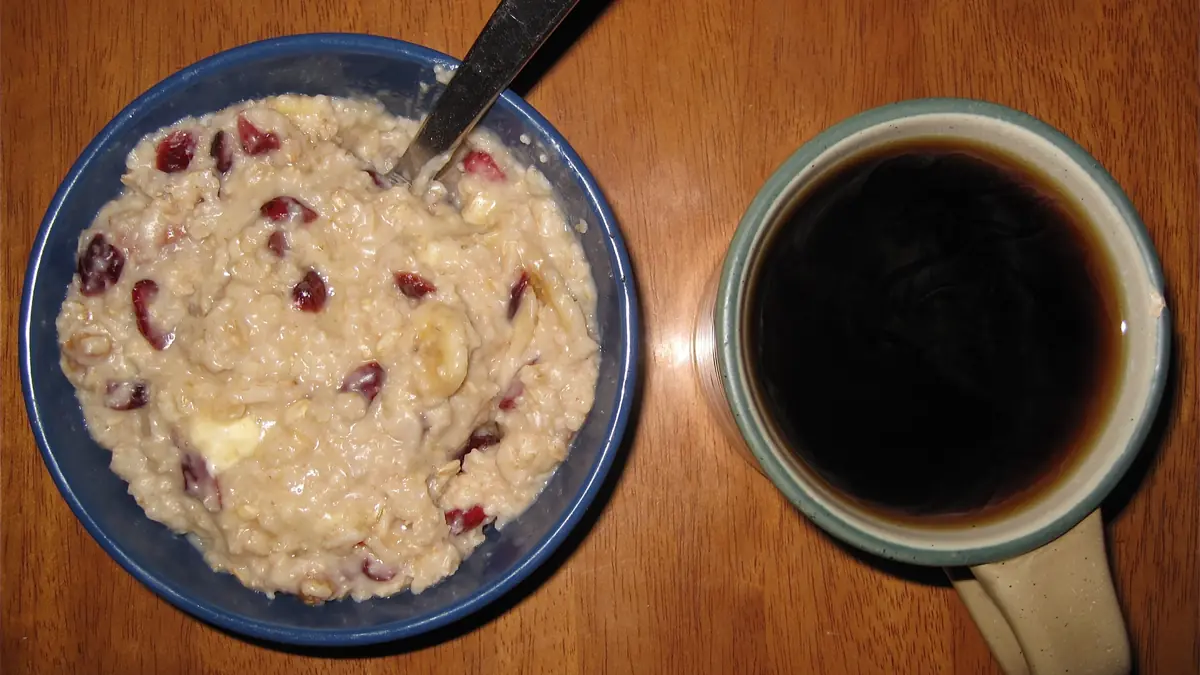
| 1-2 h before | Plain yoghurt with 50 g of oats and a banana | 60 g | 12 g |
| 30-60 min before | A banana | 25 g | 1 g |
| 30-60 min before | Two rice cakes with a little honey | 25 g | 2 g |
These are approximate figures: carbohydrate and protein vary by brand and portion. They give you a sense of scale, not an amount to count to the gram.
Depending on your goal and schedule
Before strength or hypertrophy training
For a 60-75 minute weights session, it is enough to have had a normal meal with carbs and protein a few hours earlier, or a light snack if a lot of time has passed. There is no need to carb-load: strength work uses glycogen, but a typical session does not deplete it if you eat normally during the day.
Before a long endurance session
Here the pre-workout meal does count. Burke and colleagues (2011) summarised in the Journal of Sports Sciences that in intense efforts of around an hour, small amounts of carbohydrate are enough, and even rinsing your mouth with a sugary drink improves performance via the nervous system. For longer efforts they recommend 30-60 grams of carbohydrate per hour during exercise, and up to 90 grams in events longer than two and a half hours. Arriving with a full tank, thanks to a carbohydrate-rich meal 3-4 hours beforehand, is the foundation.
If you train early in the morning
If you get up and train within an hour, there is no time for a full meal. Options: train fasted if it suits you, have something small and easy to digest, such as a banana or a drinkable yoghurt, or eat a good dinner the night before, which is what really fills your glycogen.
If you want to lose fat
The pre-workout meal does not change much: what matters is your total calorie deficit. Choose the option that lets you train at a higher quality, because a good session burns more than a mediocre one, and save carbohydrates for around training if that helps you structure your day.
What if I train fasted?
Fasted training is neither bad nor magic. According to Aird's meta-analysis (2018), fasted exercise increases the amount of fat used during the session, but eating beforehand improves performance in prolonged efforts. Burning more fat during the session does not mean losing more fat by the end of the week: we explain it in detail in fasted cardio: myth or reality.
In practice: if you train strength first thing and feel fine fasted, that is fine, as long as you eat protein afterwards. If you feel dizzy or weak, or perform worse, eat something.
Coffee before training: how much and when
Caffeine is one of the few supplements with solid evidence. The International Society of Sports Nutrition position stand by Guest and colleagues (2021) concludes that it improves performance in endurance, strength, sprinting and jumping, at doses of 3 to 6 mg per kilo taken about 60 minutes beforehand. The minimum effective dose may be as low as 2 mg per kilo, and very high doses, around 9 mg per kilo, trigger side effects without adding anything.
| Body weight | 3 mg/kg dose | Approximate equivalent |
|---|---|---|
| 55 kg | 165 mg | About two cups of filter coffee |
| 70 kg | 210 mg | A little over two cups |
| 85 kg | 255 mg | About three cups |
The European Food Safety Authority (EFSA) concluded in 2015 that single doses of up to 200 mg and up to 400 mg a day raise no safety concerns in healthy adults, and up to 200 mg a day during pregnancy. The amount per cup varies a lot depending on the coffee and how it is made, so the table is only a guide. If you train in the afternoon, remember that caffeine can affect sleep: avoid it in the 6 hours before bed. There is more on this and other supplements in the guide to supplements that work.
How to avoid stomach trouble
Digestive problems during exercise are very common. The review by de Oliveira, Burini and Jeukendrup (2014) estimates that they affect 30-50% of athletes, especially in endurance sports. One of the main causes is that during intense exercise less blood reaches the gut, and the problem gets worse with dehydration. What helps:
- Leave more time between the meal and training if the meal is large.
- Cut down on fibre, fat and protein in the meal closest to the session: they slow digestion.
- Avoid trying new things on race day or before an important session.
- Arrive hydrated: dehydration makes symptoms worse. See how much to drink in the guide on how much water to drink a day.
- Train your stomach: tolerating food before or during exercise can be trained too, little by little.
Common mistakes
- Eating a huge meal right before. Digestion competes with your muscles for blood.
- Taking a pre-workout with 300-400 mg of caffeine without realising. Check the label: many doses far exceed what is useful.
- Obsessing over protein right before and forgetting the daily total.
- Doing a long, intense session fasted and being surprised you perform worse.
- Copying what works for someone else. Digestive tolerance is highly individual.
Conclusion
For strength training, it is enough to have eaten normally a few hours earlier, or a carb snack if a lot of time has passed. For long endurance sessions, arrive with a carbohydrate-rich meal 3-4 hours beforehand (1-4 g per kilo) and reduce the amount the closer you are to the session. Coffee, at 3 mg per kilo an hour beforehand, improves performance. And remember that what matters most is what you eat all day, including your post-workout meal. If you want a routine that fits your schedule, Progrevia's routine generator builds it in a minute.
- Aird TP, Davies RW, Carson BP. Effects of fasted vs fed-state exercise on performance and post-exercise metabolism: a systematic review and meta-analysis. Scandinavian Journal of Medicine & Science in Sports. 2018;28(5):1476-1493.
- Thomas DT, Erdman KA, Burke LM. American College of Sports Medicine Joint Position Statement. Nutrition and Athletic Performance. Medicine & Science in Sports & Exercise. 2016;48(3):543-568.
- Kerksick CM, Arent S, Schoenfeld BJ, et al. International society of sports nutrition position stand: nutrient timing. Journal of the International Society of Sports Nutrition. 2017;14:33.
- Schoenfeld BJ, Aragon AA, Krieger JW. The effect of protein timing on muscle strength and hypertrophy: a meta-analysis. Journal of the International Society of Sports Nutrition. 2013;10(1):53.
- Burke LM, Hawley JA, Wong SH, Jeukendrup AE. Carbohydrates for training and competition. Journal of Sports Sciences. 2011;29(Suppl 1):S17-S27.
- Guest NS, VanDusseldorp TA, Nelson MT, et al. International society of sports nutrition position stand: caffeine and exercise performance. Journal of the International Society of Sports Nutrition. 2021;18(1):1.
- EFSA Panel on Dietetic Products, Nutrition and Allergies (NDA). Scientific Opinion on the safety of caffeine. EFSA Journal. 2015;13(5):4102.
- de Oliveira EP, Burini RC, Jeukendrup A. Gastrointestinal complaints during exercise: prevalence, etiology, and nutritional recommendations. Sports Medicine. 2014;44(Suppl 1):S79-S85.
Progrevia · · How we write our guides
Frequently asked questions
What is best to eat before training?
A combination of carbohydrate and some protein that is easy to digest. With 3-4 hours to go, a full meal such as rice with chicken; with 1-2 hours, something light such as toast with turkey or yoghurt with oats; with 30-60 minutes, a banana.
How long before training should you eat?
Ideally a full meal 3-4 hours before or a light one 1-2 hours before. The ACSM position (2016) recommends 1 to 4 grams of carbohydrate per kilo taken 1 to 4 hours beforehand, with less the closer you are to the session.
Is it bad to train fasted?
No. For a short strength session, if it suits you there is no problem, as long as you eat protein afterwards. Aird's meta-analysis (2018) showed that eating beforehand improves performance in aerobic efforts lasting over an hour, not in shorter ones.
How much coffee should you have before training?
Between 3 and 6 mg of caffeine per kilo about 60 minutes beforehand, according to the ISSN (2021): about 210 mg for a 70 kg person. EFSA considers single doses of up to 200 mg and up to 400 mg a day safe for healthy adults.
Do you need protein right before training?
It is not essential. Schoenfeld's meta-analysis (2013) found that protein timing did not improve strength or hypertrophy once other variables were controlled. What matters is total daily protein, spread over several meals.
Informational content based on the available scientific evidence: it does not replace advice from a healthcare professional. If you have an injury or a medical condition, or are pregnant, check with one before changing your training or diet.
