Plant-based protein for muscle gain: how much to take and which sources work best
Published on
Can you gain as much muscle with plant protein as with animal protein? The most recent evidence has a nuanced answer that changes how you should plan your diet.
The difference that does matter: the amino acid profile
Plant protein is functionally different from animal protein for muscle synthesis. The reason is the essential amino acid profile: most plant proteins are incomplete - they lack sufficient amounts of leucine, lysine or methionine. Leucine is the amino acid that acts as the signal to start muscle protein synthesis. Animal sources contain 2-3 times more leucine per gram than most plant sources.
- Soy (tofu, tempeh, edamame): a complete protein, the closest to animal protein
- Peas: high in branched-chain amino acids, complement with rice (low in methionine)
- Quinoa: one of the few plants with complete protein
- Hemp: a complete essential amino acid profile
How to compensate for the limitations
1. Protein complementation: combining sources with complementary profiles covers the limiting amino acids. Rice plus legumes is the classic example. It does not have to happen in the same meal - if the day's diet includes both, the effect is equivalent.
2. Increase total intake: vegans need 10-20 per cent more total protein than omnivores to compensate for lower bioavailability and lower leucine content. In practice: if an omnivore needs 1.6 g/kg, a vegan should aim for 1.8-2 g/kg.
The protein calculator gives you your range based on your weight and goal; if you are vegan, aim for the upper end.
Read the video text
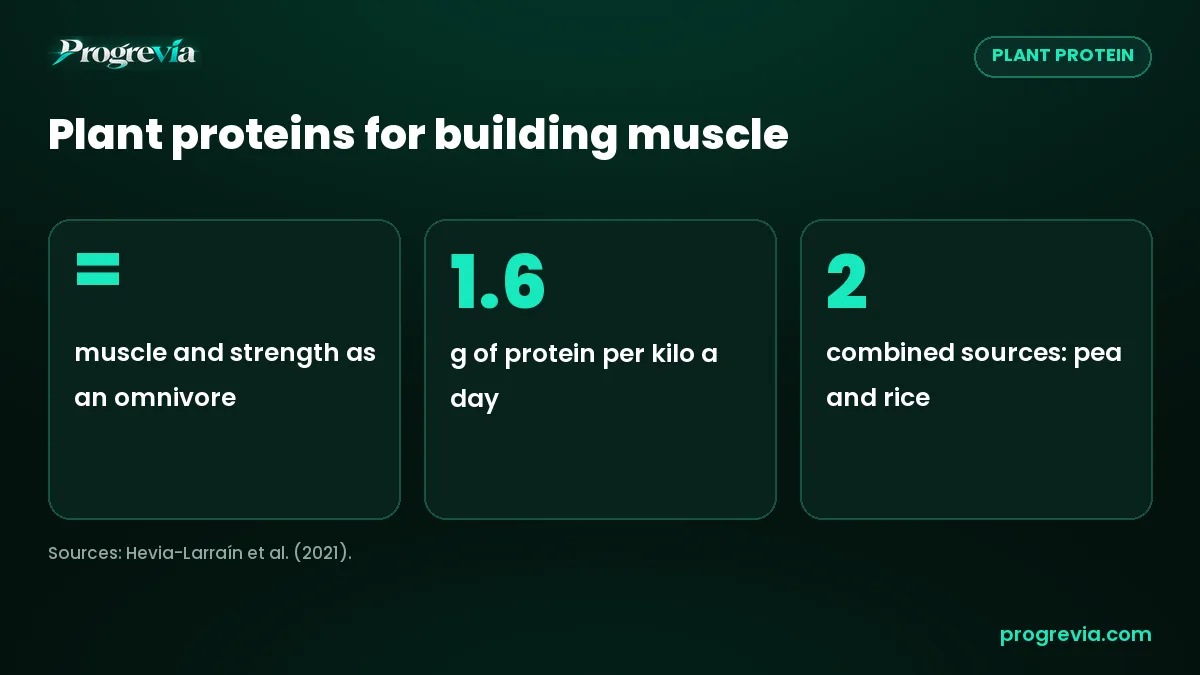
Can you build muscle as a vegan? Same: muscle and strength in vegans and omnivores with the same protein (Hevia-Larraín et al., 2021). 1.6 g of protein per kilo a day in that trial (Hevia-Larraín et al., 2021). 2 combined sources, like pea and rice, complete the amino acids. And creatine works even better in vegans. The video ends by showing how to create the routine in Progrevia.
Can a vegan build as much muscle as an omnivore?
The most recent research (Lim et al., 2021; Monteyne et al., 2023) suggests yes, with the right strategies. A 2023 meta-analysis found no statistically significant differences in hypertrophy between vegan and omnivorous diets when total protein intake and training were equivalent.
What are essential amino acids and why do they matter for muscle?
Proteins are made of chains of amino acids. Of the 20 amino acids the human body uses, 9 are essential: the body cannot synthesise them and they must come from the diet. Among these, the three branched-chain amino acids (BCAAs) - leucine, isoleucine and valine - are especially relevant for muscle protein synthesis. Leucine in particular acts as the main anabolic signal: it activates the mTORC1 pathway, the master switch for muscle building.
Animal proteins (meat, eggs, dairy, fish) contain all 9 essential amino acids in proportions that are optimal for human muscle. Plant proteins have incomplete or unbalanced profiles: most are deficient in one or more essential amino acids. Wheat is low in lysine, corn in tryptophan, legumes in methionine. This is the only real deficit you need to compensate for on a plant-based diet.
How much protein do you really need as a vegan or vegetarian?
The most recent studies suggest that vegan athletes should consume 10-20 per cent more total protein to compensate for two factors: the lower digestibility of plant proteins (their average DIAAS score is below that of animal proteins) and the lower leucine concentration per gram of protein. In practical terms, if the general recommendation for hypertrophy is 1.6-2.2 g/kg of body weight, a vegan should aim for 1.8-2.4 g/kg.
Digestibility matters as much as quantity. Soy protein has a digestibility of 91-98 per cent, comparable to whey. Pea protein reaches 85-90 per cent. However, protein from whole wheat or cooked legumes can drop to 70-80 per cent because of fibre and antinutritional factors such as phytates and protease inhibitors.
The best plant protein sources for muscle
Not all plant proteins are equal. This ranking will help you build your daily intake strategically:
Soy and its derivatives (the best plant profile): soy is the only legume with a complete amino acid profile comparable to egg. 100 g of firm tofu provides 8-10 g of protein; 100 g of tempeh, up to 19 g; 100 g of cooked edamame, 11 g. Tempeh has the added advantage of being fermented, which improves bioavailability and reduces antinutrients.
Legumes (lentils, chickpeas, beans): they provide 7-9 g of protein per 100 g cooked. They are rich in lysine - the amino acid that is scarce in cereals - which makes them the ideal complement to rice, oats or quinoa. A serving of brown rice plus lentils provides a complete amino acid profile comparable to meat.
Plant protein powders: soy protein isolate (90 per cent or more protein) and pea plus rice blends (which complement each other in amino acids) are the most effective options. Several clinical trials have shown that 25-30 g of pea protein post-training produces muscle gains equivalent to whey when total daily intake is matched.
Seitan (wheat gluten): at 25 g of protein per 100 g, it is the most concentrated plant source. However, its amino acid profile is deficient in lysine and threonine. It should not be your only protein source, but as a complement within a varied diet it is very useful.
Quinoa, amaranth and buckwheat: these pseudocereals have a complete profile (they contain all 9 essentials). Quinoa provides 4.4 g of protein per 100 g cooked and integrates easily into salads, scrambles or as a base.
Protein complementation: what does modern science say?
For decades, vegetarians were taught to combine complementary proteins in the same meal (rice plus lentils, for example). Current science nuances this: the liver maintains a free amino acid pool that can be used for several hours after intake. It is not necessary to combine within the same meal, but it is necessary across the same day. The simplest practice is to diversify sources across daily meals.
An example of a day with a complete protein profile for a 75 kg athlete targeting 2 g/kg, or 150 g of protein:
- Breakfast: 100 g of oats plus 30 g of pea protein powder plus 20 g of hemp seeds = around 45 g protein
- Lunch: 200 g of tempeh plus 150 g of edamame plus brown rice = around 55 g protein
- Snack: 200 g of soy yoghurt plus 30 g of almonds = around 20 g protein
- Dinner: 200 g of cooked lentils plus 150 g of quinoa plus vegetables = around 30 g protein
Total: around 150 g protein
Supplements: when they make sense and which to choose
If whole foods do not get you to your daily protein target, supplements are a valid tool and not a sign of failure. The two best options for vegans:
Soy protein isolate: it has the most complete amino acid profile among plant proteins. Digestibility above 95 per cent. Ideal for those who tolerate soy.
Pea plus rice blend (70/30): pea protein is rich in BCAAs and lysine; brown rice protein is rich in methionine and cysteine. Combined, they approach the whey profile. It is the best option for those avoiding soy. Look for products with at least 20-25 g of protein per serving and a leucine content of 2 g or more per serving.
Creatine deserves a special mention: vegans have naturally low intramuscular creatine stores (creatine comes mainly from meat and fish). Supplementing with 3-5 g/day of creatine monohydrate produces significant improvements in strength and power, especially in vegan populations. It is the supplement with the best evidence-to-cost ratio available.
Critical micronutrients in the vegan athlete's diet
Beyond protein, some micronutrients deserve special attention on a plant-based diet combined with endurance or strength training:
Vitamin B12: it does not exist in natural plant sources in meaningful amounts. Supplementation is mandatory: 1000 mcg/day of cyanocobalamin or methylcobalamin. Without adequate B12, red blood cell synthesis is compromised and aerobic performance falls.
Non-heme iron: plant iron (non-heme) has 2-3 times lower bioavailability than heme iron from meat. To maximise absorption: consume iron sources (lentils, spinach, tofu) alongside vitamin C (peppers, kiwi, citrus) and avoid coffee or tea within an hour before or after.
Zinc: zinc absorption is reduced by the phytates present in grains and legumes. Soaking and sprouting significantly reduce phytates. Consider a chelated zinc supplement (10-15 mg/day) if legume consumption is high.
Omega-3 (EPA and DHA): algae are the direct source of EPA/DHA in the plant kingdom. ALA from flax or chia converts to EPA/DHA with low efficiency (around 5-15 per cent). If you consume neither algae nor an algae-based omega-3 supplement, consider 250-500 mg/day of algal DHA.
Calcium: fortified soy and oat milk, tofu (set with calcium sulphate), tempeh, dark leafy greens (kale, bok choy) and sesame seeds are good sources. Aim for 1000-1200 mg/day spread across 2-3 servings.
A 12-week action plan
Weeks 1-4: establish your total protein baseline. Log a typical week and calculate your average intake. If you are below 1.6 g/kg, add one protein serving (shake, tempeh, tofu) until you hit the target. Weeks 5-8: add variety of sources. If your protein intake is monotonous, introduce at least 4 different sources per week. Weeks 9-12: optimise distribution across the day. Spread protein across 4 equal meals and place the largest serving in the post-training window.
The trial that had vegans and omnivores training side by side
The debate about plant protein used to stay in the lab: amino acid profiles, digestibility, acute protein synthesis responses. What was missing was someone putting two groups through weeks of training and measuring the muscle at the end.
That is what Hevia-Larraín, Gualano, Longobardi and colleagues did in a trial published in Sports Medicine in 2021. They compared habitual vegans with habitual omnivores — not people converted for the study, which matters — putting both groups through the same resistance training and, crucially, matching protein intake at around 1.6 g per kilo per day.
To achieve that match they used supplements: whey protein for the omnivores and soy protein for the vegans, adjusted to each participant's needs. The result was that both diets supported similar increases in muscle mass and strength.
| Variable | What happens on a plant-based diet | What to do about it |
|---|---|---|
| Muscle mass gain | Similar, with protein matched | Nothing special: reach the daily total |
| Strength gain | Similar, with protein matched | Nothing special |
| Protein density of foods | Lower: more food volume for the same intake | Legumes, soy, seitan and, if needed, a supplement |
| Amino acid profile per source | More incomplete source by source | Combine sources across the day |
| Target intake | The same reference as an omnivore | Around 1.6 g/kg/day as a floor |
The conclusion is not that protein source is irrelevant in every circumstance: it is that once total intake is matched, the difference stops showing up on the scale and on the bar. The real obstacle of a plant-based diet for building muscle is not protein quality, it is reaching the total without ending up eating twice the volume.
If you want to turn this into a specific routine, the Progrevia routine generator builds one for free in under a minute, adapted to your goal, level and equipment.
- Hevia-Larraín V, Gualano B, Longobardi I, et al. High-protein plant-based diet versus a protein-matched omnivorous diet to support resistance training adaptations: a comparison between habitual vegans and omnivores. Sports Medicine. 2021;51(6):1317-1330.
- Morton RW, Murphy KT, McKellar SR, et al. A systematic review, meta-analysis and meta-regression of the effect of protein supplementation on resistance training-induced gains in muscle mass and strength in healthy adults. British Journal of Sports Medicine. 2018;52(6):376-384.
- Monteyne AJ, Coelho MOC, Murton AJ, Abdelrahman DR, Blackwell JR, Koscien CP, et al. Vegan and omnivorous high protein diets support comparable daily myofibrillar protein synthesis rates and skeletal muscle hypertrophy in young adults. The Journal of Nutrition. 2023;153(6):1680-1695.
- Lim MT, Pan BJ, Toh DWK, Sutanto CN, Kim JE. Animal protein versus plant protein in supporting lean mass and muscle strength: a systematic review and meta-analysis of randomized controlled trials. Nutrients. 2021;13(2):661.
Progrevia · · How we write our guides
Frequently asked questions
Do I need plant protein powder if I'm vegan?
Not mandatory, but it can help reach the target intake (1.8-2g/kg). A pea + rice protein blend has an amino acid profile close to whey and is backed by direct evidence. Soy protein isolate is also a complete option. If you can reach the target with whole foods, powder is unnecessary.
Does creatine work the same for vegans?
Vegans have lower baseline creatine levels than omnivores because dietary creatine comes primarily from meat and fish. Creatine monohydrate supplementation produces larger improvements in vegans than omnivores precisely because the margin of improvement from baseline is greater. Creatine is especially recommended for vegan athletes.
Is tempeh better than tofu for muscle building?
Tempeh has an advantage: the fermentation process improves amino acid bioavailability and reduces antinutrients (phytates) that can interfere with absorption. Tempeh also contains more protein per 100g (~19g vs ~8g for firm tofu). Both are complete soy sources and valid for hypertrophy diets.
Informational content based on the available scientific evidence: it does not replace advice from a healthcare professional. If you have an injury or a medical condition, or are pregnant, check with one before changing your training or diet.
