Collagen: does it help your joints and build muscle? What the studies say
Published on
In young men who trained, collagen did not raise muscle protein synthesis compared with a placebo. For joints there is some evidence. What the trials say and how to take it if you decide to try.
In 2017, Gregory Shaw (Australian Institute of Sport) and Keith Baar (University of California, Davis) ran a simple experiment with 8 healthy men. They gave them 5 or 15 g of gelatin with vitamin C, or a placebo, and 1 hour later had them skip rope for 6 minutes. With 15 g, the blood marker showing that the body is making collagen doubled. In addition, ligaments grown in the lab with those participants' blood built up more collagen and withstood tension better.
It is one of the studies behind the collagen trend. But two things that are often mixed up need separating: what collagen can do for tendons and joints, and what it does not do for muscle.
What collagen is and how it differs from other proteins
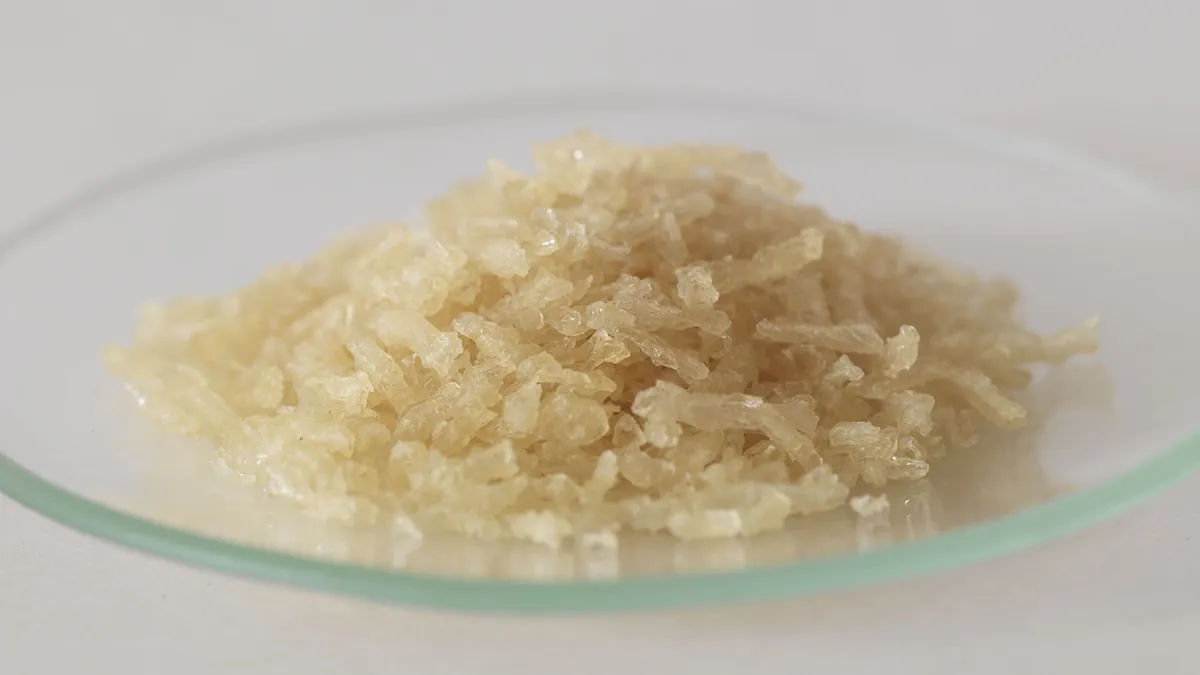
Collagen is the main protein in tendons, ligaments, cartilage, bone and skin. As a supplement it is sold as gelatin or as hydrolysed collagen, which is the same protein broken into smaller pieces. It is rich in glycine, proline and hydroxyproline, the amino acids the body uses to build its own collagen.
As a protein for muscle, however, it is incomplete: it has no tryptophan, one of the essential amino acids, and little leucine, the amino acid that most strongly switches on muscle protein synthesis. That is why it cannot be compared with protein from milk, eggs or meat. We explain it in how much protein to eat a day.
Does collagen help your joints?
There is some evidence, with modest effects. In 2008, Kristine Clark's team (Penn State University) split 147 college athletes with activity-related joint pain and no joint disease into two groups: 10 g of hydrolysed collagen a day or a placebo, for 24 weeks. Data from 97 could be analysed. On a pain scale from 0 to 10, pain when walking fell by 1.11 points with collagen and by 0.46 with placebo, and other pain measures also improved.
A 2021 systematic review led by Mishti Khatri (University of Huddersfield) pooled 15 randomised trials of collagen combined with exercise. Its conclusion was that collagen helps most with joint function and pain. For body composition, strength and muscle recovery, they found some improvements, but less clear ones.
| Goal | What has been seen | Strength of evidence |
|---|---|---|
| Joint pain in athletes | A small drop in pain with 10 g a day for 24 weeks (Clark, 2008) | Moderate |
| Tendons and ligaments | 15 g with vitamin C before exercise doubled a marker of collagen synthesis (Shaw, 2017) | Low: a blood marker, not injuries |
| Muscle protein synthesis | No increase versus placebo in young men who trained (Kirmse, 2024) | Moderate |
| Muscle mass in older adults with sarcopenia | More fat-free mass than with a protein-free placebo (Zdzieblik, 2015) | Low: not compared with another protein |
Read the video text
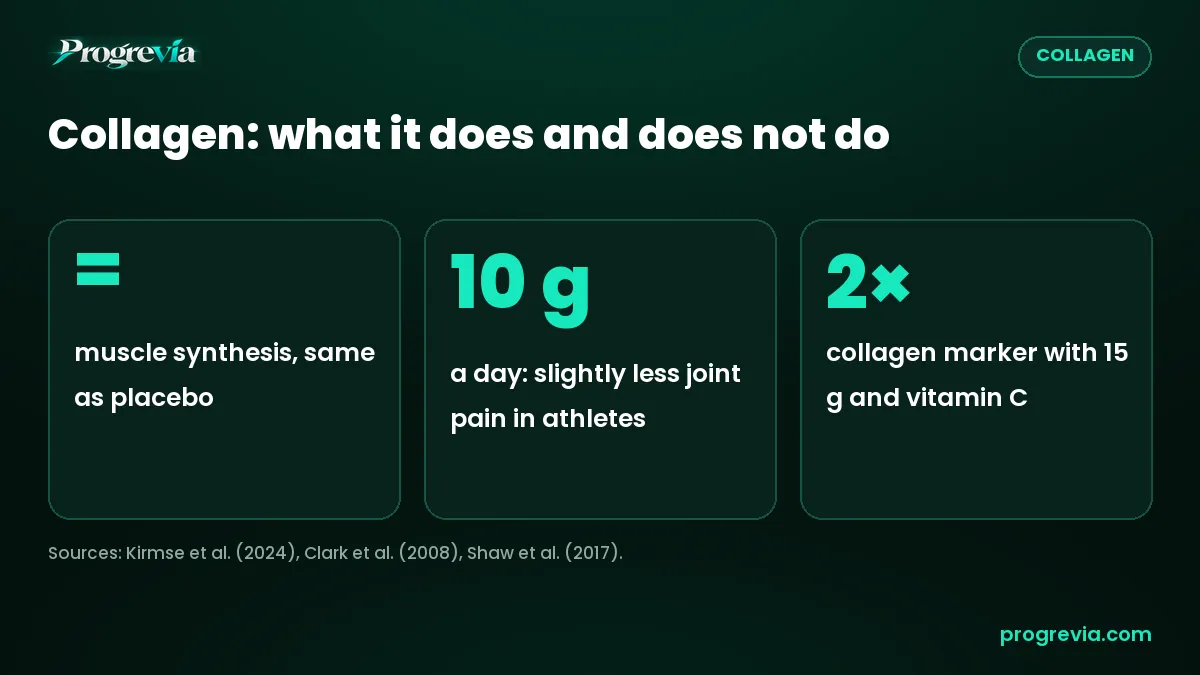
Does collagen help you build muscle? Same: muscle protein synthesis same as placebo in young men who trained (Kirmse et al., 2024). 10 g a day for 24 weeks: slightly less joint pain when walking (Clark et al., 2008, 147 athletes). 2× a collagen synthesis marker with 15 g and vitamin C before training (Shaw et al., 2017). For muscle, choose a complete protein. The video ends by showing how to create the routine in Progrevia.
Does collagen help you build muscle?
The study most often cited in favour is by Denise Zdzieblik (University of Freiburg), from 2015. In 53 men with sarcopenia, with an average age of 72, who did strength training 3 times a week for 12 weeks, those who took 15 g of collagen a day gained 4.2 kg of fat-free mass versus 2.9 kg with placebo, and increased quadriceps strength more (16.5 versus 7.3 Nm). But the placebo contained no protein. Most likely, much of the effect comes from adding protein to the diet of older adults, not from collagen as such.
When it is compared with something fairer, the advantage disappears. In 2024, Marius Kirmse (Ruhr University Bochum), with Luc van Loon among the authors, gave 25 young men 15 g of collagen 2 times a day or a placebo during 1 week of intense training. Muscle protein synthesis was the same in both groups (1.34% a day), and so was synthesis of the muscle's connective tissue (1.97 versus 2.00% a day). And a 2020 trial from Stuart Phillips's group (McMaster University) found that a milk protein, lactalbumin, raised muscle synthesis 13% more than the same amount of collagen.
The practical takeaway: if you want to build muscle, collagen does not replace a good protein source. You will find alternatives in foods highest in protein and in plant proteins.
How to take collagen if you decide to try it
- Amount: studies use between 10 and 15 g a day.
- Timing: Shaw's protocol was 15 g with vitamin C 1 hour before loading the tendons with exercise.
- Form: gelatin or hydrolysed collagen. Cooking gelatin is the same protein.
- Protein counting: do not count it as quality protein for muscle. It adds to your daily total, but it does not cover what you need.
What has more evidence for your tendons: loading them progressively through training, without sudden jumps in volume. If you have a niggle, see how to train with a shoulder or knee injury. And if you are looking for a performance supplement with far more evidence, read the creatine guide.
The rest of the supplements are ranked by evidence in the supplements that work. In the Progrevia generator the plan increases load gradually and schedules deload weeks, which give tendons and joints a rest.
- Shaw G, Lee-Barthel A, Ross ML, Wang B, Baar K. Vitamin C-enriched gelatin supplementation before intermittent activity augments collagen synthesis. American Journal of Clinical Nutrition. 2017;105(1):136-143.
- Clark KL, Sebastianelli W, Flechsenhar KR, et al. 24-Week study on the use of collagen hydrolysate as a dietary supplement in athletes with activity-related joint pain. Current Medical Research and Opinion. 2008;24(5):1485-1496.
- Khatri M, Naughton RJ, Clifford T, Harper LD, Corr L. The effects of collagen peptide supplementation on body composition, collagen synthesis, and recovery from joint injury and exercise: a systematic review. Amino Acids. 2021;53(10):1493-1506.
- Zdzieblik D, Oesser S, Baumstark MW, Gollhofer A, König D. Collagen peptide supplementation in combination with resistance training improves body composition and increases muscle strength in elderly sarcopenic men: a randomised controlled trial. British Journal of Nutrition. 2015;114(8):1237-1245.
- Kirmse M, Lottmann TM, Volk NR, et al. Collagen peptide supplementation during training does not further increase connective tissue protein synthesis rates. Medicine and Science in Sports and Exercise. 2024;56(12):2296-2304.
- Oikawa SY, Macinnis MJ, Tripp TR, McGlory C, Baker SK, Phillips SM. Lactalbumin, not collagen, augments muscle protein synthesis with aerobic exercise. Medicine and Science in Sports and Exercise. 2020;52(6):1394-1403.
Progrevia · · How we write our guides
Frequently asked questions
Does collagen help you build muscle?
Not better than other proteins. In a 2024 trial with young men who trained, 15 g of collagen 2 times a day did not raise muscle protein synthesis compared with a placebo.
Does collagen help your joints?
It may help a little. In athletes with joint pain, 10 g a day for 24 weeks reduced pain when walking slightly more than a placebo. The effects are modest.
How much collagen should you take a day?
Studies use between 10 and 15 g a day. One protocol that has been studied is taking 15 g with vitamin C 1 hour before exercise.
Does collagen count as protein?
It adds to your daily total, but it is not a complete protein: it lacks tryptophan and has little leucine. Do not count it as quality protein for muscle.
Is gelatin the same as collagen?
Yes, gelatin is collagen. Hydrolysed collagen is the same protein broken into smaller pieces, which dissolves better in cold water.
Informational content based on the available scientific evidence: it does not replace advice from a healthcare professional. If you have an injury or a medical condition, or are pregnant, check with one before changing your training or diet.
