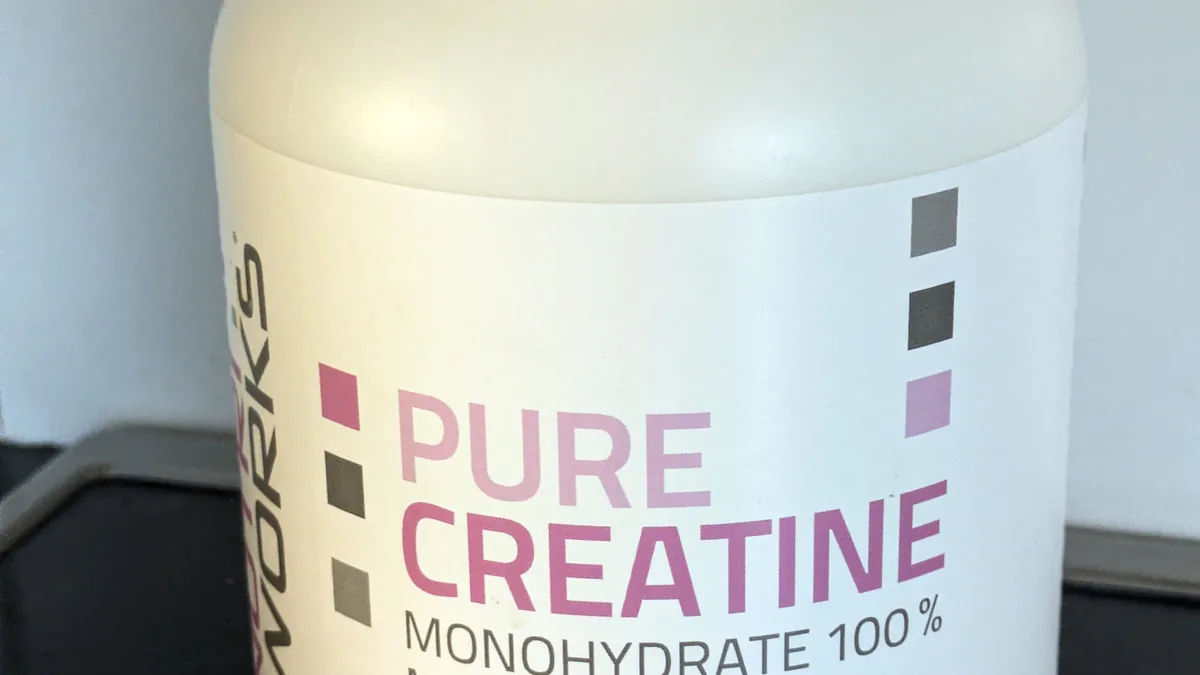
Creatine: what it is, how to take it and what to expect (evidence-based guide)
Published on
It is the most studied supplement in sports history and yet it is still surrounded by myths. How much to take, when, whether you need a loading phase, and the truth about water, hair and kidneys.
Creatine monohydrate is by far the supplement with the strongest scientific backing for improving strength performance and gaining muscle mass. More than 500 human studies support its efficacy and safety. This guide summarises what you need to know, without the marketing.
What it is and how it works
Creatine is a compound your body produces naturally (liver, kidneys and pancreas) and that you also get from meat and fish. It is stored in muscle as phosphocreatine, the energy system that fuels short, intense efforts: a set of squats, a sprint, a heavy bench press.
Supplementing raises muscle stores by 20-40 per cent, which translates into 1-3 extra reps in strength ranges, better recovery between sets and, over time, more effective training volume and therefore more muscle.
How much to take and when
- Standard dose: 3-5 g per day, every day. Rest days included.
- Loading phase? Optional. At 20 g/day for 5-7 days you saturate the stores in a week; at 3-5 g/day it takes 3-4 weeks to reach the same point. The end result is identical.
- Time of day? Irrelevant according to the evidence. What matters is daily consistency. Taking it at the same time (with breakfast, for instance) helps you not forget.
- With what? It absorbs well with any liquid. It needs neither juice nor sugar.
What to expect (realistic expectations)
- An initial gain of 0.5-1.5 kg of weight in the first weeks: this is intramuscular water (inside the muscle, not subcutaneous retention). It is normal and desirable.
- Improved performance in efforts of 5-30 seconds: more reps at the same weight.
- In the medium term, greater muscle gain thanks to the extra volume it lets you accumulate.
- Around 20-30 per cent of people are non-responders (their stores are already high from diet or genetics) and notice little effect.
Common myths, short answers
- It damages the kidneys: false in healthy people. Decades of studies show no renal damage at standard doses. If you have pre-existing kidney disease, consult your doctor.
- It causes hair loss: the evidence is anecdotal. A single 2009 study measured an increase in DHT without measuring hair loss, and it has not been replicated. There is no demonstrated causal link.
- It is a steroid / it is cheating: no. It is a natural dietary compound, legal in every sport.
- You have to cycle off it: unnecessary. There is no evidence that cycling adds anything.
- The expensive versions are better: plain monohydrate is the most studied and the cheapest. HCL, ethyl ester and other variants have not demonstrated superiority.
Who benefits most?
Anyone who trains for strength, and especially those who eat little meat or fish (vegetarians and vegans usually notice the effect more because they start from lower stores). There is also interesting emerging evidence in cognitive function and in older adults for preserving muscle mass.
Remember the correct order: creatine optimises good training, it does not replace it. First you need a routine with structured progression; the supplement adds the final 5 per cent.
What the scientific consensus actually says about creatine
Creatine monohydrate carries more rumours than almost any other supplement, and most of them are settled by reading a single document: the official position stand of the International Society of Sports Nutrition (ISSN), signed by Kreider and thirteen other researchers and published in 2017.
The point that reassures doubters most is safety. After reviewing the available literature, the ISSN concludes that short- and long-term supplementation — up to 30 g per day for five years — is safe and well tolerated in healthy individuals, and also across clinical populations ranging from infants to the elderly. The contrast is worth underlining: 30 g a day is six to ten times the usual maintenance dose.
That does not make creatine a context-free product. The document itself is a position stand on healthy populations; if you have diagnosed kidney disease or take chronic medication, the decision belongs with your doctor, not with an article. But it leaves little room for the gym-floor idea that it "strains the kidneys" in a healthy person.
| Protocol | Dose | Time to saturation | Who it suits |
|---|---|---|---|
| With loading phase | 20 g/day split into 4 servings for 5-7 days, then 3-5 g/day | About 5-7 days | Anyone wanting the effect sooner who tolerates it well |
| No loading | 3-5 g/day from day one | About 3-4 weeks | Most people: fewer stomach complaints, same end saturation |
| Maintenance | 3-5 g/day, every day | — | Everyone, including days you do not train |
Two practical details follow. First: the loading phase is optional, not mandatory; it only brings the result forward by a few weeks. Second: creatine works by saturating the muscle, so what matters is daily consistency, not taking it right before training. The days you skip the gym still count.
- Kreider RB, Kalman DS, Antonio J, et al. International Society of Sports Nutrition position stand: safety and efficacy of creatine supplementation in exercise, sport, and medicine. Journal of the International Society of Sports Nutrition. 2017;14(1):18.
Frequently asked questions
How much creatine should I take daily?
3 to 5 grams of creatine monohydrate every day, rest days included. The loading phase is optional and only speeds up saturation.
Does creatine damage the kidneys?
Not in healthy people. Decades of studies at standard doses show no kidney damage. Consult a doctor if you have pre-existing kidney disease.