Progrevia requiere JavaScript

Este generador de rutinas necesita JavaScript para funcionar. Activa JavaScript en tu navegador y recarga la página.

Progrevia needs JavaScript to work. Please enable JavaScript in your browser and reload the page.

Progrevia a besoin de JavaScript pour fonctionner. Active JavaScript dans ton navigateur et recharge la page.

Recargar / Reload / Recharger
Skip to main content
Workouts · Technique · Nutrition · Science
Blog Progrevia

Guides and articles based on scientific evidence on hypertrophy, strength training, fat loss and muscle recovery. Real expert-written content, no myths.

Free calculator

Protein calculator: how much you need per day

Calculate how many grams of protein you need per day and at each meal based on your weight and your goal: health, building muscle, losing fat or recomposition. Using the ranges from the International Society of Sports Nutrition (ISSN).

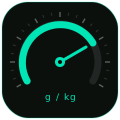
Illustration of a dial with daily protein marked in grams
Units
Body fat % · optional

It runs in your browser: we do not send or store your data.

Recommended daily protein— g/day
—–— gRange
— g/kgPer kg of body weight
— g × —Per meal
—Useful minimum per meal (0.4 g/kg)
Generate your routine for this goal →

How much protein you need for your goal

The amount depends mainly on your weight and whether you train. The protein calculator uses these ranges, in grams per kilo of body weight per day:

Daily protein ranges used by the calculator
GoalProtein (g/kg/day)What it is based on
Health, no training0.8-1.0Reference for sedentary adults
Training and maintaining1.4-1.8ISSN (2017): 1.4-2.0 g/kg for people who exercise
Building muscle1.6-2.2Morton (2018) and Schoenfeld and Aragon (2018)
Losing fat1.8-2.4ISSN (2017) and Helms (2014): more protein in a deficit
Recomposition1.8-2.4Longland (2016): 2.4 g/kg gained lean mass in a deficit

If you enter your body fat percentage and your goal is to lose fat or recomp, the calculator uses 2.3-3.1 g per kilo of lean mass, the range proposed by the ISSN and by Helms and colleagues to preserve muscle in a deficit.

What the research says

The position stand of the International Society of Sports Nutrition (ISSN) (Jäger and colleagues, 2017) sets 1.4 to 2.0 g/kg per day as sufficient for most people who exercise, and more in a deficit. The meta-analysis by Morton and colleagues (2018), with 49 studies and 1,863 participants, found that, on average, there was no further gain in lean mass above about 1.62 g/kg per day. Since that is an average, Schoenfeld and Aragon (2018) take 2.2 g/kg as the upper limit supported by the literature: that is why the range for building muscle goes from 1.6 to 2.2.

How much protein per meal

Schoenfeld and Aragon (2018) concluded that, to maximize muscle building, you should eat about 0.4 g per kilo at each meal spread across at least four meals. The calculator gives you the grams per meal based on how many meals you eat, along with that useful minimum as a reference.

How to reach your number

Build each meal around a protein source: meat, fish, eggs, dairy, legumes or tofu. You will find lists and amounts in the foods highest in protein and, if you do not eat meat, in plant proteins for building muscle. We go deeper in how much protein per day to build muscle.

If you have kidney or liver disease, do not increase your protein intake without consulting your doctor first.
Frequently asked questions

How much protein do I need per day to build muscle?

Between 1.6 and 2.2 g per kilo of body weight per day. The meta-analysis by Morton and colleagues (2018) found that, on average, there was no further gain in lean mass above about 1.6 g/kg.

How much protein should I eat to lose fat?

Somewhat more than to build muscle: around 1.8-2.4 g/kg of body weight, or 2.3-3.1 g per kilo of lean mass if you know your body fat percentage. More protein helps preserve muscle in a deficit.

How much protein can you absorb in one meal?

There is no fixed limit, but for building muscle Schoenfeld and Aragon (2018) recommend about 0.4 g per kilo per meal, spread across at least four meals a day.

Is eating a lot of protein bad for you?

For healthy people, the ranges in this calculator are safe. If you have kidney or liver disease, consult your doctor before increasing your intake.

Other calculators

From numbers to a plan

Calories and protein supply the fuel; training decides what you do with it. Generate a free routine tailored to your goal, your level and your equipment.

Generate your routine for this goal
References
  1. Jäger R, Kerksick CM, Campbell BI, Cribb PJ, Wells SD, Skwiat TM, et al. International Society of Sports Nutrition Position Stand: protein and exercise. Journal of the International Society of Sports Nutrition. 2017;14:20.
  2. Morton RW, Murphy KT, McKellar SR, Schoenfeld BJ, Henselmans M, Helms E, et al. A systematic review, meta-analysis and meta-regression of the effect of protein supplementation on resistance training-induced gains in muscle mass and strength in healthy adults. British Journal of Sports Medicine. 2018;52(6):376-384.
  3. Schoenfeld BJ, Aragon AA. How much protein can the body use in a single meal for muscle-building? Implications for daily protein distribution. Journal of the International Society of Sports Nutrition. 2018;15:10.
  4. Helms ER, Aragon AA, Fitschen PJ. Evidence-based recommendations for natural bodybuilding contest preparation: nutrition and supplementation. Journal of the International Society of Sports Nutrition. 2014;11:20.
  5. Longland TM, Oikawa SY, Mitchell CJ, Devries MC, Phillips SM. Higher compared with lower dietary protein during an energy deficit combined with intense exercise promotes greater lean mass gain and fat mass loss: a randomized trial. American Journal of Clinical Nutrition. 2016;103(3):738-746.
Welcome

No account? Sign up free

or
Create account

¿Ya tienes cuenta? Log in

We will send you service emails (verification, security) and, at most, 3 one-time reminders (one if you don't generate your first routine and two if you stop using your account). You can disable reminders via the link included in any of those emails.

📬
Verify your email

Enter the 6-digit code we sent you

🔐
Recover access

Enter your email and we will send you a code.

or
🔑
New password

Code sent to your email. Expires in 15 minutes.

or
Your dashboard
1
Data
2
Goal
3
Plan
4
Preferences
5
Confirm
20%
Personal data

Basic info to calibrate your routine precisely

years
kg
cm
Your goal

Define the direction of your training

Optimal rep range
5–15 reps depending on the day · RIR 3–4 → 1–2 · Volume: 12–20 sets/week per muscle group
Planning

Set your weekly availability

4 days → Upper/Lower · higher frequency per group (2×/week)
60 min
Optimizes exercises

The engine adapts the exercise library based on the equipment you have available.

If disabled, the routine, PDF and email will not include the warm-up section.

Preferences

Customise the exercises in your routine (optional)

Exercises you enjoy the most. We will prioritise them in the selection — they will appear more often in your routine if they fit your goal.

✓ Top priority · higher frequency

Select the exercises you want to include in your routine

Specific exercises you want out of your routine. We swap them for others working the same muscle group, so you do not lose that work.

✗ Swapped for an alternative

Leave it empty if there is none you want to avoid

Groups you prefer not to train — by preference, accumulated fatigue or any other reason. We will omit them entirely from your routine.

✗ Omitted from the entire routine

Indicate any injured or sensitive area. We will automatically exclude exercises that could aggravate it and apply a safe alternative training protocol.

🛡 Safe protocol activated

Injuries are health data (Art. 9 GDPR). By selecting them you explicitly consent to their processing for the sole purpose of excluding contraindicated exercises. Optional field — you can withdraw consent by removing them. More info in the Privacy Policy.

The groups you want to develop most. They will receive +1 set per exercise, more selected exercises and a priority position in the session.

★ +1 extra set · priority position
Summary

Review your settings before generating

The name will appear in your history, PDFs and emails.

Generating your routine
Applying scientific principles…
Profile
Analysis
Exercises
Plan
Your personalized routine
Why this routine for you
Auto-generated This routine was generated automatically by our own engine from the data you provided. It has not been reviewed by a healthcare professional.
Generated routines are for informational purposes only. They do not constitute medical advice. Consult a professional before starting if you have injuries or health conditions.

⚠️ You train at your own risk. Suggested loads are guidance only: increase them only if your technique is solid and pain-free. This does not replace advice from a medical professional or trainer. If you feel pain or get injured, stop and consult a specialist.

Information
Language
Security
Reminders
Contact

Escríbenos a [email protected]