What a calorie deficit is
It means eating fewer calories than you burn, and this calorie deficit calculator tells you how large that gap should be for your weight loss. Your body covers the difference from its reserves, and if you do strength training and eat enough protein, most of it comes from fat. There is no way to lose fat without a deficit: the type of diet or meal timing does not matter, what counts is the balance at the end of the week.
How big a deficit to use
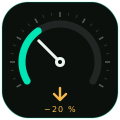
The calculator offers three rates below your maintenance: slow (−10%), moderate (−20%) and fast (−25%). The review by Helms and colleagues (2014) recommends aiming for a loss of between 0.5 and 1% of body weight per week to preserve as much muscle as possible, and the calculator warns you if your rate exceeds that.
One study measured this directly. Garthe and colleagues (2011) compared slow weight loss (0.7% of body weight per week) with fast weight loss (1.4%) in 24 athletes. The slow group took longer, but gained lean mass and improved their strength more than the fast group.
| Rate | Calories per day | Daily deficit | Estimated loss per week |
|---|---|---|---|
| Slow (−10%) | 2,340 | 260 kcal | ≈ 0.24 kg (0.3%) |
| Moderate (−20%) | 2,080 | 520 kcal | ≈ 0.47 kg (0.6%) |
| Fast (−25%) | 1,950 | 650 kcal | ≈ 0.59 kg (0.7%) |
The safety floor
The calculator never suggests eating below your basal metabolic rate or below 1,200 kcal for women or 1,500 for men, the usual minimums without professional supervision. If your deficit hits that floor, it tells you so: at those numbers, you should talk to a professional before cutting any further.
Protein and training: what decides what you lose
The deficit decides how much weight you lose; protein and training decide how much of it is fat. In the trial by Longland and colleagues (2016), two groups with the same deficit and the same training ate 1.2 or 2.4 g of protein per kilo: the higher-protein group gained lean mass and lost more fat. Calculate yours with the protein calculator and see how to put it into practice in how to lose fat without losing muscle.
Why weight loss slows down
The 7,700 kcal per kilo figure is useful for planning, but your body adapts: when you weigh less, you burn less. The model by Hall and colleagues (2011) showed that body weight responds slowly to a change in calories. Recalculate every time you lose 2-3 kg. If you are interested in the full theory, you will find it in how to calculate your calorie deficit.