Hypertrophy routine: how to build it according to science (with a 4-day plan)
Published on
Weekly sets, reps, effort and frequency: what the meta-analyses say about building muscle, and a 4-day upper-lower plan with the volume already spread out.
In 2026, Joshua Pelland and his team at the Muscle Physiology Laboratory of Florida Atlantic University published in Sports Medicine an analysis of 67 studies and 2058 participants on how much you need to train. Their conclusion confirms what research had been pointing to for years: muscle grows more the more weekly sets you do, but each extra set pays off a little less than the one before. Frequency, on the other hand, barely affected muscle size when volume was the same.
This guide turns that into a routine: how many sets, how many reps, how hard, how many days and how to progress. At the end you have a ready-to-use 4-day plan.
What a hypertrophy routine needs
A muscle grows when it gets enough tension, repeatedly, with room to recover. In practice, five variables control that: weekly volume, the effort of each set, the rep range, frequency and progression. We explain the mechanism in how muscle grows; here we stick to the practical side.
| Variable | Starting point | What the evidence says |
|---|---|---|
| Weekly sets per muscle | 10-12 if you are starting out; 12-20 with experience | More volume brings more growth, with diminishing returns (Schoenfeld, 2017; Pelland, 2026) |
| Effort | 1-3 reps short of failure | Going to failure gives no clear advantage (Refalo, 2023) |
| Reps | 6-12 on compound lifts; 10-20 on isolation | Heavy and light loads give similar hypertrophy close to failure (Schoenfeld, 2017) |
| Frequency | Each muscle 2 times a week | 2 times beats 1 (Schoenfeld, 2016); with equal volume, more days barely change size (Pelland, 2026) |
| Rest | 2-3 min on compound lifts; 60-90 s on isolation | Very short rests lower the load of the following sets |
How many weekly sets per muscle for hypertrophy
The 2017 meta-analysis by Brad Schoenfeld (Lehman College, New York), Ogborn and Krieger pooled 15 studies: each additional weekly set was linked to a 0.37% greater muscle gain, and the trend favoured 10 or more sets per muscle. A 2022 review led by Eneko Baz-Valle (University of the Basque Country), in young trained men, found no difference in the quadriceps or biceps between doing 12-20 weekly sets and doing more than 20; only the triceps responded better to high volume.
Pelland's analysis adds the nuance of diminishing returns: adding sets when you do few makes a much bigger difference than adding them when you already do a lot. A reasonable starting point:
- If you are starting out: 10-12 weekly sets per large muscle.
- With a year or more of experience: 12-20.
- More than 20: only for a muscle you want to prioritise for a few weeks, while lowering the volume of others.
Effective sets are the ones that count, those that end close to failure. Compound lifts also work the muscles that assist: a bench press works the triceps. Pelland's team found that counting those indirect sets as half a set predicts results better. We cover it in depth in how much volume you need to build muscle.
Read the video text
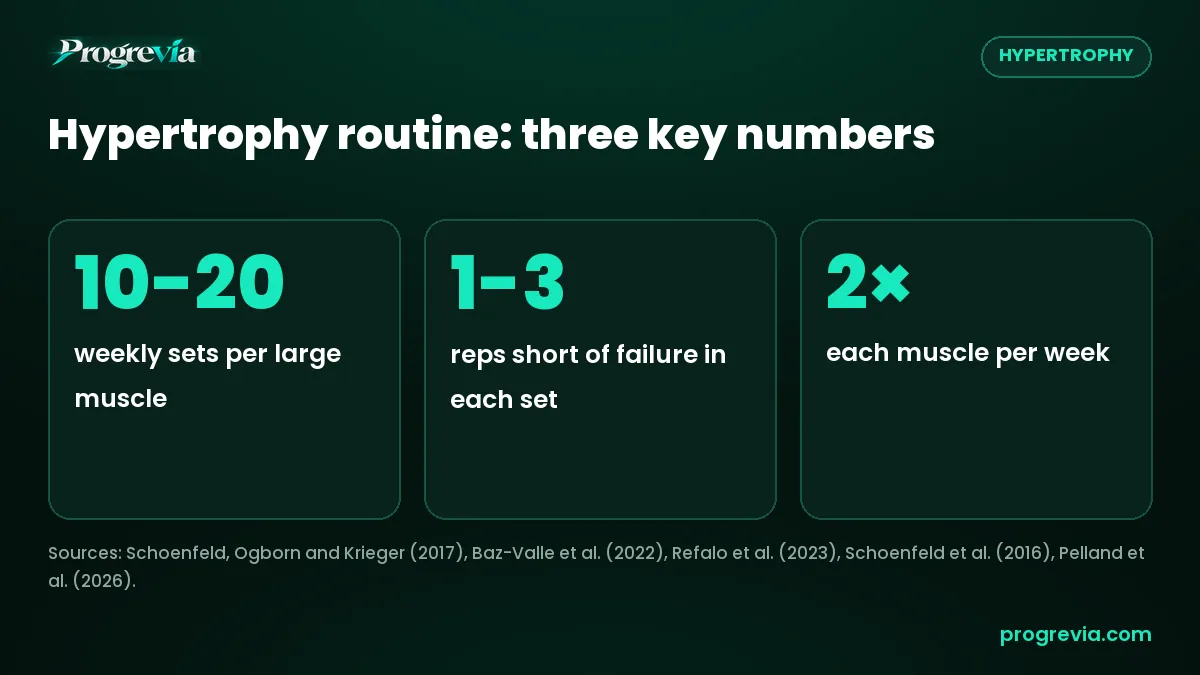
How many sets do you need to build muscle? 10-20 weekly sets per muscle (Schoenfeld, Ogborn and Krieger, 2017 · Baz-Valle et al., 2022). 1-3 reps short of failure: going to failure gives no extra muscle (Refalo et al., 2023, 15 studies). 2× each muscle per week, to spread the volume (Schoenfeld et al., 2016 · Pelland et al., 2026). And every few weeks, more weight or more reps. The video ends by showing how to create the routine in Progrevia.
How hard and how many reps
In 2017, Schoenfeld, Grgic, Ogborn and Krieger compared, across 21 studies, training with light loads (60% of 1RM or less) and with heavy loads, always to failure. Maximal strength went up more with heavy loads, but muscle growth was similar. Size depends mainly on getting close to failure, not on the exact weight.
Do you need to reach failure? A 2023 meta-analysis by Martin Refalo (Deakin University, Australia), with 15 studies, found no evidence that training to muscular failure builds more muscle than stopping a little earlier. Stopping 1-3 reps short of failure gives a very similar stimulus with less fatigue and leaves energy for the next set. If it is hard to judge, see how to use RIR and RPE.
On that basis, the practical split is 6-12 reps on compound lifts (squat, presses, rows, Romanian deadlift), where heavy loads let you progress in kilos and build strength at the same time, and 10-20 on isolation exercises. You will find the details in the rep range for hypertrophy.
How many days a week to train for hypertrophy
Schoenfeld's 2016 meta-analysis, with 10 studies, found that training each muscle 2 times a week gave more hypertrophy than doing it 1 time. Pelland's team, with far more data, adds a nuance: if weekly volume is the same, spreading it over more days barely changes growth, although it does help strength. In practice, the 2 sessions are there to spread the volume: 16 sets for one muscle in a single day force you to do the last ones very tired, while splitting them 8 and 8 works better.
With 3 days, a full body; with 4, an upper-lower; with 5 or 6, a push pull legs. All three structures meet the frequency of 2 if the plan is well built, so choose the one you can stick to. More detail in how often to train each muscle.
4-day hypertrophy routine (upper-lower)
This plan gives each large muscle about 10-14 direct weekly sets, plus the indirect ones, over 4 sessions. Rest 2-3 minutes on compound lifts and 60-90 seconds on everything else.
| Day | Exercises |
|---|---|
| Monday: upper A | Bench press 4×6-8 · Barbell row 4×8-10 · Seated dumbbell shoulder press 3×8-12 · Lat pulldown 3×10-12 · Lateral raises 3×12-15 · Dumbbell curl 2×10-12 |
| Tuesday: lower A | Squat 4×6-8 · Romanian deadlift 4×8-10 · Leg press 3×10-12 · Lying leg curl 3×10-15 · Calf raise 3×10-15 |
| Thursday: upper B | Incline dumbbell press 4×8-10 · Pull-ups or pulldown 4×6-10 · Cable row 3×10-12 · Cable fly 3×12-15 · Triceps pushdown 3×10-15 · Face pull 2×12-15 |
| Friday: lower B | Hip thrust 4×8-10 · Bulgarian split squat 3×8-12 · Leg extension 3×12-15 · Seated leg curl 3×10-15 · Calf raise 3×12-15 |
Indirect sets add up too: the shoulder press and chest presses work the triceps, and rows and pulldowns work the biceps. That is why the arms get little direct work.
How to progress week by week
A hypertrophy routine works if every few weeks you move more load or do more reps with the same technique. The simplest way is double progression: you work within a range, for example 8-10 reps, and when you complete every set with 10, you add 2.5-5% to the weight and go back to 8. Every 4-6 weeks, or when fatigue builds up, a deload week helps you recover. It is explained in progressive overload.
Training sends the signal, food supplies the material: muscle is built with protein, around 1.6 g per kilo of body weight per day, and with enough energy. We cover it in how much protein to eat a day and in the diet for building muscle.
Mistakes that hold back hypertrophy
- Changing routine every few weeks. If you do not repeat exercises, you cannot check whether you are progressing.
- Adding sets without effort. A set that ends far from failure barely counts as an effective set.
- Always going to failure. It builds fatigue and does not give more muscle (Refalo, 2023).
- Resting 30 seconds on compound lifts. It lowers the load of the following sets. The detail is in rest between sets.
In the Progrevia generator you choose hypertrophy, your days and your equipment, and the plan spreads the weekly sets per muscle, sets the RIR for each set and schedules the deload week.
- Pelland JC, Remmert JF, Robinson ZP, Hinson SR, Zourdos MC. The resistance training dose response: meta-regressions exploring the effects of weekly volume and frequency on muscle hypertrophy and strength gains. Sports Medicine. 2026;56(2):481-505.
- Schoenfeld BJ, Ogborn D, Krieger JW. Dose-response relationship between weekly resistance training volume and increases in muscle mass: a systematic review and meta-analysis. Journal of Sports Sciences. 2017;35(11):1073-1082.
- Baz-Valle E, Balsalobre-Fernández C, Alix-Fages C, Santos-Concejero J. A systematic review of the effects of different resistance training volumes on muscle hypertrophy. Journal of Human Kinetics. 2022;81:199-210.
- Schoenfeld BJ, Grgic J, Ogborn D, Krieger JW. Strength and hypertrophy adaptations between low- vs. high-load resistance training: a systematic review and meta-analysis. Journal of Strength and Conditioning Research. 2017;31(12):3508-3523.
- Refalo MC, Helms ER, Trexler ET, Hamilton DL, Fyfe JJ. Influence of resistance training proximity-to-failure on skeletal muscle hypertrophy: a systematic review with meta-analysis. Sports Medicine. 2023;53(3):649-665.
- Schoenfeld BJ, Ogborn D, Krieger JW. Effects of resistance training frequency on measures of muscle hypertrophy: a systematic review and meta-analysis. Sports Medicine. 2016;46(11):1689-1697.
Progrevia · · How we write our guides
Frequently asked questions
How many sets per muscle do you need for hypertrophy?
Between 10 and 20 effective weekly sets per large muscle. If you are starting out, 10-12 are enough; with experience, 12-20. Above 20 the extra gain is small for most muscles.
Which rep range is best for building muscle?
Heavy and light loads give similar hypertrophy if you finish close to failure. In practice, 6-12 reps on compound lifts and 10-20 on isolation exercises.
Do you have to train to failure to build muscle?
No. Refalo's meta-analysis (2023) found no advantage in reaching failure. Stopping 1-3 reps short gives a very similar stimulus with less fatigue.
How many days a week should you train for hypertrophy?
The usual approach is to work each muscle 2 times a week, which you can do with 3 to 6 days depending on the structure. With the same weekly volume, adding more days barely changes size.
How long does it take to notice a hypertrophy routine?
Measurable changes in size usually appear after several weeks of consistent training. What helps most is repeating the same exercises and gradually adding load or reps.
Informational content based on the available scientific evidence: it does not replace advice from a healthcare professional. If you have an injury or a medical condition, or are pregnant, check with one before changing your training or diet.
