VO2 max: what it is, which values are normal and how to raise it, according to science
Published on
Being among the least fit carried five times the risk of death in 122,007 patients. What VO2 max is, how it is measured, which number is good and which intervals raise it most.
In 2018, Kyle Mandsager and his team at the Cleveland Clinic (United States) reviewed the treadmill tests of 122,007 patients and followed them for an average of 8.4 years. People in the least fit group were five times more likely to die during that time than the elite group. Being below rather than above average carried as much risk as smoking or diabetes, and there was no ceiling: more fitness was always better, including in people over 70.
That fitness boils down to one number, VO2 max. Here is what it is, how it is measured, which values are normal and which training raises it most.
What VO2 max is
It is the maximum amount of oxygen your body can take in, carry and use during one minute of all-out effort. It depends on three links: the heart, which pumps blood; the blood, which carries oxygen; and the muscles, which burn it. That is why it reflects the health of your heart and your muscles at the same time.
It is expressed in millilitres of oxygen per kilo of body weight per minute (mL/kg/min). You will also see METs: 1 MET is 3.5 mL/kg/min, the oxygen you use sitting still. A VO2 max of 35 mL/kg/min is about 10 METs.
How it is measured: lab, field test or watch
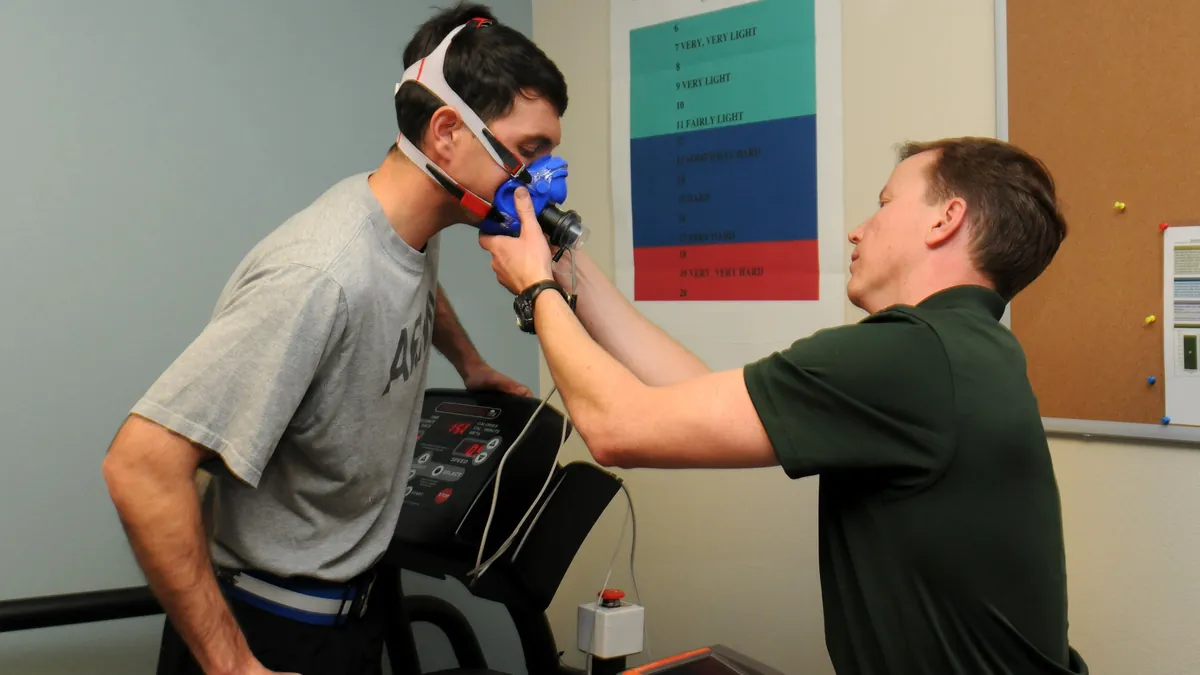
- Exercise test with gas analysis: you run or cycle wearing a mask that measures the oxygen you breathe while the intensity climbs until exhaustion. This is the gold standard.
- Exercise test without gases: the value is calculated from the speed and incline you reach on the treadmill. This is what the Mandsager study used.
- Watch or fitness band: it estimates the number from your heart rate and your running or cycling pace.
How far off is the watch? In 2022, Pablo Molina-García and the PROFITH group at the University of Granada (Spain) pooled 14 validation studies. Watches that use exercise data were right on average (an error of -0.09 mL/kg/min), but for any one person they could be about 10 mL/kg/min too high or too low. Those that estimate it at rest overestimated it by about 2 mL/kg/min, with even wider margins. The practical takeaway: a watch tells you whether your VO2 max is going up or down over time, not what your exact number is.

Read the video text
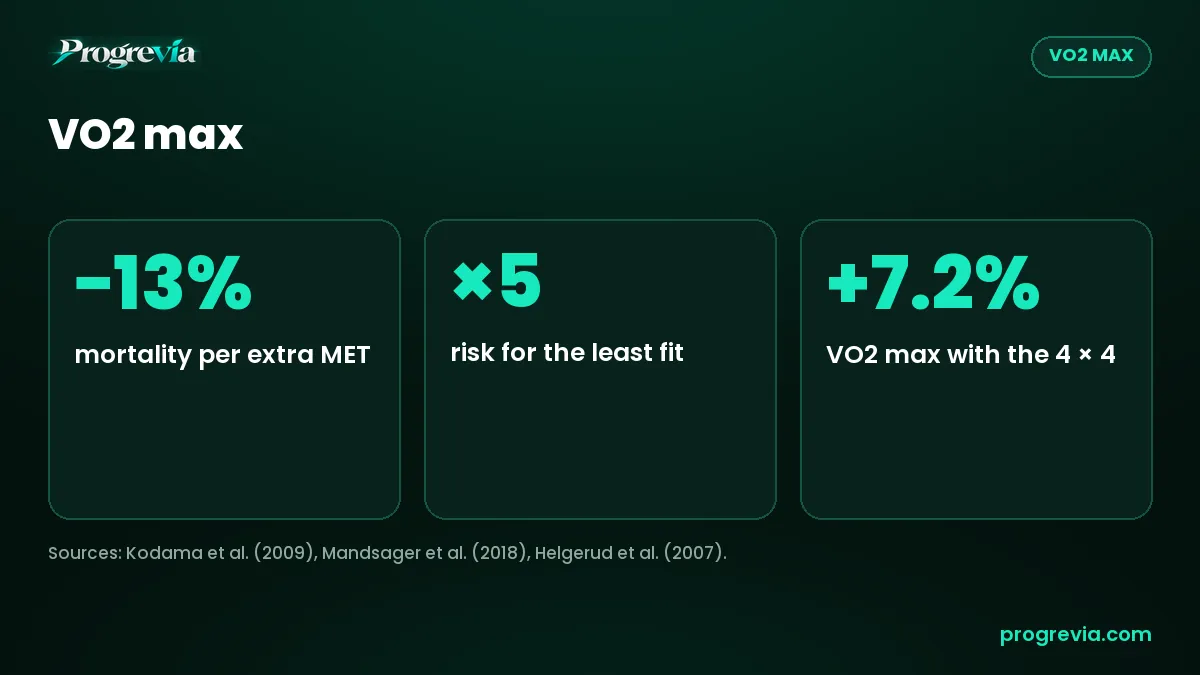
What VO2 max is good? −13% mortality for every extra MET of fitness, running 1 km/h faster (Kodama et al., 2009). ×5 risk of death for the least fit compared with the elite (Mandsager et al., 2018). +7.2% VO2 max with 4 × 4 intervals in just 8 weeks (Helgerud et al., 2007). Steady cardio and intervals. The video ends by showing how to create the routine in Progrevia.
What VO2 max is normal?
It depends on age and sex. The US FRIEND registry, updated in 2022 by Leonard Kaminsky (Ball State University) with 22,379 exercise tests from healthy adults, shows that the median drops by 13.5% per decade on average, about 4 mL/kg/min every ten years, and that it is higher in men than in women at every age.
To judge whether your number is good for your health, the most useful benchmark comes from the meta-analysis by Satoru Kodama (University of Tsukuba, Japan), which grouped 102,980 healthy people into three fitness levels:
| Level | METs | Approximate VO2 max | Risk compared with high |
|---|---|---|---|
| Low | under 7.9 | under 28 mL/kg/min | 1.70 times |
| Intermediate | 7.9 to 10.8 | 28 to 38 mL/kg/min | 1.21 times |
| High | 10.9 or more | 38 mL/kg/min or more | reference |
The intermediate figure comes from dividing the two the study reports (1.70 against high and 1.40 against intermediate). The authors put it simply: below 7.9 METs, rates of death and cardiovascular disease were clearly higher. And every extra MET, the equivalent of running 1 km/h faster, was linked to 13% lower mortality and 15% fewer cardiovascular events.
These are observational studies: they show a very consistent link, not proof that VO2 max is the only cause. Part of fitness is genetic, but improving it through training is also linked to lower risk, and that is the part you control.
How to improve your VO2 max
Both steady cardio and intervals work. In 2015, Zoran Milanović (University of Niš, Serbia) analysed 28 studies with 723 healthy adults aged 18 to 45:
- Steady cardio raised VO2 max by 4.9 mL/kg/min compared with no training.
- High-intensity intervals raised it by 5.5 mL/kg/min.
- Head to head, intervals won by 1.2 mL/kg/min, with a bigger edge for longer programmes and longer repetitions.
The most quoted trial on which intervals to use is by Jan Helgerud of the Norwegian University of Science and Technology (Trondheim). In 2007 he split 40 moderately trained men into four groups that did the same total work, 3 days a week for 8 weeks:
| Training | What it involved | VO2 max |
|---|---|---|
| Long slow run | at 70% of maximum heart rate | less than the intervals |
| Threshold | at 85% of maximum heart rate | less than the intervals |
| 15/15 intervals | 15 s at 90-95% and 15 s easy | +5.5% |
| 4 × 4 intervals | 4 min at 90-95% and 3 min easy, four times | +7.2% (from 55.5 to 60.4 mL/kg/min) |
The amount of blood the heart pumps with each beat rose by about 10% with intervals, and that is where the gain comes from. The fact that easy running improved VO2 max less in these already fit men does not mean it is useless: in people starting from a low base, Milanović's meta-analysis shows large gains with either type.
An 8-week plan to raise your VO2 max
- Day 1, 4 × 4 intervals: 10 minutes of warm-up, 4 blocks of 4 minutes at an effort where you can only say two or three words in a row, 3 easy minutes between blocks, and a 5-minute cool-down.
- Day 2, steady cardio: 30 to 45 minutes at a pace where you can talk in full sentences. That is zone 2.
- If you are starting from scratch: do two or three weeks of steady cardio only, then start the intervals with 2-minute blocks and build up to 4.
- How to check progress: repeat the same route or test every 4 weeks and see whether you do it faster at the same heart rate.
Any activity that uses a lot of muscle works: running, cycling, rowing, the elliptical or brisk uphill walking. If fitting cardio around your weights is the problem, see cardio and strength together, and the differences between the two styles of cardio in HIIT or moderate cardio.
What about strength training?
Lifting does little for VO2 max, but it does not compete with it: strength and muscle mass protect you in their own right, and the ideal is to have both. We cover this in strength and longevity.
Safety: if you have not exercised for a while, have heart disease or several risk factors, check with a health professional before starting high-intensity intervals. If you feel chest pain, dizziness or unusual breathlessness, stop.
The Progrevia generator builds your strength days, each with its own warm-up. Add this plan's two cardio sessions to your week and you have both pillars covered.
- Kodama S, Saito K, Tanaka S, et al. Cardiorespiratory fitness as a quantitative predictor of all-cause mortality and cardiovascular events in healthy men and women: a meta-analysis. JAMA. 2009;301(19):2024-2035.
- Mandsager K, Harb S, Cremer P, Phelan D, Nissen SE, Jaber W. Association of Cardiorespiratory Fitness With Long-term Mortality Among Adults Undergoing Exercise Treadmill Testing. JAMA Network Open. 2018;1(6):e183605.
- Helgerud J, Høydal K, Wang E, et al. Aerobic high-intensity intervals improve VO2max more than moderate training. Medicine and Science in Sports and Exercise. 2007;39(4):665-671.
- Milanović Z, Sporiš G, Weston M. Effectiveness of High-Intensity Interval Training (HIT) and Continuous Endurance Training for VO2max Improvements: A Systematic Review and Meta-Analysis of Controlled Trials. Sports Medicine. 2015;45(10):1469-1481.
- Molina-Garcia P, Notbohm HL, Schumann M, et al. Validity of Estimating the Maximal Oxygen Consumption by Consumer Wearables: A Systematic Review with Meta-analysis and Expert Statement of the INTERLIVE Network. Sports Medicine. 2022;52(7):1577-1597.
- Kaminsky LA, Arena R, Myers J, et al. Updated Reference Standards for Cardiorespiratory Fitness Measured with Cardiopulmonary Exercise Testing: Data from the Fitness Registry and the Importance of Exercise National Database (FRIEND). Mayo Clinic Proceedings. 2022;97(2):285-293.
Progrevia · · How we write our guides
Frequently asked questions
What is a good VO2 max?
It depends on age and sex, but as a health benchmark, above about 38 mL/kg/min (10.9 METs) is the high level in Kodama's large meta-analysis, and below about 28 mL/kg/min (7.9 METs) the risk of death was clearly higher.
Is my watch's VO2 max reliable?
For tracking the trend, yes. For your exact number, no: in a review of 14 studies, watches were right on average but could be about 10 mL/kg/min too high or too low for any one person.
How much can VO2 max improve?
In healthy adults, by about 5 mL/kg/min within a few months according to a meta-analysis of 28 studies, and more if you start from a low level. In a trial with already trained men, 4 × 4 intervals raised it by 7.2% in 8 weeks.
Which is better for VO2 max, HIIT or steady cardio?
Both work. High-intensity intervals win narrowly, by about 1.2 mL/kg/min on average, especially with long repetitions like the 4 × 4. Doing one day of each is a good option.
Does VO2 max drop with age?
Yes, by 13.5% per decade on average according to the FRIEND registry, about 4 mL/kg/min every ten years. Training does not stop that decline, but it keeps you well above the average for your age.
Informational content based on the available scientific evidence: it does not replace advice from a healthcare professional. If you have an injury or a medical condition, or are pregnant, check with one before changing your training or diet.
