Range of motion: full or partial reps for building muscle?
Published on
A meta-analysis of 16 studies found more strength and more leg hypertrophy with full range of motion. But partials in the part of the range where the muscle is stretched work very well. What studies say, which part of the range stretches each muscle and when it makes sense to cut it short.
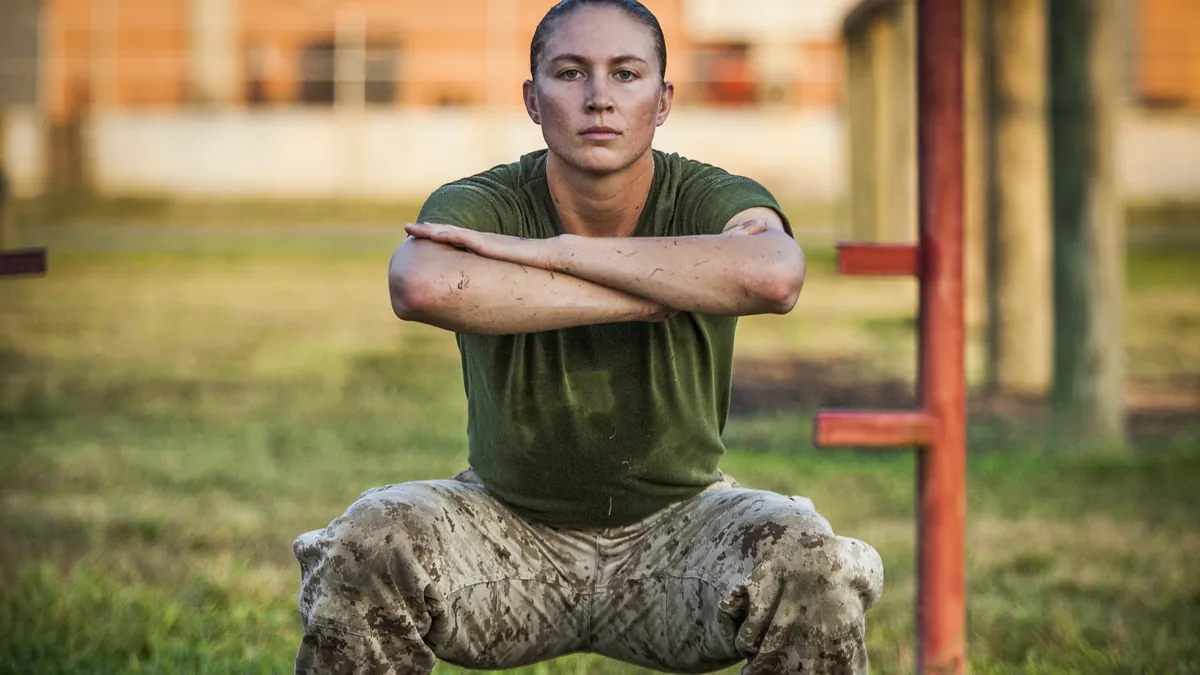
In 2013, a group of researchers had 17 students squat for 12 weeks. Half went down to 120 degrees of knee flexion, almost all the way; the other half stopped at 60 degrees, a half squat. At the end, the half-squat group had improved their half-squat maximum by 36%, but their deep squat by only 9%. The deep-squat group improved by around 20% in both and, above all, gained more muscle at the front of the thigh.
The study by Bloomquist and Raastad sums up the range-of-motion debate well: with half reps you lift more weight, but what you gain is strength in that range and less muscle. The story does not end there, though: some partials work very well. It depends on which part of the range you cut.
Full or partial range? What the meta-analysis says
In 2021, Jesús G. Pallarés's team at the University of Murcia pooled 16 studies comparing full and partial range of motion. Full range produced more strength (effect size 0.56) and more hypertrophy in the legs (0.88). Functional performance also came out better with full range (0.44), although without a significant difference, and there were no large differences in muscle architecture.
The trial by McMahon and colleagues (2014) adds a practical detail: after 8 weeks of training and 4 weeks off, the group that trained with a short range lost the strength they had gained sooner. The authors put it bluntly: range of motion should not be sacrificed to put more weight on the bar.
| Outcome | Effect size favouring full range | Significant difference? |
|---|---|---|
| Muscle strength | 0.56 | Yes |
| Leg hypertrophy | 0.88 | Yes |
| Functional performance | 0.44 | No |
| Muscle architecture | 0.28 | No |
The nuance: partials at long muscle lengths
More recent studies separate two kinds of partial. Doing only the half of the range where the muscle is stretched is not the same as doing the half where it is shortened.
- Leg extension (Pedrosa, 2022): 45 untrained women trained with full range, only the first half (knee bent, quadriceps stretched), only the second half or alternating. The first-half group achieved more relative hypertrophy in several regions of the thigh than the full-range and second-half groups. The second-half group, in some regions, was no different from the group that did not train.
- Calves (Kassiano, 2023): 42 young women did calf raises for 8 weeks. Using the bottom part of the range, with the calf stretched, the medial gastrocnemius grew by 15.2%, compared with 6.7% with full range and 3.4% with the top part.
- Hamstrings (Maeo, 2021): the seated leg curl, which works the hamstrings in a more stretched position than the lying curl, increased total hamstring volume by 14%, compared with 9% for the lying curl.
The idea that ties all these data together: what drives the most growth is working the muscle at long lengths. Full range always includes it; a partial may or may not. Cutting out the stretched part is the worst partial possible.
| Exercise | Lengthened position | Evidence |
|---|---|---|
| Squat | The bottom, with the knee deeply bent | Bloomquist (2013): the deep squat built more thigh muscle |
| Leg extension | The first half, with the knee bent | Pedrosa (2022) |
| Leg curl | Seated rather than lying | Maeo (2021) |
| Calf raise | The bottom, with the heel below the step | Kassiano (2023) |
| Bench press and flyes | The bottom, with the bar or dumbbells near the chest | Same logic; no specific trial cited here |
| Biceps curl | The bottom, with the arm almost straight | Same logic; no specific trial cited here |
When a partial makes sense
- Because of an injury or a mobility limitation: if full range hurts, a partial in the range you tolerate keeps the stimulus while you recover. We explain it in training with a shoulder or knee injury.
- To work a specific weak point: in strength athletes, partials in the range where the bar stalls are a classic tool. Bear in mind that the strength you gain will mostly be in that range, as Bloomquist found.
- As a complement, not a substitute: if a partial at long lengths lets you add more quality sets, it can help. If you use it to load more weight and skip the hard part, it hurts.
Common range-of-motion mistakes
- Overloading and cutting range: the classic “90-degree” squat with more weight than you can control. You move more kilos and gain less muscle.
- Confusing full range with bouncing: going all the way down is not dropping. Control the descent and pause briefly if you notice yourself bouncing.
- Forcing a range your mobility does not allow: full range is the range you can do with good technique, not the theoretical maximum. In the squat, it partly depends on your ankles and hips; we cover it in barbell squat technique.
If you want to understand why tension at long muscle lengths is so effective, we explain it in the mechanisms of hypertrophy, and to apply it to your legs, in the best leg exercises. In the routine created by the Progrevia generator, each exercise includes a short technique cue; use it as a reminder and move through the full range you can control.
- Pallarés JG, Hernández-Belmonte A, Martínez-Cava A, Vetrovsky T, Steffl M, Courel-Ibáñez J. Effects of range of motion on resistance training adaptations: a systematic review and meta-analysis. Scandinavian Journal of Medicine & Science in Sports. 2021;31(10):1866-1881.
- Bloomquist K, Langberg H, Karlsen S, Madsgaard S, Boesen M, Raastad T. Effect of range of motion in heavy load squatting on muscle and tendon adaptations. European Journal of Applied Physiology. 2013;113(8):2133-2142.
- McMahon GE, Morse CI, Burden A, Winwood K, Onambélé GL. Impact of range of motion during ecologically valid resistance training protocols on muscle size, subcutaneous fat, and strength. Journal of Strength and Conditioning Research. 2014;28(1):245-255.
- Maeo S, Huang M, Wu Y, et al. Greater hamstrings muscle hypertrophy but similar damage protection after training at long versus short muscle lengths. Medicine & Science in Sports & Exercise. 2021;53(4):825-837.
- Pedrosa GF, Lima FV, Schoenfeld BJ, et al. Partial range of motion training elicits favorable improvements in muscular adaptations when carried out at long muscle lengths. European Journal of Sport Science. 2022;22(8):1250-1260.
- Kassiano W, Costa B, Kunevaliki G, et al. Greater gastrocnemius muscle hypertrophy after partial range of motion training performed at long muscle lengths. Journal of Strength and Conditioning Research. 2023;37(9):1746-1753.
Progrevia · · How we write our guides
Frequently asked questions
Is full range of motion better for building muscle?
In general, yes. In the meta-analysis by Pallarés (2021), full range produced more strength and more leg hypertrophy than partial range. The exception is partials in the part where the muscle is stretched, which can match or beat it.
Are half reps any use?
It depends on which half you do. Partials at long muscle lengths, such as the bottom part of the calf raise, gave very good results in studies. Partials in the shortened part, by contrast, produced the least growth.
How deep should you squat?
As deep as you can with good technique. In Bloomquist's study (2013), the deep squat, to 120 degrees of knee flexion, built more thigh muscle than the 60-degree half squat.
Why can I lift more weight with half reps?
Because you skip the hardest part of the range. You gain strength mostly in that range: in Bloomquist's study, the half squat improved by 36% in the half squat but only 9% in the deep squat.
Which leg curl is better, seated or lying?
Seated. In Maeo's study (2021), the seated leg curl increased hamstring volume by 14%, compared with 9% for the lying curl, because it works them in a more stretched position.
Informational content based on the available scientific evidence: it does not replace advice from a healthcare professional. If you have an injury or a medical condition, or are pregnant, check with one before changing your training or diet.
