Posture exercises: what science says about the back, the neck and a rounded upper back
Published on
A review of 41 reviews found no consensus that posture causes back pain. When exercises really help, what about phones, and a routine to strengthen your back.
In 2019, physiotherapist Diane Slater and her colleagues, among them Peter and Kieran O'Sullivan, published an opinion piece whose title says it all: "Sit up straight": time to re-evaluate. Their starting point was uncomfortable for many people: the belief that back pain comes from sitting, standing or bending "wrongly" has no solid evidence behind it, and yet a whole industry of products and exercises has grown up to "correct" posture.
That does not mean the back cannot be trained. Here is what the evidence says about posture and pain, when exercises really help and a routine to strengthen your back.
Does bad posture cause back pain?
That is the question Christopher Swain's team (Australian Catholic University) asked in 2020. They screened 4285 publications and kept 41 systematic reviews on spinal posture, prolonged sitting or standing, bending, twisting or heavy physical work, and their link with low back pain. They found results in both directions, and when they looked only at studies that follow people over time, the conclusions were less consistent. Their verdict was that, despite so many reviews, there is no consensus on whether those postures cause pain.
Put another way: the way you sit does not seem to be the main cause of back pain. Other things matter much more, such as how much you move, how strong you are, sleep, stress or how you relate to pain. If your back hurts when training, there is a specific guide on lower back pain in the gym.
What about neck pain or phone posture?
In 2016, Karen Richards and her team at Curtin University (Australia) photographed 1108 seated 17-year-olds and grouped them into 4 types of neck and upper-back posture: upright, intermediate, slumped with the head forward, and straight with the head forward. There were no differences in the risk of neck pain or headache between the 4 groups. They did see two other things: slumped teenagers were more likely to report symptoms of depression, and upright ones exercised more.
Phones show something similar. A 2025 review led by Paula Resende (UNILAVRAS, Brazil) analysed 21 studies on so-called text neck and neck pain. 90% were observational, and none met the criteria epidemiology uses to talk about cause. With what we have, it cannot be said that looking at your phone causes neck pain.
| What is often said | What the evidence says |
|---|---|
| Sitting badly causes back pain | There is no consensus that spinal posture causes low back pain (Swain, 2020) |
| A forward head gives neck pain | In 1108 teenagers, posture type did not change the risk of neck pain (Richards, 2016) |
| Phones wreck your neck | None of 21 studies met the criteria for causation (Resende, 2025) |
| There is a perfect posture | No ideal posture has been shown; the problem is spending hours in any one without moving (Slater, 2019) |
| A rounded back cannot be fixed | In older adults with hyperkyphosis, exercise reduced the curve (Katzman, 2017) |
Read the video text
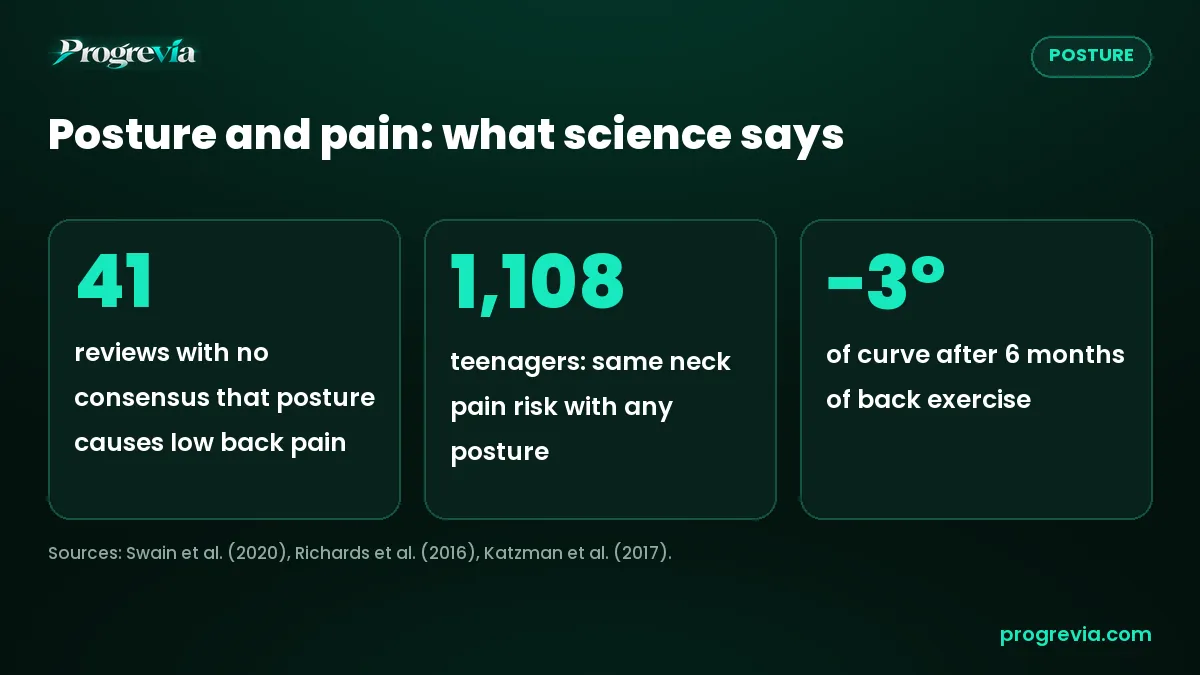
Does sitting badly give you back pain? 41 reviews and no consensus that posture causes low back pain (Swain et al., 2020). 1,108 teenagers: their posture did not change the risk of neck pain (Richards et al., 2016). −3° of curve in older adults with a very rounded back, after 6 months of exercise (Katzman et al., 2017, SHEAF trial). The best posture is the one you keep changing. The video ends by showing how to create the routine in Progrevia.
When posture exercises do help
There is one case in which exercise changes the shape of the back: hyperkyphosis, the excessive rounding of the upper back that appears with age and that many people call a hunchback. In the SHEAF trial, Katzman's team at the University of California, San Francisco recruited 99 people aged 60 or over with a curve of 40 degrees or more. Half of them did back-strengthening and posture-training exercises for 6 months, 3 times a week, in 1-hour sessions with a physiotherapist. The other group received health talks.
The group that trained reduced the curve by 3 degrees more than the control group, measured on X-ray, and improved how they saw themselves. In the physical function tests, however, there were no differences. If you are worried about rounding due to age or osteoporosis, see also exercise during menopause and the routine for people over 40.
For everyone else, the reasonable goal is not to "correct" a posture, but to have a strong, resilient back that copes well with any position, and to move throughout the day. Put practically: the best posture is the one you keep changing.
Exercise routine for posture and the back
These exercises strengthen the upper back, the muscles that draw the shoulders back and the spinal extensors. Do the routine 2 or 3 times a week, on its own or at the end of your workout.
| Exercise | Sets × reps | What it works |
|---|---|---|
| Dumbbell row | 3 × 10-12 per side | Lats and mid back |
| Cable or band face pull | 3 × 12-15 | Rear delts and shoulder-blade muscles |
| Band pull-apart | 2 × 15-20 | Upper back |
| Prone Y raise | 2 × 10-12 | Middle and lower trapezius |
| Back extension on a bench | 3 × 10-15 | Spinal extensors and glutes |
| Bird dog | 2 × 8 per side | Trunk stability |
| Front plank | 3 × 20-40 s | Abs and trunk |
Increase the difficulty gradually: more reps, a harder band or more weight. Without a gym, the face pull and band pull-apart can be done with a band, as we explain in resistance bands. There are more options in back exercises and plank technique in the plank.
For everyday life: if you work sitting down, get up every 30-60 minutes, even for a couple of minutes, and alternate positions. Walking and strength training do more for your back than checking whether you are perfectly straight.
When to see a doctor
The exercises in this guide are for people without a diagnosed injury. See a doctor or physiotherapist if the pain does not improve within a few weeks, if it appears after a blow or a fall, if it wakes you at night or if it comes with tingling, loss of strength, fever or unexplained weight loss.
In the Progrevia generator you can enter your injuries, and the plan avoids the exercises that do not fit and includes upper-back and trunk work during the week.
- Slater D, Korakakis V, O'Sullivan P, Nolan D, O'Sullivan K. "Sit up straight": time to re-evaluate. Journal of Orthopaedic and Sports Physical Therapy. 2019;49(8):562-564.
- Swain CTV, Pan F, Owen PJ, Schmidt H, Belavy DL. No consensus on causality of spine postures or physical exposure and low back pain: a systematic review of systematic reviews. Journal of Biomechanics. 2020;102:109312.
- Richards KV, Beales DJ, Smith AJ, O'Sullivan PB, Straker LM. Neck posture clusters and their association with biopsychosocial factors and neck pain in Australian adolescents. Physical Therapy. 2016;96(10):1576-1587.
- Resende PA, Tavares Correia IM, de Sá Ferreira A, Meziat-Filho N, Lunkes LC. Neck pain and text neck using Hill's criteria of causation: a scoping review. Journal of Bodywork and Movement Therapies. 2025;42:132-138.
- Katzman WB, Vittinghoff E, Lin F, et al. Targeted spine strengthening exercise and posture training program to reduce hyperkyphosis in older adults: results from the study of hyperkyphosis, exercise, and function (SHEAF) randomized controlled trial. Osteoporosis International. 2017;28(10):2831-2841.
Progrevia · · How we write our guides
Frequently asked questions
Does bad posture cause back pain?
There is no solid evidence. A review of 41 systematic reviews (Swain, 2020) found no consensus that spinal posture causes low back pain. Movement, strength, sleep and stress matter more.
Can a rounded upper back be corrected with exercise?
Partly. In the SHEAF trial, people aged 60 or over with a very rounded back reduced the curve by 3 degrees with 6 months of back exercise, 3 times a week.
Does looking at your phone cause neck pain?
Current evidence does not allow us to say so. A review of 21 studies on phone posture found none that met the criteria to speak of cause.
Which exercises are good for posture?
Those that strengthen the upper back and spine: rows, face pulls, band pull-aparts, Y raises, back extensions, bird dogs and planks, 2 or 3 times a week.
What is the correct posture for sitting?
No ideal posture has been shown. What helps is not spending hours in the same one: get up every 30-60 minutes and alternate positions.
Informational content based on the available scientific evidence: it does not replace advice from a healthcare professional. If you have an injury or a medical condition, or are pregnant, check with one before changing your training or diet.
