Foam rolling: what it really does, when to use it and how, according to the studies
Published on
After a squat session designed to leave them sore, 20 minutes of foam rolling cut the pain and sped up recovery. What a foam roller does, what it does not and how to use it well.
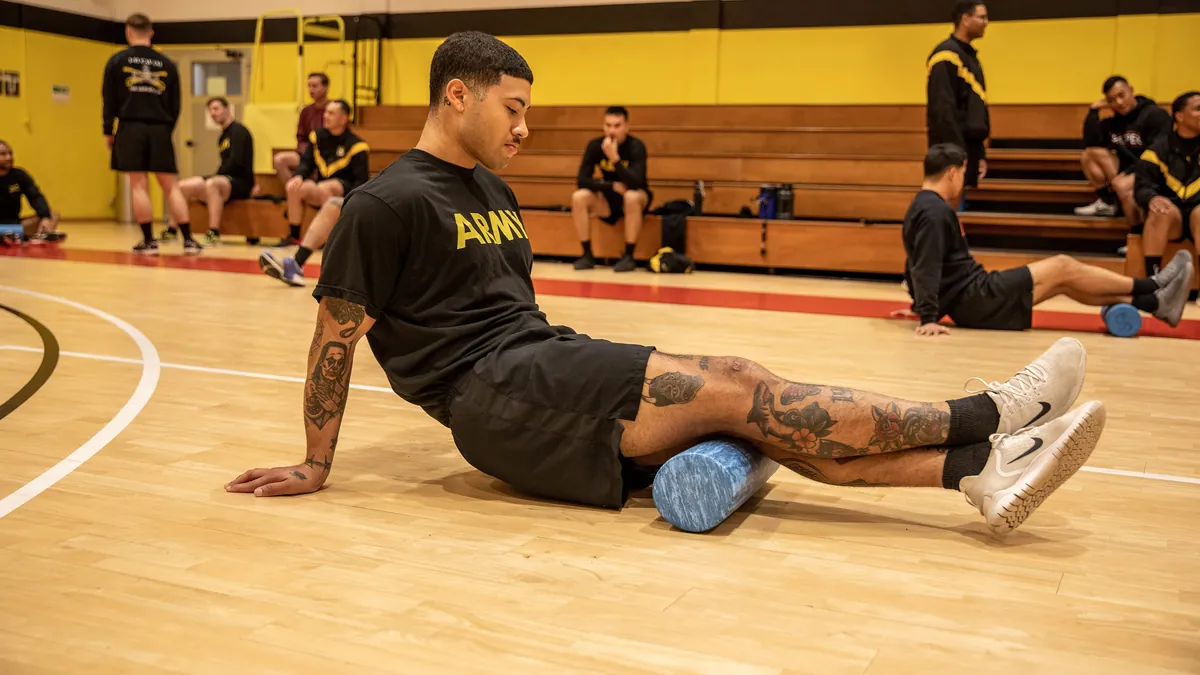
In 2015, Gregory Pearcey and Duane Button's team at Memorial University of Newfoundland (Canada) had eight men do 10 sets of 10 squats at 60% of their max, a session designed to leave them sore. In one of two trials, four weeks apart, they spent 20 minutes on a foam roller straight afterwards, at 24 hours and at 48 hours. With the roller, the quadriceps hurt much less when pressed, and sprint, broad jump and leg endurance recovered better.
It is a small study, but it points in the same direction as the rest. Here is what a foam roller does, what it does not do, when to use it and how.
What a foam roller does and does not do
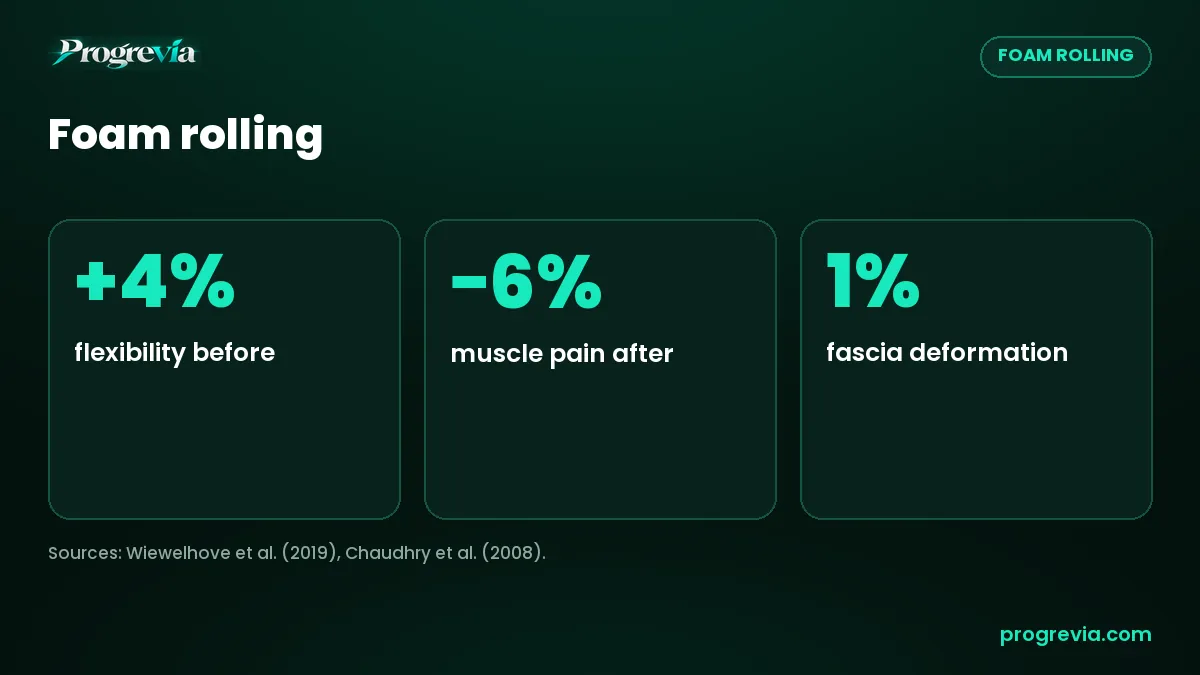
You often hear that rolling "releases fascia", the layer of tissue that wraps around muscles, or that it breaks up knots and adhesions. In 2008, engineer Hans Chaudhry (New Jersey Institute of Technology), working with fascia researcher Robert Schleip, used a mathematical model to work out how much force it would take to deform fascia for good. Compressing or stretching the fascia lata of the thigh or the plantar fascia by just 1% required forces outside the normal physiological range, far beyond what your body weight on a roller can apply.
The feeling that "something lets go" has a more likely explanation: the nervous system. Pressure changes how you perceive the muscle and raises your tolerance to stretch and discomfort for a while. That is why the effect is real but short-lived.
Before training: more flexibility, no strength loss
The best summary is the meta-analysis by Thimo Wiewelhove (Ruhr University Bochum, Germany), who in 2019 pooled 21 studies: 14 with rolling before exercise and 7 after.
| What was measured | Rolling before | Rolling after |
|---|---|---|
| Sprint | +0.7% | +3.1% compared with not rolling |
| Strength | +1.8% (negligible) | +3.9% compared with not rolling |
| Jump | -1.9% (negligible) | -0.2% (negligible) |
| Flexibility | +4.0% | no data |
| Muscle pain | no data | 6% less |
Before training, a foam roller buys you a little extra range of motion without taking away strength or jump height. It fits nicely into a warm-up but does not replace one: you still need to raise your heart rate and rehearse the movement. We explain this in the RAMP warm-up.
Read the video text
Does the foam roller really work? +4% flexibility when used before training (Wiewelhove et al., 2019). −6% muscle pain when used after training (Wiewelhove et al., 2019). 1% fascia deformation would take forces beyond the physiological range (Chaudhry et al., 2008). Small effect, but real. The video ends by showing how to create the routine in Progrevia.
After training: less soreness
Used after exercise, rolling reduced the drop in sprint and strength over the following days and lowered perceived muscle pain. Foam rollers tended to do better than roller sticks for recovering strength (+5.6% versus -0.1%). The authors themselves conclude that the effects are "rather minor", though they can matter in some cases, such as before a sprint or to ease pain. If soreness is your problem, the other options are in what muscle soreness is and how to ease it.
In the long run: does it improve flexibility?
Yes, roughly as much as stretching. In 2024, Andreas Konrad (University of Graz, Austria) compared 85 studies, 72 on stretching and 13 on foam rolling. Both increased range of motion moderately, with no clear difference between them. With one exception: in programmes of four weeks or less, static stretching worked and foam rolling did not yet.
A practical detail from the same group: in 2023, seven weeks of rolling and stretching the sole of the foot did nothing for shoulder mobility. The effect on distant areas seen after a single session does not build up over time, so work directly on the muscle you want to improve.
How to use a foam roller
- Before training: 30 to 60 seconds per muscle, with slow passes, on the areas you are about to train. Then the rest of your warm-up.
- After training or the next day: 1 or 2 minutes per area if you are sore. In Pearcey's study it was 20 minutes in total, repeated at 24 and 48 hours.
- Pressure: uncomfortable but bearable. If you have to hold your breath or tense the muscle, it is too much.
- Where: quads, hamstrings, calves, glutes, adductors and lats. Avoid rolling directly over the lower back, joints and bones.
- Smooth or textured, soft or firm: there is no evidence that one is better. Pick the one you can use at the right pressure.
Common foam rolling mistakes
- Using it instead of a warm-up: on its own it does little to prepare your body for heavy loads.
- More pain is not more effect: pressing until it hurts does not improve the result.
- Expecting it to fix your posture or "put something back": there is no evidence that it does.
- Spending ten minutes on one area before training: a minute is enough for the effect you are after.
Stretch or roll? For long-term flexibility they give similar results, and what really counts is doing it consistently. See when and how to stretch in stretching before or after training.
Safety: if you have a recent injury, varicose veins, circulation problems, osteoporosis or take blood thinners, check with a health professional before using a foam roller. Stop if you feel tingling, numbness or pain that is not muscular.
The Progrevia generator includes a phased warm-up in every session: raise your heart rate, activate and mobilise the day's muscles. If you like rolling, it fits into the mobility phase, right before your first sets.
- Wiewelhove T, Döweling A, Schneider C, et al. A Meta-Analysis of the Effects of Foam Rolling on Performance and Recovery. Frontiers in Physiology. 2019;10:376.
- Pearcey GE, Bradbury-Squires DJ, Kawamoto JE, Drinkwater EJ, Behm DG, Button DC. Foam rolling for delayed-onset muscle soreness and recovery of dynamic performance measures. Journal of Athletic Training. 2015;50(1):5-13.
- Konrad A, Alizadeh S, Anvar SH, Fischer J, Manieu J, Behm DG. Static Stretch Training versus Foam Rolling Training Effects on Range of Motion: A Systematic Review and Meta-Analysis. Sports Medicine. 2024;54(9):2311-2326.
- Chaudhry H, Schleip R, Ji Z, Bukiet B, Maney M, Findley T. Three-dimensional mathematical model for deformation of human fasciae in manual therapy. The Journal of the American Osteopathic Association. 2008;108(8):379-390.
- Konrad A, Reiner M, Manieu J, et al. The non-local effects of 7-week foot sole static stretching and foam rolling training on shoulder extension range of motion. Frontiers in Sports and Active Living. 2023;5:1335872.
Progrevia · · How we write our guides
Frequently asked questions
What is a foam roller good for?
For gaining a little flexibility before training without losing strength, and for easing soreness and the drop in performance over the following days. The effects are small but real, according to a meta-analysis of 21 studies.
Is it better to foam roll before or after training?
Both make sense. Before, as part of your warm-up, it slightly improves flexibility; after, it reduces muscle pain and helps sprint and strength recover over the following days.
Does foam rolling break up adhesions or release fascia?
There is no evidence that it does. A mathematical model found that deforming thigh fascia by 1% takes forces outside the normal physiological range. The effect most likely comes from the nervous system.
How long should you foam roll?
Before training, 30 to 60 seconds per muscle is enough. After training, if you are sore, one or two minutes per area. Spending much longer on one area does not add anything.
Can foam rolling replace stretching?
For long-term flexibility they give similar results according to a meta-analysis of 85 studies, except in programmes of four weeks or less, where stretching worked and rolling did not yet.
Informational content based on the available scientific evidence: it does not replace advice from a healthcare professional. If you have an injury or a medical condition, or are pregnant, check with one before changing your training or diet.
