
Whey protein powder: whether you need it, which type to choose, how much to take and whether it harms your kidneys
Published on
Whey is milk protein: it only helps if you fall short of your daily target, and above about 1.6 g per kilo it adds nothing. Types, amount, timing and what studies say about the kidneys.
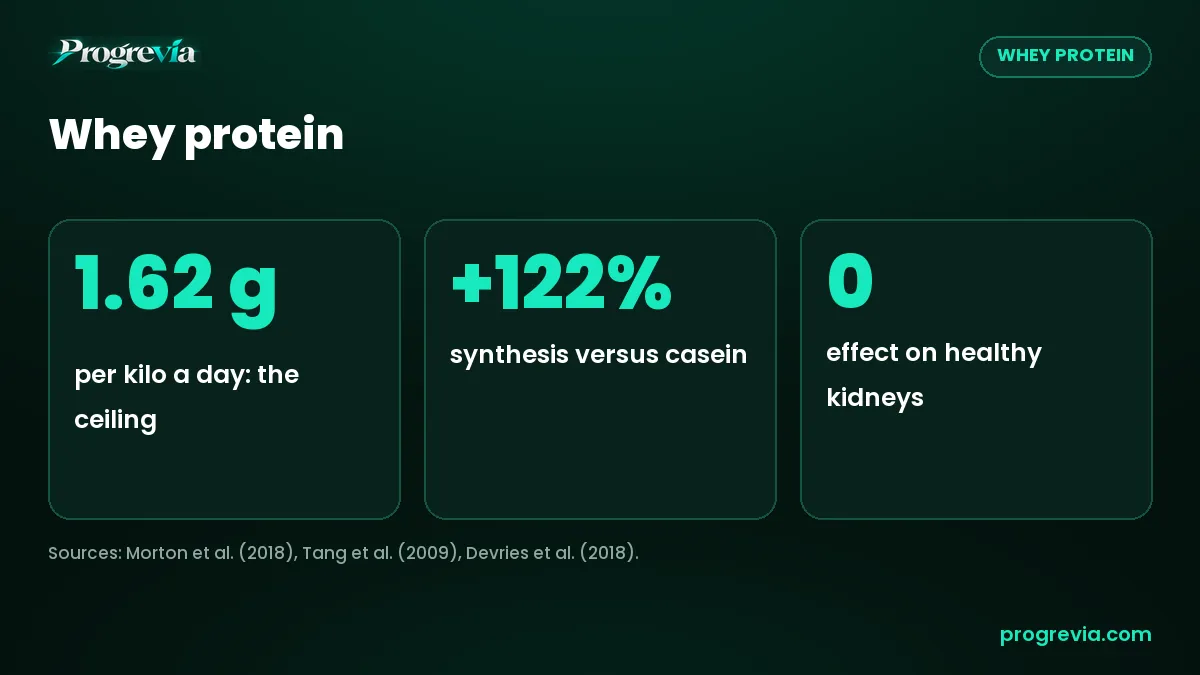
In 2009, Jason Tang and colleagues at McMaster University (Canada) gave 18 young men, in three groups of 6, a drink with the same amount of essential amino acids (10 g) as whey protein, casein or soy, right after training one leg. After training, whey stimulated muscle protein synthesis 122% more than casein and 31% more than soy.
That explains its reputation. What it does not explain is whether you need to buy it. Here is what whey protein is, when it really helps, how much to take and what studies say about the kidneys.
What whey protein is
Whey is the protein in milk whey, the liquid left over when cheese is made. It is filtered, dried and sold as a powder. It is a complete protein, with all the essential amino acids and plenty of leucine, and it is digested quickly. There are three main forms:
| Type | Protein per 100 g | Who it suits |
|---|---|---|
| Concentrate | 70-80 g | The cheapest option for most people |
| Isolate | 90 g or more | If lactose disagrees with you or you want less fat and carbs |
| Hydrolysate | Similar to isolate | Pre-digested; more expensive and with no clear advantage for muscle |
Do you need whey protein to build muscle?
No, if you already eat enough protein. In 2018, Robert Morton (McMaster University) pooled 49 trials with 1,863 participants who did strength training for at least 6 weeks. With protein supplements, gains were greater: 0.30 kg more fat-free mass and 2.49 kg more one-rep-max strength, on average. But above about 1.62 g of protein per kilo of body weight a day, the extra protein no longer added muscle.
The practical takeaway: whey is a convenient way to reach your daily target, not an extra that works beyond it. If food already gets you there, it adds nothing. You will find how to work out your number in how much protein you need a day and in the protein calculator.
Read the video text
Do you need protein powder? 1.62 g per kilo a day: above it, extra protein added no muscle (Morton et al., 2018). +122% muscle synthesis with whey versus casein after training (Tang et al., 2009). 0 effect of high-protein diets on kidney function in healthy adults (Devries et al., 2018). Food, not magic. The video ends by showing how to create the routine in Progrevia.
Whey, casein or plant protein
Tang's study measures the response over a few hours, not the muscle gained over months, and with the same daily protein the long-term differences shrink a lot. Even so, it helps you choose:
- Whey: the one that stimulated muscle most after training in that study. A good default.
- Casein: digested more slowly. Useful if you want a serving that lasts, for example before bed.
- Plant (soy, pea, rice): a valid alternative if you do not take dairy; it pays to take a little more or mix sources. We explain it in plant proteins for building muscle.
How much whey protein to take and when
- Per serving: 20-40 g of protein, one or two scoops depending on the product. Check the label: a scoop does not always contain the same amount of protein.
- Per day: whatever you are short of to reach your target with food, no more.
- When: what matters most is the daily total. Taking it after training is convenient, but not required. We look at it in post-workout nutrition.
Does whey protein harm the kidneys?
In healthy people, studies do not show it. In 2018, Michaela Devries (McMaster University) analysed 28 trials with 1,358 adults without kidney disease that compared high-protein diets (at least 1.5 g per kilo a day, or 100 g a day) with normal or low ones. When the change in kidney function in each group was compared, protein had no effect.
The exception is anyone who already has kidney disease: in that case, their doctor has to set the amount of protein.
How to choose a tub of whey protein
- Protein per 100 g: the figure that matters for comparing prices.
- A short ingredient list: protein, a flavouring and little else.
- An independent quality-testing seal if you compete under anti-doping rules: it reduces the risk of contamination with banned substances.
- Be wary of promises of fast muscle gain or "patented" ingredients: whey is milk protein; it does nothing food does not.
You will find the full list of what does work in sports supplements that work.
Health: if you have kidney or liver disease, a milk protein allergy or take medication, see a healthcare professional before adding protein supplements.
Work out how much protein you need with the Progrevia protein calculator and pair it with a routine from the generator: protein only turns into muscle if there is training.
- Tang JE, Moore DR, Kujbida GW, Tarnopolsky MA, Phillips SM. Ingestion of whey hydrolysate, casein, or soy protein isolate: effects on mixed muscle protein synthesis at rest and following resistance exercise in young men. Journal of Applied Physiology. 2009;107(3):987-992.
- Morton RW, Murphy KT, McKellar SR, Schoenfeld BJ, Henselmans M, Helms E, et al. A systematic review, meta-analysis and meta-regression of the effect of protein supplementation on resistance training-induced gains in muscle mass and strength in healthy adults. British Journal of Sports Medicine. 2018;52(6):376-384.
- Devries MC, Sithamparapillai A, Brimble KS, Banfield L, Morton RW, Phillips SM. Changes in Kidney Function Do Not Differ between Healthy Adults Consuming Higher- Compared with Lower- or Normal-Protein Diets: A Systematic Review and Meta-Analysis. The Journal of Nutrition. 2018;148(11):1760-1775.
Progrevia · · How we write our guides
Frequently asked questions
Do I need whey protein to build muscle?
No, if food already gets you to your daily target. In Morton's meta-analysis (2018), above about 1.62 g per kilo a day the extra protein added no muscle. Whey is a convenient way to get there.
Whey concentrate or isolate?
Concentrate is cheaper and suits most people. Isolate has more protein per 100 g and almost no lactose, so it is better if lactose disagrees with you.
How much whey protein should I take a day?
Whatever you are short of to reach your target with food. Per serving, 20-40 g of protein; check the label, because a scoop does not always contain the same amount.
Is it better to take it after training?
It is convenient, but not required. What matters most for building muscle is your total daily protein.
Does whey protein harm the kidneys?
In healthy adults, no: in Devries's meta-analysis (2018) of 28 trials, high-protein diets did not change kidney function. If you already have kidney disease, see your doctor.
Informational content based on the available scientific evidence: it does not replace advice from a healthcare professional. If you have an injury or a medical condition, or are pregnant, check with one before changing your training or diet.
