
Omega-3 and muscle: whether it helps build mass and strength, who it helps and how to take it
Published on
The latest meta-analysis found no clear effect of omega-3 on muscle or strength in healthy adults. What studies say in older adults, on recovery and whether fish or capsules are better.
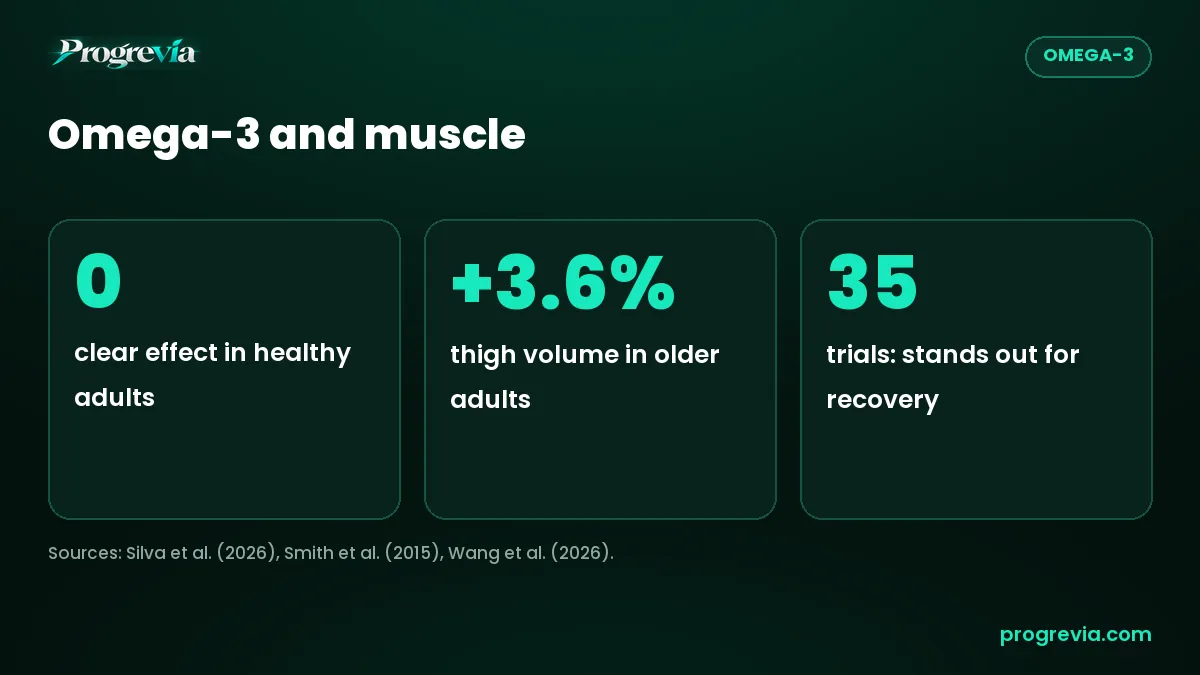
In 2026, André Silva and colleagues at the Faculty of Medicine of the University of São Paulo (Brazil) gathered every trial comparing omega-3 supplements with a placebo in healthy adults. With 4 studies on fat-free mass and 8 on strength, they found no clear effect on either, and rated the certainty of the evidence as very low.
Omega-3 has a reputation for helping muscle, but the data in young, healthy people do not back it up. Here is what the studies say, who it might help and how to take it if you decide to.
What omega-3s are
They are fats the body does not make in sufficient amounts and that have to come from food. The two that matter most are EPA and DHA, found mainly in oily fish (salmon, sardines, mackerel, anchovies) and seafood. Walnuts, flax and chia provide another omega-3, ALA, which the body converts into EPA and DHA in very small amounts.
Does omega-3 help build muscle?
In healthy adults, according to Silva's meta-analysis, there is no evidence that it does. The explanation is simple: building muscle comes down to training, total daily protein and enough calories. A fat supplement does not change that equation much. If you want a supplement with a proven effect, creatine has far more evidence; we explain it in the creatine guide.
Read the video text
Does omega-3 build muscle? 0 clear effect on muscle and strength in healthy adults (Silva et al., 2026). +3.6% thigh volume in older adults after 6 months (Smith et al., 2015). 35 trials: better for recovery than strength (Wang et al., 2026). Oily fish, once or twice a week. The video ends by showing how to create the routine in Progrevia.
Omega-3 and muscle in older adults
Here the data are more interesting. In 2015, Gordon Smith (Washington University School of Medicine in St. Louis, United States) gave fish oil or corn oil for 6 months to 60 people aged 60 to 85, without adding any training. 44 finished. Compared with the control group, omega-3 increased thigh muscle volume by 3.6%, grip strength by 2.3 kg and maximum strength by 4.0%.
It is a single trial, with no training involved. For an older person, what protects muscle most is still strength training; we look at it in the routine for over-40s.
What about recovery after training?
In 2026, Ziyu Wang (Sejong University, Seoul) compared 35 trials with 1,211 trained athletes taking protein, creatine or omega-3 in a network meta-analysis. Each supplement stood out in one thing:
| Outcome | Best performer | In practice |
|---|---|---|
| Strength | Creatine | The supplement with most support for strength training |
| Endurance | Protein | Helps if you fall short of your daily target |
| Recovery | Omega-3 | Moderate effect on recovery measures |
It is an indirect comparison between different studies, so take it as a hint. If soreness is holding you back, there are measures with more weight behind them, such as sleeping well and progressing gradually; we explain it in muscle soreness.
Fish or capsules
Most dietary guidelines recommend eating fish once or twice a week, preferably oily. That gets you a reasonable amount of EPA and DHA and, along the way, quality protein. Capsules are an alternative if you do not eat fish, although they are not essential for training.
How to choose an omega-3 supplement
- Look at the EPA and DHA per capsule, not the milligrams of oil: that tells you how much omega-3 you are really taking.
- Check the date and the smell: oxidised oil smells rancid.
- If you do not eat fish, algae oil provides EPA and DHA without an animal source.
- Be wary of promises of muscle or fat burning: that is not what the studies say.
You will find the full list of what works in sports supplements that work.
Health: if you take anticoagulants or antiplatelet drugs, are due to have surgery or are allergic to fish, see a healthcare professional before taking omega-3 supplements.
If your goal is to build muscle, start with what matters most: a training plan from the Progrevia generator and the protein you need, which you can work out with the protein calculator.
- Silva AMF, Simões MO, Artioli GG. Omega-3 supplementation shows no clear benefit for fat-free mass or muscle strength in healthy adults: a systematic review and meta-analysis of randomized controlled trials. Nutrition. 2026;153:113378.
- Smith GI, Julliand S, Reeds DN, Sinacore DR, Klein S, Mittendorfer B. Fish oil-derived n-3 PUFA therapy increases muscle mass and function in healthy older adults. The American Journal of Clinical Nutrition. 2015;102(1):115-122.
- Wang Z, Qin G, Kim BM. Comparative Effects of Dietary Protein, Creatine, and Omega-3 Supplementation on Muscle Strength, Endurance, and Recovery in Trained Athletes: A Systematic Review and Network Meta-Analysis. Nutrients. 2026;18(6):909.
Progrevia · · How we write our guides
Frequently asked questions
Does omega-3 help build muscle?
In healthy adults it has not been shown to: Silva's meta-analysis (2026) found no clear effect on either fat-free mass or strength.
Does omega-3 help older adults?
There is one promising trial: in Smith (2015), 6 months of fish oil increased thigh volume by 3.6% in people aged 60 to 85. Even so, what protects muscle most is strength training.
Does omega-3 improve recovery?
In Wang's network meta-analysis (2026), it was the supplement that came out best for recovery, with a moderate effect. Sleeping well and progressing gradually still matter more.
Is fish or omega-3 capsules better?
Oily fish once or twice a week covers a reasonable amount and adds protein. Capsules are an alternative if you do not eat fish.
Who should not take omega-3 without checking first?
Anyone taking anticoagulants or antiplatelet drugs, due for surgery or allergic to fish: in those cases, see a healthcare professional first.
Informational content based on the available scientific evidence: it does not replace advice from a healthcare professional. If you have an injury or a medical condition, or are pregnant, check with one before changing your training or diet.
