Biceps curl: correct technique, which variation to choose and whether you need to go to failure
Published on
Incline or preacher curl: in 12 weeks the arm grew the same with both, although each favoured a different muscle. Technique, variations, mistakes and programming.
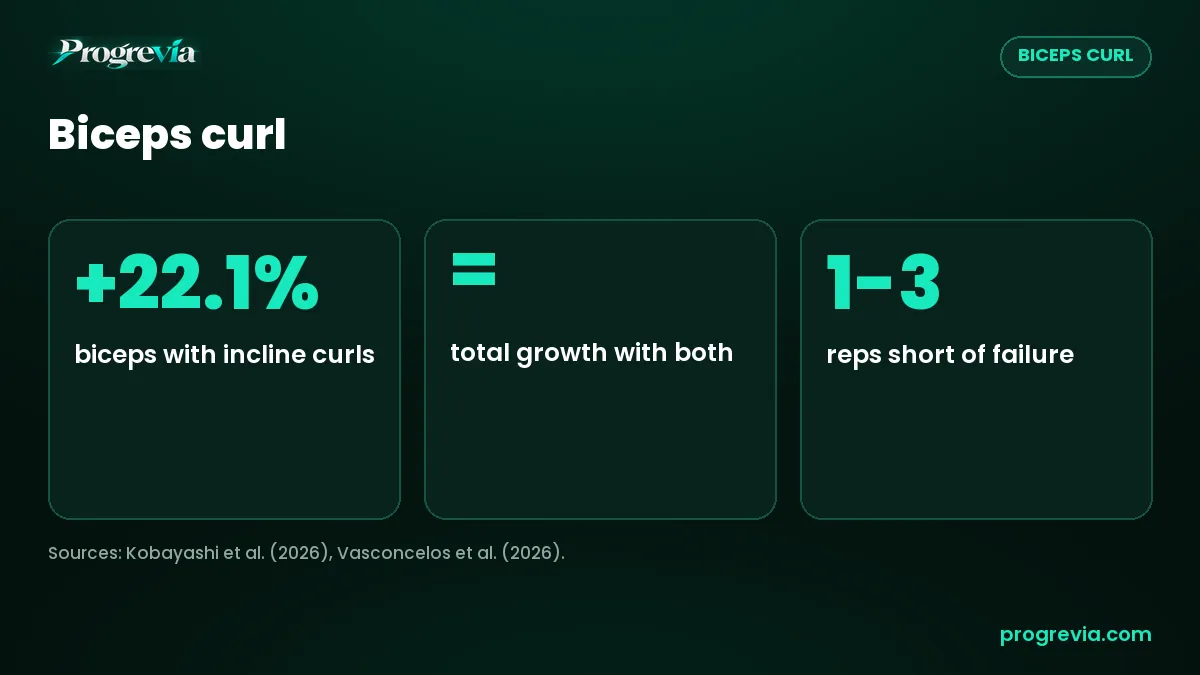
In 2026, Yuuto Kobayashi and colleagues at Ritsumeikan University (Japan) trained 21 untrained adults for 12 weeks: one arm did incline dumbbell curls, sitting on a reclined bench, and the other did preacher curls, with the arm resting on a pad. They then measured each muscle with MRI. The biceps grew more with the incline curl (22.1% versus 18.9%), the brachialis and brachioradialis more with the preacher (21.1% versus 17.1% and 17.6% versus 13.5%), and the muscles that bend the elbow as a whole grew the same with both.
Each curl variation shares out the work in its own way, but none is essential. Here is how to do the biceps curl, which variations exist and how to program it.
Which muscles the biceps curl works
- Biceps: the muscle at the front of the arm. It bends the elbow and turns the palm up.
- Brachialis: it sits under the biceps and is the one that produces most force when bending the elbow, whatever the hand position.
- Brachioradialis: it runs from the elbow to the forearm and works more with the palm facing in, as in the hammer curl.
If you already do rows and pull-ups, the biceps gets some work, but the curl adds a direct stimulus you will notice. You will find the other exercises in biceps and triceps exercises.
How to do the biceps curl step by step
- The start. Standing, barbell or dumbbells in your hands, arms straight, palms facing forward.
- The elbows. Tucked into your sides: they should not drift forward as you lift.
- The ascent. Bend your elbows until the weight is close to your shoulders, without swinging your torso.
- At the top. Squeeze for a moment without letting your elbows move forward.
- The descent. Over 2-3 seconds, until your arms are almost fully straight.
Read the video text
Incline curl or preacher? +22.1% biceps growth with incline curls, versus 18.9% with preacher (Kobayashi et al., 2026). Same: elbow flexor growth with both curls (Kobayashi et al., 2026). 1-3 reps short of failure: same muscle and strength (Vasconcelos et al., 2026). Elbows still, full range. The video ends by showing how to create the routine in Progrevia.
Incline curl or preacher curl: what the MRI measured
| Muscle | Incline curl | Preacher curl |
|---|---|---|
| Biceps | +22.1% | +18.9% |
| Brachialis | +17.1% | +21.1% |
| Brachioradialis | +13.5% | +17.6% |
| All elbow flexors | +17.6% | +19.2% |
The differences between muscles were small to moderate, and the total did not change. In practice: if you like both, combine them; if you only do one, that is fine.
Does shoulder position matter in the curl?
The incline curl puts the arm behind the body, and that biceps stretch is often said to be what makes it better. In 2026, Stian Larsen (Nord University, Norway) put it to the test with 24 untrained men who did one-arm cable curls for 10 weeks, 6 to 8 sets a week to failure: one arm with the shoulder in a neutral position and the other with the shoulder taken back as far as possible. With the same resistance and the same elbow range, both arms grew between 7% and 9%, with no differences.
Shoulder position on its own does not decide the outcome. Choose the variation that feels comfortable and lets you use the full range.
Do you need to go to failure on biceps curls?
Not necessarily. Also in 2026, Tiago Vasconcelos (CIDESD, Covilhã, Portugal) trained 19 experienced adults for 8 weeks, 2 days a week, with one-arm preacher curls at 70-80% of their maximum. One arm reached failure on every set and the other stopped 1-3 reps short. Muscle thickness and strength improved similarly in both. We cover it in training to failure.
Biceps curl variations
| Variation | What changes | Who it suits |
|---|---|---|
| Barbell curl | More weight with both hands at once | Those who want to progress in load |
| EZ bar curl | Slightly angled grip | If the straight bar bothers your wrists |
| Dumbbell curl | Each arm works on its own | Fixing differences between arms; at home |
| Hammer curl | Palms facing in | More brachialis and brachioradialis |
| Incline curl | Arm behind the body | A little more biceps (Kobayashi, 2026) |
| Preacher curl | Arm resting on a pad | A little more brachialis; prevents swinging |
| Cable curl | Even tension across the range | Varying the stimulus without changing the movement |
Common biceps curl mistakes
- Swinging your body: if you need momentum, the weight is too heavy.
- Bringing the elbows forward as you lift: the work moves to the shoulder.
- Half reps: lower until your arm is almost straight on every rep.
- Lowering without control: the descent is half the exercise.
- Curling the wrists in to lift more: keep them in line with your forearm.
How to program the biceps curl
- Sets and reps: 2-4 sets of 8-15 reps, 1-3 reps short of failure.
- Frequency: 2 times a week, as in the Kobayashi and Vasconcelos studies.
- Where to put it: after rows and pull-ups, which already tire the biceps.
- Progression: more reps with the same weight and, when you reach the top of the range, a little more weight. We explain it in progressive overload.
Safety: if you feel pain in your elbow or at the front of your shoulder, lower the weight or switch to the EZ bar or the hammer curl, and see a healthcare professional if the discomfort continues.
The Progrevia generator picks the curl variation according to your equipment and removes it if you mark an elbow or biceps tendon injury; with a wrist injury, it leaves out the barbell curl.
- Kobayashi Y, Maeo S, Eihara Y, Ono M, Sato M, Sugiyama T, et al. Exercise-specific preferential hypertrophy of individual elbow flexor muscles after incline versus preacher dumbbell curl training. Journal of Sports Sciences. 2026:1-14.
- Larsen S, Sandvik Kristiansen B, Østerås Sandberg N, Bao Fredriksen A, van den Tillaar R, Wolf M, et al. The effects of shoulder extension angle on elbow flexor hypertrophy in the cable curl exercise. Frontiers in Physiology. 2026;17:1750722.
- Vasconcelos T, Alves AR, Refalo MC, Lucas GC, Vasconcelos PR, Paulo Brito J, et al. Elbow Flexor Adaptations to Failure Versus Repetitions-in-Reserve Training: A Unilateral Within-Participant Study in Resistance-Trained Adults. Muscles. 2026;5(3):61.
Progrevia · · How we write our guides
Frequently asked questions
Which muscles does the biceps curl work?
The biceps, brachialis and brachioradialis. The palm-up curl loads the biceps more; the hammer curl, palm facing in, loads the brachialis and brachioradialis more.
Is the incline curl or the preacher curl better?
In Kobayashi's study (2026), the incline grew the biceps a little more and the preacher the brachialis, but the group as a whole grew the same. Combine them if you like both.
Do I need to go to failure on curls?
Not necessarily. In Vasconcelos (2026), stopping 1-3 reps short of failure gave the same muscle and strength as reaching failure on every set.
Barbell or dumbbell curls?
Both work. The barbell allows more weight; dumbbells let each arm work on its own. If the straight bar bothers your wrists, try the EZ bar.
How many sets of curls should I do?
2-4 sets of 8-15 reps, 1-3 reps short of failure, 2 times a week, after rows and pull-ups.
Informational content based on the available scientific evidence: it does not replace advice from a healthcare professional. If you have an injury or a medical condition, or are pregnant, check with one before changing your training or diet.
