Lateral raises: correct technique, arm rotation and whether dumbbells or cables are better
Published on
With dumbbells or cables, the lateral deltoid grew the same in 8 weeks. What does change the exercise is how you rotate your arm. Technique, variations and programming.
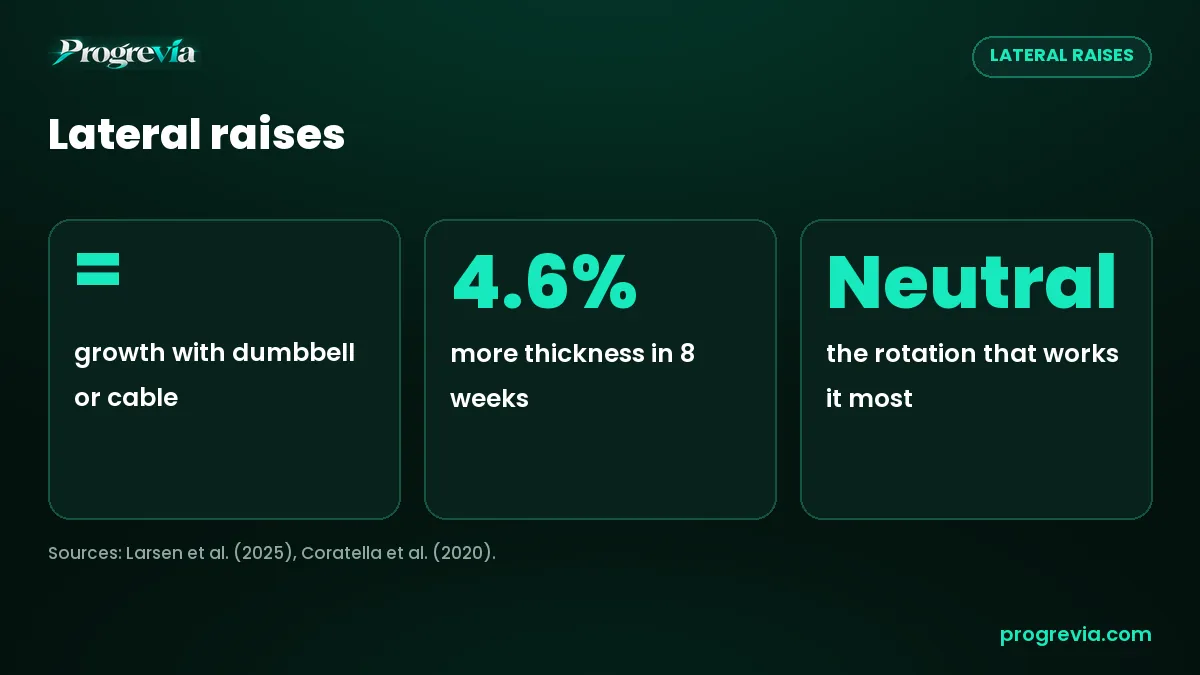
In 2025, Stian Larsen and colleagues at Nord University (Norway) had 24 men and women who already trained do lateral raises for 8 weeks, with a twist: each arm used a different tool, one a dumbbell and the other a cable, over the same range of motion. They did 5 sets to failure, 2 days a week. Lateral deltoid thickness rose between 3.3% and 4.6%, and both arms grew the same.
The tool matters less than it seems; the technique, a lot more. Here is how to do lateral raises, what changes when you rotate the arm, how much weight to use and how to program them.
What lateral raises work
The shoulder has three heads: front, side and rear. Presses work the front a lot, and rows and pulldowns help the rear, but the side head, the one that gives width from the front, gets little direct work unless you go after it. The lateral raise is the exercise that isolates it. You will find the full map in shoulder exercises.
How to do lateral raises step by step
- The start. Standing, a dumbbell in each hand by your thighs, torso leaning slightly forward.
- The elbows. Slightly bent and fixed for the whole movement.
- The ascent. Raise your arms out to the sides, leading with your elbows, until they reach shoulder height.
- The shoulders. Down, away from your ears: if they shrug, the work moves to the trapezius.
- The descent. Slowly, over 2-3 seconds, without dropping the weight.
Read the video text
Dumbbell or cable for your shoulders? Same: lateral delt growth with dumbbell and cable, same range (Larsen et al., 2025). 4.6% more lateral delt thickness in 8 weeks (from 3.3%) (Larsen et al., 2025). Neutral the arm rotation that activates the lateral delt most (Coratella et al., 2020). Light weight, no swinging. The video ends by showing how to create the routine in Progrevia.
Lateral raises and arm rotation: neutral, up or down
In 2020, Giuseppe Coratella (University of Milan) used electromyography to measure 10 competitive bodybuilders doing lateral raises with the arm in three rotations, with the elbow bent, and front raises. This is what the study found:
- Neutral rotation (back of the hand facing out): the one that activated the lateral deltoid most.
- Internal rotation (thumb down, as if pouring from a jug): more rear deltoid, upper trapezius and triceps.
- External rotation (thumb up): more front deltoid than with the thumb down.
- Elbow well bent: less lateral deltoid work than with the arm almost straight.
- Front raise: mainly front deltoid and chest.
The practical takeaway: for the lateral deltoid, neutral rotation and an almost straight elbow. The jug-pouring move adds nothing for that head and, with the arm up and turned in, it bothers many people's shoulders.
Lateral raises with dumbbells, cables or a machine
| Tool | Where it is hardest | What it is for |
|---|---|---|
| Dumbbells | At the top, with the arm horizontal | The most accessible; ideal at home |
| Low cable | More even across the range, including the bottom | Loads the bottom part, where the dumbbell barely weighs anything |
| Machine | Depends on the design | Easy to take close to failure without losing technique |
| Resistance band | At the top, the more it stretches | No heavy equipment or gym needed |
In Larsen's study, with the range matched, dumbbell and cable gave the same growth. Use whichever you have to hand and lets you lift without momentum.
Does the bottom of the range matter?
A 2026 review by Gustavo Pedrosa (Federal University of Santa Maria, Brazil) gathered the studies on the length at which a muscle is trained. Its conclusion: muscle tends to grow more when the exercise puts a meaningful load on it in the position where it is stretched. In the dumbbell lateral raise, the bottom part barely weighs anything; the cable does load it there.
That is no reason to drop dumbbells: in Larsen's trial, with the same range, they grew the same. But if you stall, the cable or starting each rep from a little lower, under control, are simple ways to change the stimulus. We cover it in full or partial range of motion.
Common lateral raise mistakes
- Too much weight: it forces you to swing your body and shrug. In this exercise, a few kilos are enough.
- Raising above the shoulder: from there it is mostly the trapezius working.
- Dropping the dumbbells: the controlled descent counts too.
- Wrists above the elbows: keep your elbows slightly ahead of your hands.
- Shrugging your neck: if your shoulders rise, lower the weight.
How to program lateral raises
- Sets and reps: 2-4 sets of 10-20 reps, 1-3 reps short of failure. With light weight and high reps it is easier to keep the technique.
- Frequency: 2 times a week, as in Larsen's study.
- Where to put them: after your presses, or at the end of the session.
- Progression: more reps before more weight. We explain it in progressive overload.
Safety: if you feel a pinch at the top of the shoulder as you lift, limit the height, use neutral rotation and see a healthcare professional if the discomfort continues. You will find more guidance in how to train with a shoulder injury.
The Progrevia generator can include lateral raises on your shoulder days, with dumbbells, cables, a machine or a band depending on your equipment, and leaves them out if you mark a shoulder or rotator cuff injury.
- Coratella G, Tornatore G, Longo S, Esposito F, Cè E. An Electromyographic Analysis of Lateral Raise Variations and Frontal Raise in Competitive Bodybuilders. International Journal of Environmental Research and Public Health. 2020;17(17):6015.
- Larsen S, Wolf M, Schoenfeld BJ, Sandberg NØ, Fredriksen AB, Kristiansen BS, et al. Dumbbell versus cable lateral raises for lateral deltoid hypertrophy: an experimental study. Frontiers in Physiology. 2025;16:1611468.
- Pedrosa GF, Pereira MR, Kassiano W. The interplay between muscle length, range of motion, and exercise selection: a review. Sports Medicine International Open. 2026;10:a27337605.
Progrevia · · How we write our guides
Frequently asked questions
Which muscle do lateral raises work?
Mainly the lateral deltoid, the shoulder head that gives width from the front. The upper trapezius also joins in and, depending on how you rotate your arm, the front or rear deltoid.
Thumb up or thumb down on lateral raises?
Neither: in Coratella's study (2020), neutral rotation activated the lateral deltoid most. Turning the thumb down loads the trapezius and rear deltoid more.
Are dumbbells or cables better?
With the same range they gave the same growth in Larsen's study (2025). The cable loads the bottom part more; the dumbbell is more accessible. Choose the one that lets you lift without swinging.
How high should I raise my arms?
To shoulder height. Above that it is mostly the trapezius working, and it bothers many people's shoulders.
How many sets of lateral raises should I do?
2-4 sets of 10-20 reps, 1-3 reps short of failure, 2 times a week. Better light weight and good technique than heavy weight with swinging.
Informational content based on the available scientific evidence: it does not replace advice from a healthcare professional. If you have an injury or a medical condition, or are pregnant, check with one before changing your training or diet.
