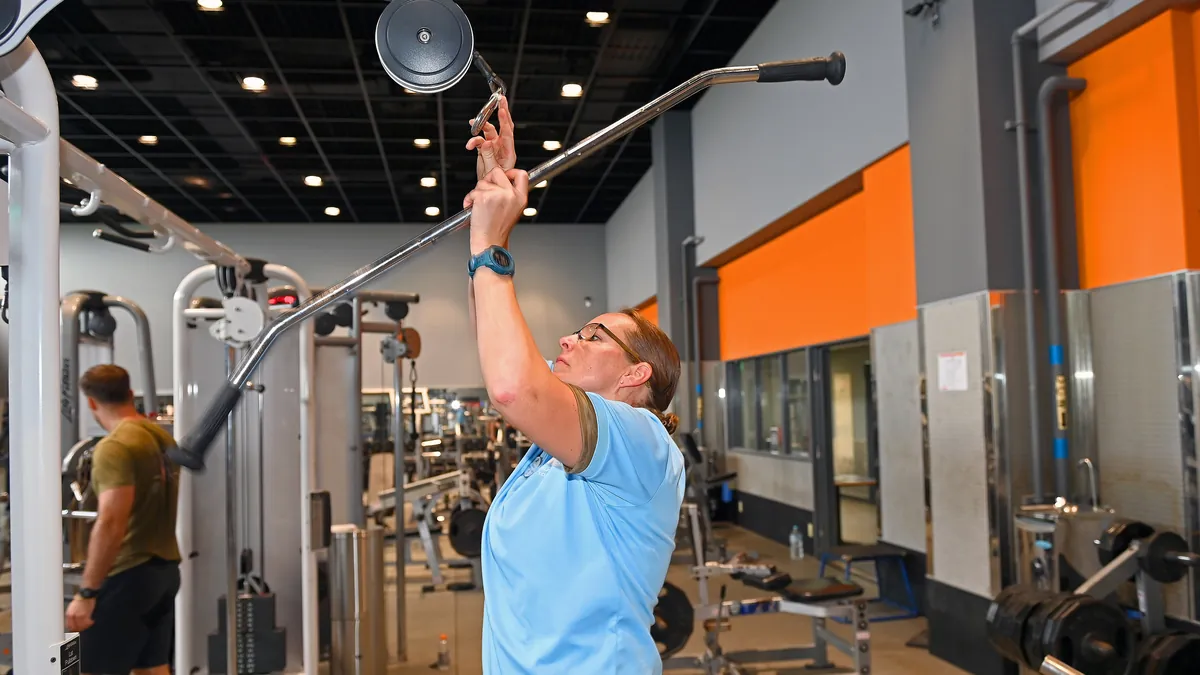
Face pull: correct technique, what it works and whether it really protects your shoulders
Published on
It loaded the rear deltoid as much as the reverse fly and more than the row. How to do the face pull, the rotators it works and what is really known about the shoulder.

In 2025, Qinghui Zhu and colleagues at Northeast Forestry University (China) recorded 10 men doing three exercises for the back of the shoulder and used a musculoskeletal model to calculate the force the rear deltoid produced in each. The dumbbell reverse fly and the standing face pull came out practically level (58.6 and 58.2 newtons), and both above the bent-over dumbbell row (47.9 newtons).
So the face pull is one of the most effective exercises for an area hardly anyone trains on purpose. Here is how to do it, which muscles it works and how to fit it into your week.
What the face pull works
- Rear deltoid: the back of the shoulder, which adds size seen from the side.
- Middle and lower trapezius and rhomboids: they pull the shoulder blades back and down.
- External rotators (infraspinatus and teres minor): they turn the arm outwards at the end of the movement.
Chest and shoulder presses load the front a lot. The face pull works exactly the opposite. You will find the rest of the shoulder in shoulder exercises.
How to do the face pull step by step
- The pulley. At face height or a little above, with the two-ended rope.
- The grip. Hold the rope with your palms facing each other or facing down and step back until your arms are straight.
- The pull. Bring the rope towards your forehead pulling your hands apart, elbows high, at shoulder height or slightly above.
- The finish. Rotate your arms outwards until your hands are beside your head, as if showing your biceps.
- The return. Slowly, without letting the weight drag your shoulders forward.
Read the video text
What does the face pull work? 58.2 N rear deltoid force, same as the reverse fly (58.6 N) (Zhu et al., 2025). 88% of rear deltoid max in a movement like the end of the face pull (Reinold et al., 2004). 36% of gym injuries, at the shoulder (Kolber et al., 2010). Elbows high, light weight. The video ends by showing how to create the routine in Progrevia.
Face pull, reverse fly or row
| Exercise | Rear deltoid force | What else it works |
|---|---|---|
| Dumbbell reverse fly | 58.6 N | Middle trapezius |
| Standing face pull | 58.2 N | Middle trapezius and external rotators |
| Bent-over dumbbell row | 47.9 N | Lats and biceps |
It is a model calculated from motion recordings, not a direct measurement of the muscle, and with few people. Even so, it matches what is usual in the gym: the reverse fly and the face pull isolate the rear shoulder better, and the row shares the work with the back. If you have no cable, the reverse fly does a similar job.
The shoulder rotators: what electromyography measures
In 2004, Michael Reinold (American Sports Medicine Institute, Birmingham) used electrodes inside the muscle to measure 10 people doing seven external rotation exercises. Lying on the side, the infraspinatus reached 62% of its maximum and the teres minor 67%. Lying face down, raising the arm out to 100 degrees with the arm rotated outwards, a movement that resembles the end of the face pull, the rear deltoid reached 88% and the supraspinatus 82%.
The face pull combines both movements, taking the arm back and rotating it outwards, so it works the rear shoulder and the rotators at the same time.
Does the face pull prevent shoulder injuries?
No studies prove it directly. What we do know is that the shoulder is one of the areas most often injured in the gym: in 2010, Morey Kolber (Nova Southeastern University, Florida) reviewed the literature and found that up to 36% of documented strength training injuries affected the shoulder, with muscle imbalances and poor technique among the risk factors.
Working the muscles at the back partly offsets an excess of presses, and the face pull is a convenient way to do it. If you already have discomfort, read how to train with a shoulder injury.
Common face pull mistakes
- Too much weight: it forces you to lean back and turns the exercise into a row.
- Low elbows: if your elbows drop below your shoulders, they work the back more and the rear shoulder less.
- Forgetting the final rotation: pulling your hands apart at the end is what works the rotators.
- Shrugging: keep your neck long throughout the range.
- Snapping back: the return counts too.
How to program the face pull
- Sets and reps: 2-3 sets of 12-20 reps, 2-3 reps short of failure. It is a technique exercise, not a weight one.
- Frequency: 2-3 times a week; it recovers quickly.
- Where to put it: at the end of your push days, or as part of your warm-up before presses.
- Without a cable: a resistance band anchored at face height works just as well. We look at it in resistance bands.
Safety: if you feel pain at the front of the shoulder when rotating your arm outwards, reduce the range and the weight, and see a healthcare professional if the discomfort continues.
The Progrevia generator can include the face pull on your shoulder or pull days, with a cable or a band depending on your equipment.
- Zhu Q, Chen Z, Feng L. Biomechanical evaluation of posterior deltoid exercises and kinematic trajectory modeling. Acta of Bioengineering and Biomechanics. 2025;27(4):135-147.
- Reinold MM, Wilk KE, Fleisig GS, Zheng N, Barrentine SW, Chmielewski T, et al. Electromyographic analysis of the rotator cuff and deltoid musculature during common shoulder external rotation exercises. Journal of Orthopaedic and Sports Physical Therapy. 2004;34(7):385-394.
- Kolber MJ, Beekhuizen KS, Cheng MS, Hellman MA. Shoulder injuries attributed to resistance training: a brief review. Journal of Strength and Conditioning Research. 2010;24(6):1696-1704.
Progrevia · · How we write our guides
Frequently asked questions
Which muscles does the face pull work?
The rear deltoid, the middle and lower trapezius, the rhomboids and the shoulder's external rotators (infraspinatus and teres minor).
Is the face pull or the reverse fly better?
In Zhu's model (2025) they loaded the rear deltoid almost equally (58.2 and 58.6 newtons). The face pull adds more rotator work; the reverse fly needs no cable.
Does the face pull prevent shoulder injuries?
No studies prove it directly. It helps balance an excess of presses, and muscle imbalances are one of the risk factors Kolber (2010) points to.
How high should the cable be for face pulls?
At face height or a little above, with the rope. Pull towards your forehead with your elbows high and pull your hands apart at the end.
How many sets of face pulls should I do?
2-3 sets of 12-20 reps, 2-3 reps short of failure, 2-3 times a week. Prioritise technique over weight.
Informational content based on the available scientific evidence: it does not replace advice from a healthcare professional. If you have an injury or a medical condition, or are pregnant, check with one before changing your training or diet.
