
Lat pulldown: correct technique, which grip to choose and how to use it to reach the pull-up
Published on
With a narrow, medium or wide grip, the lats worked similarly, and the wide grip moved less weight. Technique, grips, why to pull in front and how to program it.
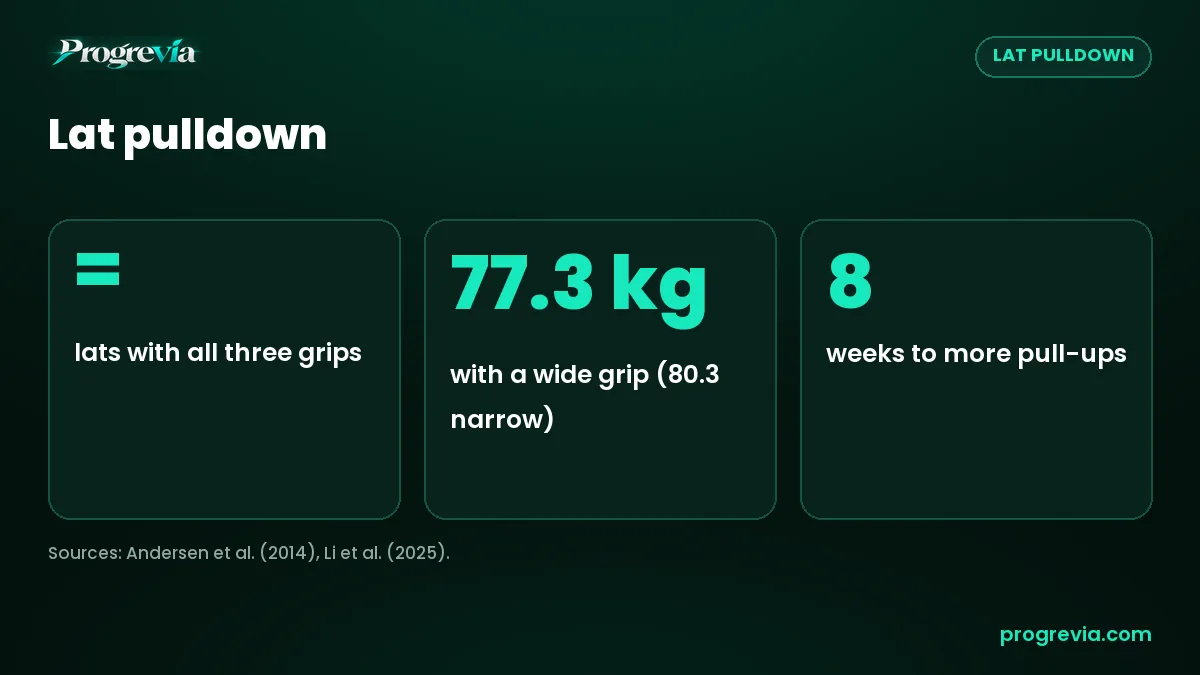
In 2014, Vidar Andersen and colleagues at Sogn og Fjordane University College (Norway) had 15 men do the lat pulldown with their 6-rep load and three grips: narrow (shoulder width), medium (1.5 times that width) and wide (double). With the narrow grip they moved 80.3 kg, with the medium 80.0 kg and with the wide 77.3 kg. Lat activation was similar with all three.
The wide grip, the one associated with a wider back, did not work the lats more, and it did allow less weight. Here is how to do the lat pulldown, which grip to choose and how to use it to get to pull-ups.
What the lat pulldown works
The pulldown is a vertical pull: you bring your arms from overhead down, as in a pull-up, but seated and with the weight you choose. It mainly works the latissimus dorsi, helped by the teres major, biceps, back of the shoulder and middle and lower trapezius. You will find the other exercises by area in the best back exercises.
How to do the lat pulldown step by step
- The set-up. Set the roller so it holds your thighs firmly.
- The grip. Take the bar a little wider than your shoulders, palms facing forward.
- The posture. Chest up and torso leaning back slightly, without swinging.
- Pulling the bar down. Drive your elbows down and back until the bar reaches your upper chest.
- The return. Controlled, until your arms are almost straight and you feel the lats stretch.
Read the video text
Wide grip or narrow? Same: lat activation with narrow, medium and wide grips (Andersen et al., 2014). 77.3 kg with a wide grip, versus 80.3 kg narrow (Andersen et al., 2014). 8 weeks of pulldowns: more consecutive pull-ups (Li et al., 2025). In front, to your chest. The video ends by showing how to create the routine in Progrevia.
Wide, narrow or neutral grip on the lat pulldown
In 2025, Andrea Buonsenso (eCampus University, Italy) went further: using electromyography, the team measured 40 men with at least 5 years of training doing seven pulldown variations at 70% of their maximum, with different grips, widths and torso angles. Lat activation did not change significantly between any of them. Only the rear deltoid worked more with a wide grip and the torso leaning back 30 degrees.
| Variation | What changes | When to use it |
|---|---|---|
| Medium overhand grip | The starting point; allows good load | By default |
| Wide grip | A little less weight; a little more rear shoulder with the torso leaning | If it feels comfortable |
| Neutral grip (palms facing) | Usually more comfortable for shoulders and elbows | If the overhand grip bothers you |
| Underhand grip (palms towards you) | More biceps involvement | To vary or to prepare the chin-up |
| Single-arm | Each side works on its own | Fixing differences between sides |
Choose the grip that lets you move the most weight with good technique and no discomfort, and change it now and then if you want variety. None of them will stop working your lats.
Lat pulldown in front of or behind the neck?
In front. Pulling the bar behind your head forces your neck forward and puts the shoulder in a strained position under load, and there is no reason to prefer it: the lats can be trained just as well in front. If you have had shoulder trouble, it is a variation worth avoiding. We look at it in how to train with a shoulder injury.
The lat pulldown and pull-ups
The pulldown is the simplest way to build the strength a pull-up demands. In 2025, Qian Li (Shanghai, China) trained 34 university students for 8 weeks with the lat pulldown: by the end, both groups in the study did more consecutive pull-ups than at the start and were stronger on the pulldown. If your goal is your first pull-up, pair it with the progression in pull-ups from scratch.
Common lat pulldown mistakes
- Pulling with your whole body: if you have to lean right back to bring the bar down, the weight is too heavy.
- Bringing the bar down to your belly button: stop at your upper chest.
- Letting it go up without control: the controlled return is what stretches the lats.
- Shoulders up by your ears: start each rep by lowering your shoulders.
- Pulling with your hands: think of driving your elbows towards your pockets.
How to program the lat pulldown
- Sets and reps: 2-4 sets of 8-12 reps, 1-3 reps short of failure.
- Frequency: 1-2 times a week, on your back or pull days.
- What to pair it with: a row, which is a horizontal pull, such as the barbell row.
- Progression: more reps, then more weight. We explain it in progressive overload.
Safety: if you feel shoulder pain when stretching your arms overhead, shorten the range or try the neutral grip, and see a healthcare professional if the discomfort continues.
The Progrevia generator can include the lat pulldown on your back days and leaves it out if you mark a shoulder, rotator cuff or biceps tendon injury.
- Andersen V, Fimland MS, Wiik E, Skoglund A, Saeterbakken AH. Effects of grip width on muscle strength and activation in the lat pull-down. Journal of Strength and Conditioning Research. 2014;28(4):1135-1142.
- Buonsenso A, Di Fonza D, Di Claudio G, Carangelo M, Centorbi M, di Cagno A, et al. Electromyographic Analysis of Back Muscle Activation During Lat Pulldown Exercise: Effects of Grip Variations and Forearm Orientation. Journal of Functional Morphology and Kinesiology. 2025;10(3):345.
- Li Q, Yan J, Qiao M, Quan J, Chen Y, Gong M, et al. Eight-week lat pull-down resistance training with joint instability leads to superior pull-up endurance performance and reduced antagonist coactivation in recreationally active male college students. European Journal of Sport Science. 2025;25(1):e12243.
Progrevia · · How we write our guides
Frequently asked questions
Which muscles does the lat pulldown work?
Mainly the latissimus dorsi, helped by the teres major, biceps, back of the shoulder and middle and lower trapezius.
Is a wide grip better on the lat pulldown?
Not for the lats: in Andersen (2014) they worked similarly with narrow, medium and wide grips, and the wide grip moved less weight. Choose the one that feels comfortable.
Lat pulldown in front of or behind the neck?
In front. Behind the neck strains your neck and shoulder under load, and there is no reason to prefer it.
Does the lat pulldown help you get pull-ups?
Yes. In Li (2025), 8 weeks of lat pulldowns were enough to do more consecutive pull-ups. Pair it with assisted and negative pull-ups.
How many sets of lat pulldowns should I do?
2-4 sets of 8-12 reps, 1-3 reps short of failure, 1-2 times a week, alongside a rowing exercise.
Informational content based on the available scientific evidence: it does not replace advice from a healthcare professional. If you have an injury or a medical condition, or are pregnant, check with one before changing your training or diet.
