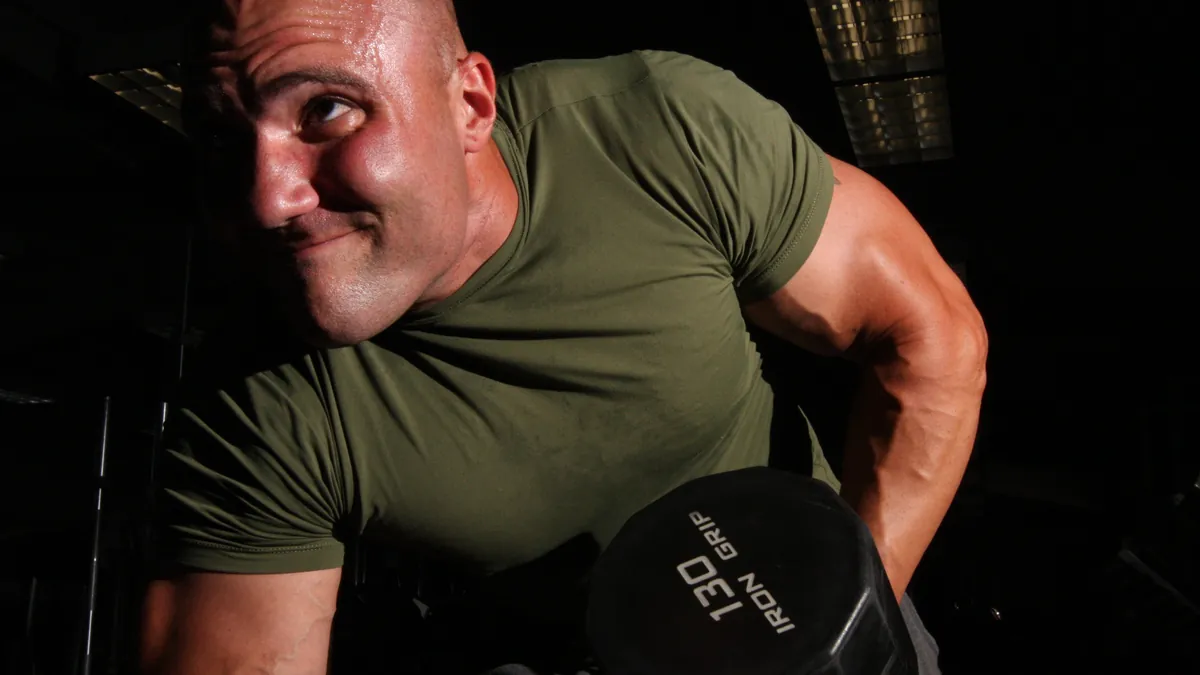
Single-arm dumbbell row: correct technique and when it beats the barbell row
Published on
One-armed, it activated the obliques more than two-armed rows, and with bench support it spares the lower back. Technique, variations, mistakes and how to program it.
In 2015, Atle Saeterbakken and colleagues at Sogn og Fjordane University College (Norway) used electromyography to measure 15 trained men doing three rows, free-weight, seated cable and machine, first with one arm and then with both, at the same effort. Rowing with one arm activated the external oblique far more: with both arms it stayed between 37% and 41% of its one-arm activity. And the free-weight row activated the back extensors more than the machine row.
The dumbbell row works your back and, along the way, makes your torso resist twisting. Here is how to do it, when it beats the barbell row and how to program it.
What the dumbbell row works
- Latissimus dorsi: the big muscle on the side of the back, especially if you drive your elbow towards your hip.
- Middle trapezius and rhomboids: they pull the shoulder blade towards the spine at the end of the pull.
- Rear deltoid and biceps: they help you pull.
- Obliques and lower back: they stop your torso rotating towards the dumbbell.
You will find the other exercises by area in the best back exercises.
How to do the dumbbell row step by step
- The support. Place the hand and knee on the same side on a flat bench, with the other leg on the floor and slightly back.
- The torso. Almost horizontal, back straight and eyes on the floor.
- The start. The dumbbell hangs under your shoulder, arm straight and shoulder blade away from your spine.
- The pull. Drive your elbow towards your hip, close to your body, until the dumbbell reaches your ribs.
- The descent. Controlled, until your arm is fully straight, without twisting your torso.
Read the video text
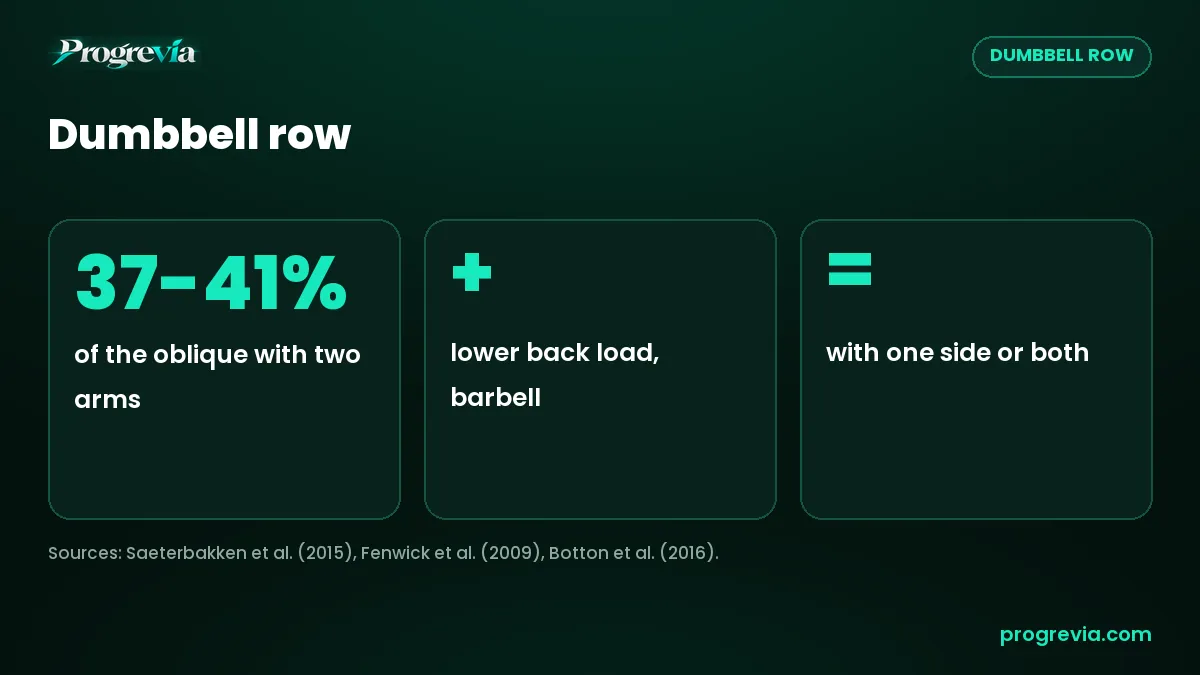
One arm or two? 37-41% of the oblique work with two arms, compared with the one-arm row (Saeterbakken et al., 2015). More lower back load with the barbell row, the highest of the three (Fenwick et al., 2009). Same: strength and muscle training one side or both (Botton et al., 2016). Elbow to hip, no torso twist. The video ends by showing how to create the routine in Progrevia.
One-arm or two-arm row: what changes in the torso
Besides the oblique, Saeterbakken's study found other differences. Two-arm rows activated the erector spinae and multifidus more; one-arm rows, the oblique more, because pulling on one side forces the torso to resist rotation. The supported dumbbell row gives you the best of both: your back works without having to hold up the whole weight of your bent-over torso.
Dumbbell row or barbell row for your lower back?
In 2009, Chad Fenwick (University of Waterloo, Canada) measured muscle activity and lumbar spine load in 7 men across three rows: the inverted row, the bent-over barbell row and the standing one-arm cable row. The barbell row activated the back heavily from top to bottom, but it placed the greatest load on the lower back. The one-arm row challenged the torso more to resist rotation.
The supported dumbbell row was not measured in that study, but resting your hand and knee on the bench takes away from your lower back the job of holding your torso bent over. That is why it is a good alternative when the barbell row bothers your lower back. We compare them in the barbell row guide and you will find more guidance in low back pain and the gym.
Does training each side separately build more muscle?
Not necessarily, but not less either. In 2016, Cíntia Botton (Federal University of Rio Grande do Sul, Brazil) trained 43 women for 12 weeks with one-leg or two-leg knee extensions: strength and muscle thickness improved similarly in both groups. It is a different muscle and exercise, so take it as a hint: one-arm work does not fall short, and it also shows whether one side is weaker than the other.
| Variation | What changes | Who it suits |
|---|---|---|
| Bench-supported | The lower back barely works | By default, and if your lower back bothers you |
| Standing, hand on a support | More torso and leg work | No bench, or for variety |
| Chest-supported on an incline bench | Two dumbbells and no lower back tension | If you want both sides at once |
| Meadow or landmine row | Grip on one end of the bar | To load more with one arm |
Common dumbbell row mistakes
- Twisting your torso to lift: if your shoulder opens upwards, the weight is too heavy.
- Pulling with your biceps: think of driving your elbow to your hip, not your hand to your chest.
- Short range: let your shoulder blade spread at the bottom and squeeze at the top.
- Rounded back: keep your chest open and your torso long.
- Dropping the weight on the way down: the controlled descent counts too.
How to program the dumbbell row
- Sets and reps: 2-4 sets of 8-12 reps per side, 1-3 reps short of failure.
- Weaker side first and the other side with the same reps.
- What to pair it with: a vertical pull, such as the lat pulldown or pull-ups.
- Progression: more reps, then a heavier dumbbell. We explain it in progressive overload.
Safety: if you feel pain in your lower back or elbow, lower the weight and check your support, and see a healthcare professional if the discomfort continues.
The Progrevia generator can include the dumbbell row on your back days, at home too, keeps it if you mark a lower back injury, where it does rule out the barbell row, and removes it if you mark a biceps tendon injury.
- Saeterbakken A, Andersen V, Brudeseth A, Lund H, Fimland MS. The Effect of Performing Bi- and Unilateral Row Exercises on Core Muscle Activation. International Journal of Sports Medicine. 2015;36(11):900-905.
- Fenwick CM, Brown SH, McGill SM. Comparison of different rowing exercises: trunk muscle activation and lumbar spine motion, load, and stiffness. Journal of Strength and Conditioning Research. 2009;23(5):1408-1417.
- Botton CE, Radaelli R, Wilhelm EN, Rech A, Brown LE, Pinto RS. Neuromuscular Adaptations to Unilateral vs. Bilateral Strength Training in Women. Journal of Strength and Conditioning Research. 2016;30(7):1924-1932.
Progrevia · · How we write our guides
Frequently asked questions
Which muscles does the dumbbell row work?
The latissimus dorsi, middle trapezius, rhomboids, rear deltoid and biceps. Done one-armed, the obliques work to stop your torso rotating.
Is the dumbbell row or the barbell row better?
Both work. The barbell allows more load, but in Fenwick (2009) it loaded the lower back the most; the bench-supported dumbbell row is the better option if your lower back bothers you.
How high should I pull the dumbbell?
To your ribs, driving your elbow towards your hip. Pulling higher usually makes you twist your torso.
Why row one-armed rather than two-armed?
Because your torso works to resist rotation: in Saeterbakken (2015), the oblique worked far more with one arm. It also shows whether one side is weaker.
How many sets of dumbbell rows should I do?
2-4 sets of 8-12 reps per side, 1-3 reps short of failure, starting with the weaker side.
Informational content based on the available scientific evidence: it does not replace advice from a healthcare professional. If you have an injury or a medical condition, or are pregnant, check with one before changing your training or diet.
