Goblet squat: correct technique, how low to go and when to move to the barbell
Published on
With the weight against the chest, the goblet activated the quadriceps more than the landmine, and going all the way down grew the glutes and adductors more. Technique, depth and when to switch.
In 2021, Kyle Collins and colleagues at North Dakota State University (United States) used electromyography and a force plate to measure 16 men and 16 women doing two squats with the same load, 30% of their body mass: the goblet, with the weight held against the chest, and the landmine, pushing the end of a bar anchored to the floor. The goblet activated the quadriceps more and loaded more vertically; the landmine shifted more work towards the hamstrings.
In practice, the goblet squat is the simplest way to learn a good squat. Here is how to do it, how it differs from the barbell squat, how low to go and when to make the jump.
What the goblet squat is and who it is for
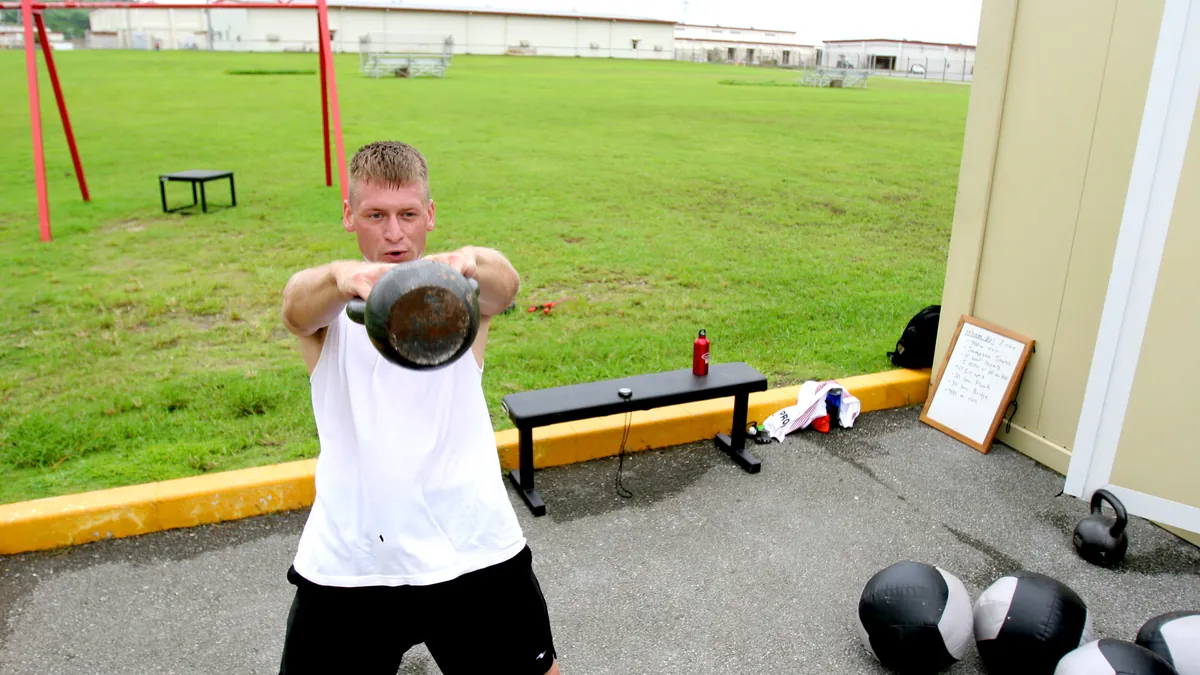
It is a squat with a dumbbell or kettlebell held in both hands in front of your chest, like a goblet. With the weight in front, the body balances itself with a more upright torso, the knees travel forward and the hips drop between the heels. That is why it is common in three cases:
- To learn the squat pattern before loading a barbell.
- To train at home or in a small gym, with a single dumbbell.
- To spare your back on days when the barbell squat does not feel right.
How to do the goblet squat step by step
- The start. Hold the dumbbell upright by one of its ends, or the kettlebell by the handle, against your chest with your elbows underneath.
- The feet. A little wider than hip width, toes turned out slightly.
- The descent. Lower by dropping your hips between your heels, chest up and knees tracking your feet.
- At the bottom. Go down until your elbows brush the inside of your knees, or as low as you can without rounding your back.
- The ascent. Drive through your whole foot until you are standing, without letting the weight move away from your chest.
Read the video text
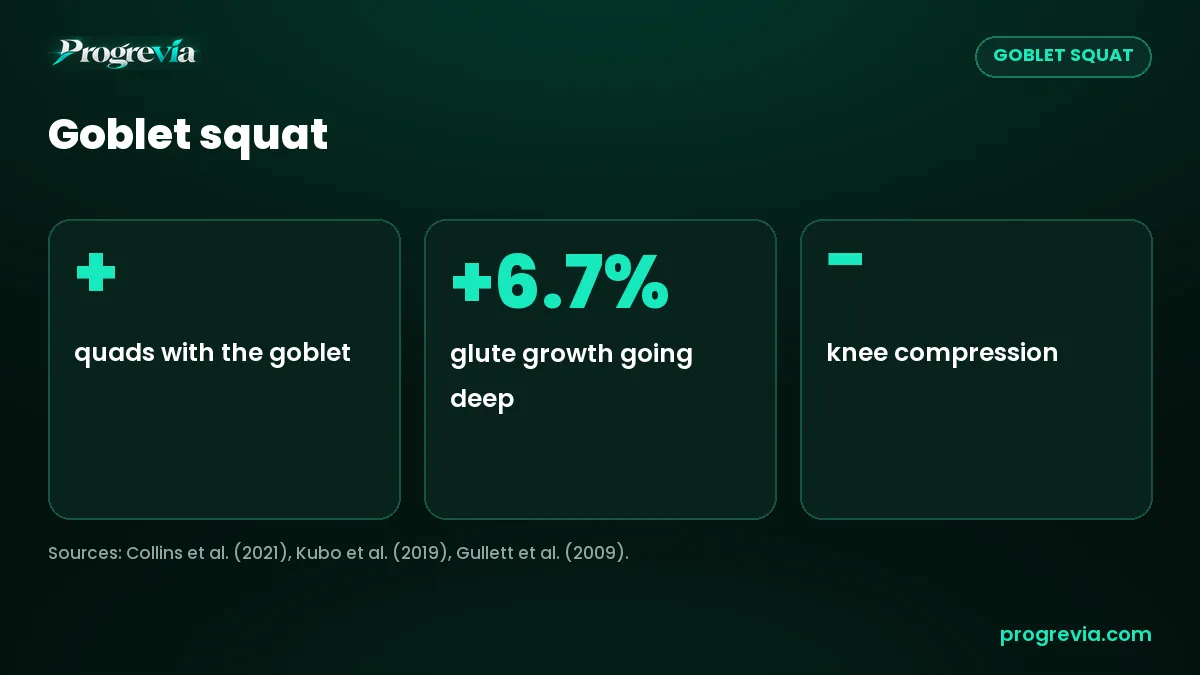
How low should you go? More quad activation with the goblet than with the landmine squat (Collins et al., 2021). +6.7% glute growth with full squats, versus 2.2% with half squats (Kubo et al., 2019). − knee compression with the weight in front, versus the bar on the back (Gullett et al., 2009). Weight at the chest, torso upright. The video ends by showing how to create the routine in Progrevia.
Goblet squat or barbell squat?
The goblet carries the weight in front, like the front squat. In 2009, Jonathan Gullett (University of Florida) compared the front squat with the back squat in 15 trained people. The front squat recruited the muscles just as effectively, with considerably lower compressive forces at the knee. The authors suggest it for people with knee problems and for long-term joint health.
The limit of the goblet is the load: at some point you cannot hold a heavier dumbbell in front of your chest, even if your legs could handle more. That is the moment to move to the barbell. You will find the technique in the barbell squat guide.
How low should you go in the goblet squat?
As low as you can with good technique. In 2019, Keitaro Kubo (University of Tokyo) trained 17 men for 10 weeks, 2 days a week, with full squats or half squats, and measured the muscles with MRI:
| Muscle | Full squat | Half squat |
|---|---|---|
| Quadriceps (vasti) | +4.9% | +4.6% |
| Adductors | +6.2% | +2.7% |
| Gluteus maximus | +6.7% | +2.2% |
The quadriceps grew similarly with both, but the glutes and adductors grew much more when going all the way down. The goblet makes exactly that easier: the weight in front lets you go low without your torso tipping forward. We cover it in full or partial range of motion.
Goblet squat or landmine squat
In Collins's study, the two squats loaded the legs differently. The goblet worked the quadriceps more and loaded more vertically; the landmine, with the bar anchored at an angle, lowered quadriceps activity, increased the backward push and balanced the work more with the hamstrings. Women activated the quadriceps more than men in both. If your goal is the quadriceps, the goblet is the more direct of the two.
Common goblet squat mistakes
- Letting the weight drift from your chest: your arms tire before your legs and your torso tips forward.
- Knees caving in: push them in the direction of your feet.
- Lifting your heels: if it happens, widen your stance a little or work on ankle mobility.
- Stopping halfway out of habit: go as low as your technique allows.
- Rounding your back at the bottom: stop just before that point.
How to program the goblet squat
- Sets and reps: 2-4 sets of 8-15 reps, 1-3 reps short of failure.
- To learn: 2-3 sets of 8 reps with a 2-second pause at the bottom, two or three days a week.
- When to move to the barbell: when you cannot hold more weight and still do 15 reps far from failure.
- Progression: more reps and pauses first, then more weight. We explain it in progressive overload.
Safety: if you feel knee or back pain on the way down, shorten the range and see a healthcare professional if the discomfort continues.
The Progrevia generator can include the goblet squat on your leg days, in the gym or at home with one dumbbell, and leaves it out if you mark a knee, lower back, hip or ankle injury.
- Collins KS, Klawitter LA, Waldera RW, Mahoney SJ, Christensen BK. Differences in Muscle Activity and Kinetics Between the Goblet Squat and Landmine Squat in Men and Women. Journal of Strength and Conditioning Research. 2021;35(10):2661-2668.
- Gullett JC, Tillman MD, Gutierrez GM, Chow JW. A biomechanical comparison of back and front squats in healthy trained individuals. Journal of Strength and Conditioning Research. 2009;23(1):284-292.
- Kubo K, Ikebukuro T, Yata H. Effects of squat training with different depths on lower limb muscle volumes. European Journal of Applied Physiology. 2019;119(9):1933-1942.
Progrevia · · How we write our guides
Frequently asked questions
Which muscles does the goblet squat work?
Mainly the quadriceps and gluteus maximus, helped by the adductors. The weight in front also makes your back and abs work to keep your torso upright.
Is the goblet squat or the barbell squat better?
To learn, the goblet; to load heavy, the barbell. Front loading, as in the front squat, recruits the muscles just as well with less compression at the knee (Gullett, 2009).
How low should I go in the goblet squat?
As low as your technique allows. In Kubo (2019), full squats grew the glutes by 6.7% versus 2.2% with half squats.
Dumbbell or kettlebell for the goblet squat?
Both work. The dumbbell is held upright by one end; the kettlebell, by the handle. Choose the one you can keep against your chest.
When should I move from the goblet squat to the barbell?
When you cannot hold more weight in front of your chest and still do 15 reps far from failure: your legs are asking for more load than your arms can hold.
Informational content based on the available scientific evidence: it does not replace advice from a healthcare professional. If you have an injury or a medical condition, or are pregnant, check with one before changing your training or diet.
